This just in from the BBC: "Twenty years ago the government backed a major expansion of the CCTV network - now funds are being cut and cameras shut off. Is the UK's CCTV boom over, asks Rachel Argyle.
In 1994, the Conservative government launched the Partners Against Crime initiative, with Home Secretary Michael Howard saying he was "absolutely convinced that CCTV has a major part to play in helping detect, and reduce crimes and to convict criminals".
The next year the CCTV Challenge Competition fund was started to encourage local authorities to set up surveillance schemes - the Home Office and local authorities invested £120m in CCTV systems within three years.
The UK has one of the largest CCTV networks in the world. But as cash-strapped councils look for cost-saving measures, the effectiveness of public CCTV is under scrutiny.
Dyfed-Powys police are set to cut funding to monitor CCTV following an independent report set up by Police and Crime Commissioner Christopher Salmon. The force covers over half of Wales and just under half a million people.
The report found that the removal of Powys Country Council CCTV did not result in a significant rise in crime or anti-social behaviour and there is little evidence that CCTV deters violent or alcohol-related crime. Salmon says the police will direct funds where the public want them, with "more bobbies on the beat".
These cuts are not an isolated case.
Cornwall was one of the first local authorities to cut their CCTV budget back in April 2011 - by £350,000. Denbighshire council will stop their funding and make a saving of £200,000 from 2016-17. Anglesey Council scrapped its CCTV altogether last year but following a successful charitable trust bid it will now be run by the island's five town councils. In Derby, 48 cameras in the city centre may be switched off.
Other areas are scaling back. Birmingham's 250 CCTV cameras will no longer be monitored around the clock and CCTV managers across the country face redundancy.
Police are under similar financial strain. Thames Valley Police could reduce its CCTV funding for the city from £225,000 annually, to as little as £50,000 by 2018.
A Freedom of Information request by Labour MP Gloria de Piero in March 2013, found that one in five councils had cut the number of CCTV cameras on the streets since the last election.
Supporters of CCTV point to the success of cameras in identifying suspects in high-profile cases, such as Robert Thompson and Jon Venables in the murder of toddler James Bulger, the Boston Marathon bombing, the London 7 July 2005 attacks and the 2011 UK riots. CCTV was crucial in the hunt for the Charlie Hebdo attackers.
But campaigners against CCTV believe it violates personal privacy and question its effectiveness.
"Britain's crime rate is not significantly lower than comparable countries that do not have such vast surveillance," says Emma Carr, director of Big Brother Watch.
The pressure group welcomes that budgetary restraints may make authorities look more closely at whether CCTV is really working. Carr adds: "Councils that reduce the number of ineffective CCTV cameras, diverting resources to where they will keep the public safer, are to be praised."
Charles Farrier, spokesperson for No CCTV, is a little more apprehensive. "The alleged cost-cutting is leading to a restructuring rather than a real reduction of camera surveillance." He points out that budget cuts will see others jump to the rescue. "Often the solutions offered are merging control rooms or taking the cameras out of the hands of democratic local bodies and into management by private companies driven by a profit motive," he added. He calls for an urgent public debate.
For some people, there's a more human alternative to fighting crime with increased CCTV. Farrier believes the solution lies in the findings of a 2013 report entitled Fortress Britain, published by the New Economics Foundation, which found that residents on an estate in London felt that "knowing people" was the key to creating trust.
"We no longer have park keepers, bus conductors, toilet attendants - people there to help act as a glue to hold the community together. Now we abdicate that responsibility to a machine. Surely instead of spending money on surveillance cameras it should be spent on proven strategies or encourage more people to walk, talk, and problem solve in their own communities?"
There has been much research into the effectiveness of CCTV as a crimefighting tool during the boom years.
A study entitled the Effects of Closed Circuit Television Surveillance on Crime (2008) found that CCTV schemes had little effect on crime deterrence, other than car crime ..."
Click here to keep reading the article.
Showing posts sorted by relevance for query cctv. Sort by date Show all posts
Showing posts sorted by relevance for query cctv. Sort by date Show all posts
Wednesday, January 14, 2015


Monday, December 10, 2007
CCTV User Group
This morning, I want to call your attention to the CCTV User Group. Located in the United Kingdom, the group has members around the globe and serves as an outstanding resource for information on public and private use of CCTV systems. You can find out more information by clicking here. Find out about the groups efforts outside the UK by clicking here.

One of the many benefits of membership is their magazine, CCTV Image. The November 2007 edition has features on School Security, Redeployable CCTV, as well as a response to draft CCTV Code of Practice. Past editions have dealt with highway CCTV, large event CCTV, public housing CCTV, as well as Video Analytics, and lens selection tips.
Of particular note in the latest edition is a link given in the CCTV User Group's Director's column to The Home Office ACPO National Strategy for CCTV. There is also a detailed discussion on the Strategy on page 8. "While developments in technology have outpaced some of the capabilities within the police and justice system, the new National CCTV strategy aspires to meet the challenges so the benefits and full potential of CCTV can be maximised," reads the commentary. It goes on to say that "the report acknowledges the significant role that CCTV has played in protecting the public and assisting the police, as well as the leading role that the UK has held in the development of CCTV worldwide." The UK's Home Office has produced some outstanding documents over the years. Those that are crafting best practice documents or SOPs for their agency should consult the HOSDB's on-line publications related to this complex field.
The why of this topic is best put this way: “You can create as many images as you want, but unless that person gets nailed in court there’s no point in creating the image! You’re the start of the journey to getting crimes into court and helping make our communities safer.” - DCI Mick Neville, Metropolitan Police (In CCTV Image, November 2007, pg. 22) I couldn't have said it better myself.
Visit the links and check this valuable resources out for yourself. Better yet, encourage your agency to fund your membership in the group. Groups like this deserve our support.
Enjoy.
Tuesday, April 6, 2010
CCTV debate in the news
From the CCTV User Group's CCTV Image Magazine:
"IT SEEMS AS IF CCTV is hardly ever out of the headlines. Stories range from the positive (eg. “Man convicted on CCTV evidence”) and the hopeful (eg. “Police release CCTV images of suspect”) to the doubtful (eg. “Why weren’t CCTV cameras working?”) and the negative (eg. “Thousands of CCTV cameras cost millions”). Meanwhile, the story that arguably kickstarted the CCTV revolu- tion in the UK is back in the news, as Jon Venables – who along with Robert Thompson abducted, tortured and murdered Jamie Bulger in February 1993 – has been recalled to prison for an unspecified violation of his licence of release.The grainy CCTV images of the toddler Jamie being led away by two children (aged 10) is widely credited with the surge in public support for CCTV. And now CCTV appears to have become a political football, with the Prime Minister Gordon Brown calling out the Conservative Party leader David Cameron for his lack of public support for CCTV.
According to an article on Bloomberg, at a major speech on law and order in Reading recently, the Prime Minister challenged the Conservative Party’s view that British society is “broken” and sought to use its opposition to closed-circuit television cameras and a DNA database as evidence that the party is made up of privileged people out of touch with the majority of the population.
“I know some people think CCTV is excessive but they don’t have to take the night bus home,” Brown said in his speech in Reading, west of London. “I know the hard-working majority will never be able to live in a gated community or hire a private security firm.” It is, according to Simon Hoggart in the Guardian, part of a wider attempt to repaint Labour as the “hanging and flogging party, whereas the Tories are a bunch of bleeding-heart, Guardian-reading milquetoasts”.
Read the rest of this interesting article by clicking here.
Enjoy.
"IT SEEMS AS IF CCTV is hardly ever out of the headlines. Stories range from the positive (eg. “Man convicted on CCTV evidence”) and the hopeful (eg. “Police release CCTV images of suspect”) to the doubtful (eg. “Why weren’t CCTV cameras working?”) and the negative (eg. “Thousands of CCTV cameras cost millions”). Meanwhile, the story that arguably kickstarted the CCTV revolu- tion in the UK is back in the news, as Jon Venables – who along with Robert Thompson abducted, tortured and murdered Jamie Bulger in February 1993 – has been recalled to prison for an unspecified violation of his licence of release.The grainy CCTV images of the toddler Jamie being led away by two children (aged 10) is widely credited with the surge in public support for CCTV. And now CCTV appears to have become a political football, with the Prime Minister Gordon Brown calling out the Conservative Party leader David Cameron for his lack of public support for CCTV.
According to an article on Bloomberg, at a major speech on law and order in Reading recently, the Prime Minister challenged the Conservative Party’s view that British society is “broken” and sought to use its opposition to closed-circuit television cameras and a DNA database as evidence that the party is made up of privileged people out of touch with the majority of the population.
“I know some people think CCTV is excessive but they don’t have to take the night bus home,” Brown said in his speech in Reading, west of London. “I know the hard-working majority will never be able to live in a gated community or hire a private security firm.” It is, according to Simon Hoggart in the Guardian, part of a wider attempt to repaint Labour as the “hanging and flogging party, whereas the Tories are a bunch of bleeding-heart, Guardian-reading milquetoasts”.
Read the rest of this interesting article by clicking here.
Enjoy.
Wednesday, December 16, 2009
UK announces National CCTV Oversight body
Exciting times for CCTV in the UK.
"Attached is a brief update on the announcement that has today been made by the Policing Minister regarding the establishment of a CCTV oversight body, which includes the appointment of Andrew Rennison as the interim CCTV Regulator."
I received the following in a note from the CCTV Users group:
"... Whilst personally supportive of the principal of a government body as all the devil will lie in the detail and as usual little detail is included in the briefing note, and so it will be critical for those representing the owners. managers and operators of the wide variety of CCTV systems to be involved to help frame and support the role of oversight body and interim CCTV regulator."
"Attached is a brief update on the announcement that has today been made by the Policing Minister regarding the establishment of a CCTV oversight body, which includes the appointment of Andrew Rennison as the interim CCTV Regulator."
I received the following in a note from the CCTV Users group:
"... Whilst personally supportive of the principal of a government body as all the devil will lie in the detail and as usual little detail is included in the briefing note, and so it will be critical for those representing the owners. managers and operators of the wide variety of CCTV systems to be involved to help frame and support the role of oversight body and interim CCTV regulator."
Click here to read the briefing.
According to the briefing note, "The role of the interim Regulator will be to work with the National CCTV Strategy Board on six key areas. These are to:
According to the briefing note, "The role of the interim Regulator will be to work with the National CCTV Strategy Board on six key areas. These are to:
- develop national standards for the installation and use of CCTV in public space;
- determine training requirements for users and practitioners; • engage with the public and private sector in determining the need and potential content of any regulatory framework;
- raise public awareness and understanding of how CCTV operates and the benefits to tackling crime and public protection;
- review the existing recommendations of the National CCTV Strategy and advising the Strategy Board on implementation, timelines and cost and development of an effective evidence base;
- promote public awareness of the complaints process and criteria for complaints to the relevant agencies (e.g. Information Commissioner, local authority, private organisation etc) and dealing with complaints relating to technical standards."
Let's hope they do the sensible thing .... and get the Doktor involved in a meaningful way.
Tuesday, October 9, 2012
Problems with CCTV evidence in court
This from Walesonline.com illustrates the problems in dealing with CCTV evidence: "... Jason Richards, 38, and Ben Hope, 39, are on trial accused of his murder and the attempted murder of his parents who had tried to stop their son from being attacked.
They both deny all the charges against them.
The jury had previously heard that that eight and a half years worth of CCTV material had been recovered during the investigation into the 17-year-old student’s death.
Earlier in the week DC James told the court he had viewed CCTV images from all over the city as part of the investigation.
The jury had also heard that around 100 to 120 cameras had been involved in the investigation and included images from public houses, private houses and commercial premises.
As part of the cross-examination of DC James which began today, Mr Rees pointed out that two clips taken from a camera at Talybont student accomodation couldn’t follow each other as the one later in sequence happened earlier in adjusted real time.
During the hearing DC James explained to the court how some differences in timings could occur.
He said it could be the case that an officer has rounded it down to the minute or up to the minute.
DC James added: “We try to be as accurate as we possibly can.”
The court heard that council cameras were treated as being accurate as they run to the atomic clock.
Mr Rees also read out in court a number of premises which had been asked to download their CCTV as part of the investigation.
He said Talybont student accommodation had been asked to do so on April 19 - eight days after Aamir had been killed.
Mr Rees said when the person responsible for doing this downloaded the images and checked it against the speaking clock they found CCTV was running 15 seconds faster than the speaking clock.
The court heard that when the North Star public house downloaded their CCTV and checked the timings they found the CCTV was running one hour and five minutes slower than the speaking clock.
DC James told the court that he would assume an officer would have been writing these timings down at the time.
He had also told the court that the CCTV team “can only work with the timings given [when the CCTV] was recovered”
The trial continues ...
They both deny all the charges against them.
The jury had previously heard that that eight and a half years worth of CCTV material had been recovered during the investigation into the 17-year-old student’s death.
Earlier in the week DC James told the court he had viewed CCTV images from all over the city as part of the investigation.
The jury had also heard that around 100 to 120 cameras had been involved in the investigation and included images from public houses, private houses and commercial premises.
As part of the cross-examination of DC James which began today, Mr Rees pointed out that two clips taken from a camera at Talybont student accomodation couldn’t follow each other as the one later in sequence happened earlier in adjusted real time.
During the hearing DC James explained to the court how some differences in timings could occur.
He said it could be the case that an officer has rounded it down to the minute or up to the minute.
DC James added: “We try to be as accurate as we possibly can.”
The court heard that council cameras were treated as being accurate as they run to the atomic clock.
Mr Rees also read out in court a number of premises which had been asked to download their CCTV as part of the investigation.
He said Talybont student accommodation had been asked to do so on April 19 - eight days after Aamir had been killed.
Mr Rees said when the person responsible for doing this downloaded the images and checked it against the speaking clock they found CCTV was running 15 seconds faster than the speaking clock.
The court heard that when the North Star public house downloaded their CCTV and checked the timings they found the CCTV was running one hour and five minutes slower than the speaking clock.
DC James told the court that he would assume an officer would have been writing these timings down at the time.
He had also told the court that the CCTV team “can only work with the timings given [when the CCTV] was recovered”
The trial continues ...
Tuesday, August 26, 2014
If a CCTV camera records an incident, it has failed to prevent that incident from occurring.
@spreadys pointed out an interesting article about the role CCTV has in fighting crime. The best part of the article are the comments at the bottom.
The best one, "I'm sorry, but bragging about 500 arrests from 41,000 incidents is truly pathetic. It just shows how useless CCTV is. If the incidents took place in front of a copper, the arrest rate would have been worth crowing about. People aren't bothered about being spotted on camera."
There's another comment that links to this article. “For every 1,000 cameras in London, less than one crime is solved per year.”
"Each case helped by the use of CCTV effectively costs £20,000 to detect, Met figures showed."
"The report, written by Detective Chief Inspector Mick Neville, who runs the Metropolitan Police’s Visual Images Identifications and Detections Office, found that the public “have a high expectation of CCTV and are frequently told they are captured on camera 300 times per day”.
Public confidence was dented when the police often stated there was no CCTV working when a crime has been committed, it said.
It also said that increasingly members of the public were complaining that officers had not bothered to view available CCTV images when trying to track down criminals.
It disclosed a “significant rise in the level of complaints from the public, where it is perceived that police have not viewed CCTV. This is now approaching 100 per year.”
The report found that untrained officers were often downloading and viewing CCTV images in their hunt for evidence. The cameras were effective in crime-fighting if the images and information from them was used properly.
Detective Superintendent Michael McNally, who commissioned the report, admitted there were “some concerns” about how CCTV was being used."
The best one, "I'm sorry, but bragging about 500 arrests from 41,000 incidents is truly pathetic. It just shows how useless CCTV is. If the incidents took place in front of a copper, the arrest rate would have been worth crowing about. People aren't bothered about being spotted on camera."
There's another comment that links to this article. “For every 1,000 cameras in London, less than one crime is solved per year.”
"Each case helped by the use of CCTV effectively costs £20,000 to detect, Met figures showed."
"The report, written by Detective Chief Inspector Mick Neville, who runs the Metropolitan Police’s Visual Images Identifications and Detections Office, found that the public “have a high expectation of CCTV and are frequently told they are captured on camera 300 times per day”.
Public confidence was dented when the police often stated there was no CCTV working when a crime has been committed, it said.
It also said that increasingly members of the public were complaining that officers had not bothered to view available CCTV images when trying to track down criminals.
It disclosed a “significant rise in the level of complaints from the public, where it is perceived that police have not viewed CCTV. This is now approaching 100 per year.”
The report found that untrained officers were often downloading and viewing CCTV images in their hunt for evidence. The cameras were effective in crime-fighting if the images and information from them was used properly.
Detective Superintendent Michael McNally, who commissioned the report, admitted there were “some concerns” about how CCTV was being used."
Tuesday, May 6, 2008
CCTV boom has failed to slash crime, say police

Police officers monitor CCTV screens in the control room at
New Scotland Yard in London.
Photograph: Kirsty Wigglesworth/AFP/Getty images
From the Guardian, UK: "Massive investment in CCTV cameras to prevent crime in the UK has failed to have a significant impact, despite billions of pounds spent on the new technology, a senior police officer piloting a new database has warned. Only 3% of street robberies in London were solved using CCTV images, despite the fact that Britain has more security cameras than any other country in Europe.
The warning comes from the head of the Visual Images, Identifications and Detections Office (Viido) at New Scotland Yard as the force launches a series of initiatives to try to boost conviction rates using CCTV evidence."
Read on by clicking here.
"Billions of pounds has been spent on kit, but no thought has gone into how the police are going to use the images and how they will be used in court. It's been an utter fiasco: only 3% of crimes were solved by CCTV. There's no fear of CCTV. Why don't people fear it? [They think] the cameras are not working." - DCI Mick Neville, MPS
Sounds familiar to me ...
Tuesday, November 2, 2010
Annoying Aspects of CCTV
From Lambert & Associates: "A photograph in a recent issue of that fine CCTV Image magazine, the organ of the CCTV User Group, showed a spanking new CCTV control room. The proud owners had invested in a bank of monitors often known as a video wall. Nothing unusual there, you might say to yourself. Indeed. (My thoughts on how to save money, power consumption and cooling costs in your control room by avoiding the need for a video wall will wait for another day.)
In CCTV where, disappointingly, end-users’ technical advice can come from an ex-policemen who doesn’t really know a pixel from a pixie or from a salesman who thinks “codecs” is spelled “codex” (because he once read The Da Vinci Code), we often see regular CCTV images being inappropriately stretched across widescreen monitors. Please, no.
Look at it, then think about it. Take the normal 4:3 CCTV picture and stretch it over a typical 16:9 LCD and you end up with a sideways distortion of 33%. That’s a whole 1/3!"
Click here to finish reading part 1. Click here for part 2. Click here for part 3.
Enjoy.
In CCTV where, disappointingly, end-users’ technical advice can come from an ex-policemen who doesn’t really know a pixel from a pixie or from a salesman who thinks “codecs” is spelled “codex” (because he once read The Da Vinci Code), we often see regular CCTV images being inappropriately stretched across widescreen monitors. Please, no.
Look at it, then think about it. Take the normal 4:3 CCTV picture and stretch it over a typical 16:9 LCD and you end up with a sideways distortion of 33%. That’s a whole 1/3!"
Click here to finish reading part 1. Click here for part 2. Click here for part 3.
Enjoy.
Wednesday, May 6, 2009
CCTV in the news ... again
From Governing.com - Long Lens of the Law
"... Camera boosters insist that cameras reduce crime. Any city that has had CCTV in place for a while can show off a highlight reel of local perps caught on camera, sometimes in quite dramatic situations. But while anecdotes of crimes solved and averted are plentiful, many researchers say the record doesn't add up to a compelling case. Recently, professors Brandon Walsh, of the University of Massachusetts, Lowell, and David Farrington of the UK-based Institute of Criminology, surveyed the research on CCTV and came away underwhelmed. They found that the presence of cameras is associated with mild declines in crime—particularly in the UK—but that video surveillance is strikingly effective at only one thing: protecting cars from vandalism in parking lots. A recent study of cameras at 19 sites in San Francisco found that the presence of cameras reduced property crime committed within 100 feet of the cameras—but were ineffective at greater distances and had no effect on violent crime.
As the use of CCTV expands and evolves, however, cities are using cameras in strikingly disparate ways that are bound to yield different results. Many police departments rely on cameras primarily for their value as a deterrent, leaving them unwatched most of the time and pulling the hard drive to aid investigations only after an incident has occurred. The city of Washington, D.C., uses them mostly for special events, and deploys cameras only sparingly in neighborhoods because of privacy concerns ..."
As the use of CCTV expands and evolves, however, cities are using cameras in strikingly disparate ways that are bound to yield different results. Many police departments rely on cameras primarily for their value as a deterrent, leaving them unwatched most of the time and pulling the hard drive to aid investigations only after an incident has occurred. The city of Washington, D.C., uses them mostly for special events, and deploys cameras only sparingly in neighborhoods because of privacy concerns ..."
"... Baltimore's use of CCTV represents still another approach. The stealthy live monitoring that goes on at Citiwatch supplies street cops with a constant stream of real-time intelligence. As Commissioner Bealefeld puts it, Baltimore has made its cameras into "a proactive crime-fighting tool." At least one independent assessment agrees. According to a forthcoming evaluation by the Urban Institute—the first rigorous study to compare CCTV deployment in multiple American cities—crime in downtown Baltimore has dropped by 24 percent since the cameras went in. Moreover, researchers found no evidence that crime was merely being displaced to other parts of the city.
"The [Baltimore] police figured out that cameras on their own don't prevent crime, people do," (emphasis added) says Nancy La Vigne, a senior researcher at the Urban Institute. Instead of treating the technology as a crime-fighting tool all its own, Baltimore has moved aggressively to integrate CCTV into its conventional operations. In particular, says Bealefeld, the department has used the cameras to target robberies and "bad guys with guns." ..."
"The [Baltimore] police figured out that cameras on their own don't prevent crime, people do," (emphasis added) says Nancy La Vigne, a senior researcher at the Urban Institute. Instead of treating the technology as a crime-fighting tool all its own, Baltimore has moved aggressively to integrate CCTV into its conventional operations. In particular, says Bealefeld, the department has used the cameras to target robberies and "bad guys with guns." ..."
Monday, December 10, 2007
Forensics as debate and discussion
For those that are familiar with this blog, you'll remember that I separate Forensics from Forensic Science. Forensics, from the Latin root "forensis," meaning forum and Forensic Science meaning the application of a broad spectrum of tools and techniques to answer questions about a particular piece of evidence in the legal system.
From the Forensics as debate and discussion files, I call your attention to The Institute of Ideas and Pfizer Debating Matters Competition 2007/08 (link). Part of their competition involves a debate on CCTV. From time to time, we (as analysts) will get drawn into a discussion about the nature of the evidence we analyse. Here is an overview of this debate's central points:
- Closed circuit television (CCTV) is a threat to our freedom
- Is CCTV effective?
- Have we sleep-walked our way into a surveillance society?
- Surely if you’ve got nothing to hide, you’ve got nothing to fear?
- So is CCTV less like Big Brother and more like a benevolent father?
A big part of using Photoshop for Forensic work is being able to explain your results in court. Whilst on the stand and under cross examination, you may get questions like the ones above. "I call your attention to People's 34A. I find that this image is grainy and unclear. What is clear is that this does not show my client - the one sitting over there. Don't you agree? With this in mind, is CCTV effective as evidence? Clearly, I would say no ..." It's up to your side's attorney to object when appropriate to do so, but you may have to answer questions such as these. You are an expert and the courts will want to hear your opinion. That is why you are there. How do you prepare?
Check out the Institute for Ideas' page on their CCTV debate. See how the arguments are structured. See the questions and responses. Look at the articles that they cite. Examine the data that they refer to. What conclusions can you draw? Is there a particular style involved when making an argument? Do you buy their premise? Are their facts correct (one side says 4.5m-5m cameras in the UK and the other rules out private unmanned CCTV and comes to a total of around 1.5m)?
There will be a time when you are on the stand and the attorney will attempt to frame a question to suit his/her client's best interest ... and it may not fit the facts. Do you accept the premise of the question and proceed to answer from a position of weakness? Do you challenge the premise? Do you ask him/her to restate the question in simpler terms? Notice on the debate's page that there are arguments both for and against. What do you do? Challenging the premise could make you appear to be a bit cocky whereas having the question restated could make you seem as though you aren't an expert.
Preparation is the key. Preparation starts with information; info like the links on this page. I want you to be as prepared as possible to engage in courtroom forensics as you are to engage in the forensic science for which you are employed (or wish to be employed). Of course it can be done. I am sure that, with adequate preparation and a dash of confidence, you can do it too.
Enjoy.
Tuesday, July 8, 2008
CCTV's Effectiveness Called Into Question
A recently published study calls into question the effectiveness of CCTV as a crime prevention tool.
- [CCTV had no] statistically significant effect in reducing the overall monthly crime rates within the target areas
- CCTV had no statistically significant effect on monthly arrest rates for misdemeanor “quality of life” infractions in either [of the target areas]
"These differences between the apparent ineffectiveness of cameras to deter violent crimes, by comparison to their apparent success in deterring property crimes, may relate back to the underlying theory that some crimes, such as property-related offenses like larceny, are often opportunistic (Fabrikant 1979). In contrast, many violent crimes may be motivated by passions that make individuals less rational, more impulsive, and therefore less influenced by the risk of detection or apprehension."
“There is a constant tug-of-war between resources. Do we put another cop on the street or get another camera in place?” (Interview, Farrell March 27, 2008). Farrell further explained that even when criminal activity is detected on the CCTV system, it is not always possible to mobilize units quickly enough to respond if there are other, higher priority calls for service. Moreover, in Hollywood, the cameras are not routinely monitored during the day, and when they are monitored, there is generally one officer monitoring footage from 14 cameras; therefore, it is likely that there are criminals who have had the experience of “getting away” with crime in the monitored areas and may no longer feel deterred by the cameras."
"Policymakers considering video surveillance of public places by law enforcement should not presume that crime reduction or prevention will occur automatically — or at all."
"Law enforcement that does not have the resources to respond to crime and enforce laws, such as certain types of property crimes and minor offenses where cameras are located, may lead to the belief by criminals that some crimes are inconsequential. Following the “broken windows” theory of policing, criminals may eventually believe that they can commit more serious crimes in the absence of consequences, nullifying any deterrent effect the cameras may have."
Many thanks to Doktor Jon for the heads up on this publication. The tide may be turning against the "Carpet Bombing" of CCTV in cities. If you are going to arguing for more cameras, it may help to read this report. The opposition surely has.
Monday, October 19, 2009
A Case Scenario : Best Practices for the Installation of CCTV Recording Systems
This just in from the FBI:
The FBI Forensic Audio, Video, and Image Analysis Unit (FAVIAU), with assistance from the FBI Training Division Distance Learning Technology Unit (DLTU) have developed a DVD Video containing the “Best Practices for the Installation of CCTV Recording Systems”.
For “24” Television series fans this is a must watch! FBI Agent Renee Walker has lent her narration skills to our project.
This twenty minute DVD Video is based on a realistic case scenario involving the do’s and don’ts of CCTV setup. The DVD contains exciting footage that will captivate its audience as well as explain the best practices and recommendations to provide personnel responsible for the installation and set up of CCTV systems guidance to obtain the best recorded footage possible. Topics include; general setup, resolution, cameras and camera placement, best collection methods of the recorded footage for Law Enforcement, native/proprietary file format, retrieval methods and much more.
The goal is to encourage Law Enforcement to pass out this DVD to the intended target audience: people who own, operate, install or are responsible for the purchase of the CCTV recording systems.
The DVD is expected to be ready for release January of 2010 and will be available free of charge to International, Federal, State, and local governments involved in law enforcement, security and counter-terrorism activities. Educators, contractors, vendors, suppliers and other interested parties will also be eligible to obtain the DVD free of charge.
More information will be forth coming when the DVD is released. Stay tuned.
Friday, April 2, 2010
Using CCTV as a defensive measure
From CCTV Image:
"It is suggested that approximately 30 per cent or more of whiplash injuries are either fraudulent or exaggerated. Excellent examples of the above are explained in detail from recent court cases.
Billows v Riley, heard in the Liverpool County Court: The Claimant was a passenger on a bus when it was struck by a small vehicle driven by the Defendant. The Defendant was uninjured and there was little damage to the vehicles.
Medical and engineering evidence could have been obtained; however the key issue in reality was the CCTV evidence. While this showed some occupancy displacement there was considerable doubt as to whether this was sufficient to cause injury.
Despite this, a claim was presented by a passenger – a postman with a pre-existing back condition, which potentially made him more susceptible to injury.
Nevertheless, the claim was defended as the CCTV indicated that the Claimant had not been displaced as much as was suggested to the medical expert during the medical examination and was insuffi- cient to cause the injury alleged. The Court agreed, and accordingly the claim was dismissed with costs.
In another case, a man from Northern Ireland admitted that he had made a fraudulent claim for personal injury compensation following a bus crash.
The claimant said that he was injured in the bus crash, but after viewing CCTV evidence it was discovered he was not even on board the bus at the time of the crash.
In court, the 58-year-old man admitted that he wasn’t on the bus at the time of the accident. The bus company was successful in defending itself against the attempt to gain injury compensation and the man withdrew his claim for personal injury compensation, but the bus company wanted to prosecute him for his fraudulent attempts to extort money from them. As a result of the ruling, he had to pay the legal bill to the company, which amounted to £2,700.
Click here for the whole article - Benefits of Mobile CCTV.
Enjoy.
"It is suggested that approximately 30 per cent or more of whiplash injuries are either fraudulent or exaggerated. Excellent examples of the above are explained in detail from recent court cases.
Billows v Riley, heard in the Liverpool County Court: The Claimant was a passenger on a bus when it was struck by a small vehicle driven by the Defendant. The Defendant was uninjured and there was little damage to the vehicles.
Medical and engineering evidence could have been obtained; however the key issue in reality was the CCTV evidence. While this showed some occupancy displacement there was considerable doubt as to whether this was sufficient to cause injury.
Despite this, a claim was presented by a passenger – a postman with a pre-existing back condition, which potentially made him more susceptible to injury.
Nevertheless, the claim was defended as the CCTV indicated that the Claimant had not been displaced as much as was suggested to the medical expert during the medical examination and was insuffi- cient to cause the injury alleged. The Court agreed, and accordingly the claim was dismissed with costs.
In another case, a man from Northern Ireland admitted that he had made a fraudulent claim for personal injury compensation following a bus crash.
The claimant said that he was injured in the bus crash, but after viewing CCTV evidence it was discovered he was not even on board the bus at the time of the crash.
In court, the 58-year-old man admitted that he wasn’t on the bus at the time of the accident. The bus company was successful in defending itself against the attempt to gain injury compensation and the man withdrew his claim for personal injury compensation, but the bus company wanted to prosecute him for his fraudulent attempts to extort money from them. As a result of the ruling, he had to pay the legal bill to the company, which amounted to £2,700.
Click here for the whole article - Benefits of Mobile CCTV.
Enjoy.
Thursday, May 2, 2013
The call for more CCTV in the US
If CCTV cameras prevented crime, places like NY and London would be the safest places in the world. But, they're not. As we've previously noted, ""Massive investment in CCTV cameras to prevent crime in the UK has failed to have a significant impact, despite billions of pounds spent on the new technology, a senior police officer piloting a new database has warned. Only 3% of street robberies in London were solved using CCTV images, despite the fact that Britain has more security cameras than any other country in Europe."
Now, folks are remarking at the private video footage that aided in the identification of the Boston bombing suspect in their call for more cooperation between private CCTV system owners and law enforcement.
When government does anything, it tends to be very expensive and more for political optics than for actual problem solving. Most of the private systems bought from big-box stores at around $600 (for 8 cameras and a DVR) can be put on the owner's DSL line and accessed by law enforcement when necessary. This seems the more intelligent option, if the owners choose to participate.
But again, whilst properly configured CCTV systems help in the investigation of crimes, as the UK has shown, they tend to have little preventative effect.
Now, folks are remarking at the private video footage that aided in the identification of the Boston bombing suspect in their call for more cooperation between private CCTV system owners and law enforcement.
When government does anything, it tends to be very expensive and more for political optics than for actual problem solving. Most of the private systems bought from big-box stores at around $600 (for 8 cameras and a DVR) can be put on the owner's DSL line and accessed by law enforcement when necessary. This seems the more intelligent option, if the owners choose to participate.
But again, whilst properly configured CCTV systems help in the investigation of crimes, as the UK has shown, they tend to have little preventative effect.
Thursday, February 12, 2009
The scary side of CCTV
I received this in the morning's mail from Peter, Director of the CCTV Users Group.
"Colleagues,
This is the first time I have heard of such an event, but please let me know if it has happened before, I will pass any comments on to the Local Authority Manager involved who is happy to talk to anyone who can help.
It occurred about a year ago and the brief summary is:
Police Officers were called to a vagrant one day, who appeared under the influence. They did nothing.
Later that evening the LA CCTV operators saw the vagrant ‘sleeping rough’
The vagrant later died, and the Police arrested the two CCTV Operators for questioning regarding potential charges of manslaughter on the grounds that they had not fulfilled their ’Duty of Care’ to the individual. No charges have in fact yet been brought.
The inquest is to be held in March, and the Police will be represented by Barristers, and so the Local Authority have appointed Barristers for themselves, and separate Barristers to represent the operators. So things are getting quite high powered.
Bearing in mind everyone has lived with this hanging over them for a year, naturally concern is rising.
Amongst all other things they are concerned that even if not charged the arrest for manslaughter will stay on their record and affect future job prospects
The help we need is, does anyone know of any other similar CCTV case in the UK where operators have been arrested by the Police, not for doing something but in the Police view failing to do something.
My personal view is we are stepping on incredibly dangerous ground here with all the incidents and events operators watch,. Is it ‘over the top action’ by the Police who themselves did not act earlier in the day?
Any helpful thoughts would be appreciated"
This is the first time I have heard of such an event, but please let me know if it has happened before, I will pass any comments on to the Local Authority Manager involved who is happy to talk to anyone who can help.
It occurred about a year ago and the brief summary is:
Police Officers were called to a vagrant one day, who appeared under the influence. They did nothing.
Later that evening the LA CCTV operators saw the vagrant ‘sleeping rough’
The vagrant later died, and the Police arrested the two CCTV Operators for questioning regarding potential charges of manslaughter on the grounds that they had not fulfilled their ’Duty of Care’ to the individual. No charges have in fact yet been brought.
The inquest is to be held in March, and the Police will be represented by Barristers, and so the Local Authority have appointed Barristers for themselves, and separate Barristers to represent the operators. So things are getting quite high powered.
Bearing in mind everyone has lived with this hanging over them for a year, naturally concern is rising.
Amongst all other things they are concerned that even if not charged the arrest for manslaughter will stay on their record and affect future job prospects
The help we need is, does anyone know of any other similar CCTV case in the UK where operators have been arrested by the Police, not for doing something but in the Police view failing to do something.
My personal view is we are stepping on incredibly dangerous ground here with all the incidents and events operators watch,. Is it ‘over the top action’ by the Police who themselves did not act earlier in the day?
Any helpful thoughts would be appreciated"
Monday, September 21, 2009
What's this? CCTV helps solve just ONE crime per 1,000
From the Mail on-line and Doktor Jon:
Read more the rest of the story by clicking here.
"Only one crime is solved a year for every 1,000 CCTV cameras, police admitted yesterday.
The startling figure comes in a Scotland Yard report which warns that a network that can capture individuals as many as 300 times a day is failing to improve public safety.
Officers found that the million cameras covering London have helped clear up barely 1,000 crimes.
Critics say the revelation should lead to a wholesale shake-up of the hugely costly CCTV system.
The senior Metropolitan Police officer behind the report warned of a crisis in public confidence over the use of surveillance cameras.
Detective Chief Inspector Mick Neville said: '£500million has been spent by the Government on cameras. Despite this, in 2008 less than 1,000 crimes were solved using CCTV despite there being in excess of one million cameras in London.'
He said that of the 269 robberies reported in one month only eight were solved with the help of CCTV footage.
The study, part of a drive to make better use of the network, follows warnings from senior Scotland Yard officers that criminals are not deterred by cameras because they assume them not to be working.
Detectives are thought to be reluctant to scour hours of recorded footage 'because it's hard work'.
Although the UK has an estimated 4.2million cameras - giving it the world's biggest surveillance network - a Home Office report conceded earlier this year that camera schemes have had only a modest impact on crime. ..."
Read more the rest of the story by clicking here.
Thursday, July 2, 2009
HD CCTV
The HD-CCTV Alliance is now formally open for business
June 16th 2009 is the official launch date for the new HD-CCTV Alliance; a technology described as "The Next Generation of Surveillance" with "All the Benefits of Digital with the Simplicity of Analog", high definition video surveillance is now set to take off in a big way. Using broadcast-industry-compliant, high-definition video (HDTV) signals which are transmitted digitally over conventional CCTV media, there is no packetisation or perceivable compression latency using this advanced technique.
The HDcctv Alliance has been set up to establish technical standards for HDcctv, thereby minimising the risks for manufacturers and helping to promote a wider understanding of the systems, making it easier to adopt in place of conventional CCTV, using a range of traditional transmission links (including RG 59B/U cable, fibre optics etc.).
As part of the official launch, the Alliance has released v0.9 of the HDcctv Interoperability Spec. which is available on their website for Member review . Subject to further consultation, a v1.0 Specification is due to be published early in September 2009, along with members details of their full range of v1.0-compliant HDcctv products in development; including cameras, DVRs, matrices, monitors, distribution boxes, repeaters, fibre concentrators, etc.
June 16th 2009 is the official launch date for the new HD-CCTV Alliance; a technology described as "The Next Generation of Surveillance" with "All the Benefits of Digital with the Simplicity of Analog", high definition video surveillance is now set to take off in a big way. Using broadcast-industry-compliant, high-definition video (HDTV) signals which are transmitted digitally over conventional CCTV media, there is no packetisation or perceivable compression latency using this advanced technique.
The HDcctv Alliance has been set up to establish technical standards for HDcctv, thereby minimising the risks for manufacturers and helping to promote a wider understanding of the systems, making it easier to adopt in place of conventional CCTV, using a range of traditional transmission links (including RG 59B/U cable, fibre optics etc.).
As part of the official launch, the Alliance has released v0.9 of the HDcctv Interoperability Spec. which is available on their website for Member review . Subject to further consultation, a v1.0 Specification is due to be published early in September 2009, along with members details of their full range of v1.0-compliant HDcctv products in development; including cameras, DVRs, matrices, monitors, distribution boxes, repeaters, fibre concentrators, etc.
Friday, November 16, 2007
Lens Correction

The ADT branded DVR exports the native multimedia data wrapped in an exe file. The self-contained player has the ability to save individual images as BMP files. These files come out at 640x480x72ppi.
Aside from the blown out highlights and overall lack of contrast to the images, the first thing you notice is the barrel effect coming from the lens. This is a fairly common defect in images coming from CCTV. Luckily for us, we've got Photoshop CS3.
Lens Correction to the Rescue
The Lens Correction filter is great for removing the various types of visual distortion which often occur in the wonderful world of low cost CCTV. Start by clicking Filter>Distort>Lens Correction. You'll get a dialog box that looks like the one below. Down the left side of the box are the following controls: the Remove Distortion Tool (D) - drag this tool towards or away from the centre of the image to correct the distortion, the Straighten Tool (A) - use this tool to draw a straight line down or across an object in the scene that you know to be straight on the horizontal or vertical access (like the door frame), and the Move Grid Tool (M) - use this tool to move the grid around to better see what changes will be necessary. These are accompanied by the ever present Move and Zoom tools.
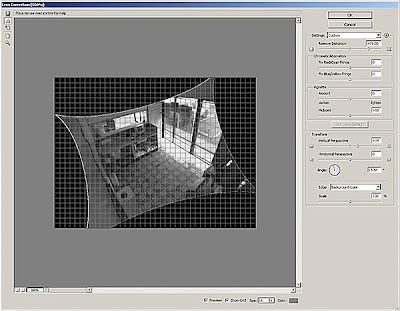
For this image, we can start with the Straighten Tool and drag a line down the door frame. The door frame is a straight vertical line and is about in the center/top of the field of view. Once you release your mouse button, Photoshop rotates the image accordingly. If the image is still a little off, you can select the Angle control and use your up/down arrow keys to nudge the angle a bit.
Next, you can correct for the barrel distortion by increasing or decreasing the Remove Distortion amount. Check your progress as you perform this adjustment by keeping your eyes on the grid. You can adjust the size of the grid size and colour with the controls on the bottom of the dialog box.
To correct perspective distortion, increase or decrease the Vertical Perspective / Horizontal Perspective sliders. I save the for last as its easier to see this work after straightening and removing the barrel distortion.
As you make your adjustments, Photoshop automatically sizes the image. This may result in a clipping of the edges. If you think too much is getting cut off, lower the Scale value at the bottom of the dialog box.
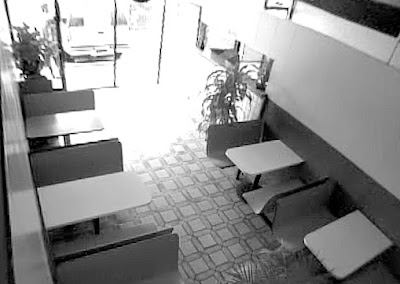
If you are processing multiple images from the same camera, you can save your settings from your first image's adjustments and apply them to the other images later. You can also choose Previous Settings from the Settings drop-down menu.
When you are finished, click OK. You may want to crop the craziness out of the image. Remember, you can choose hide the crop as opposed to deleting the cropped area.
Enjoy the day.
Wednesday, November 3, 2010
“On CCTV 300 times a day.” Rubbish. And here’s why.
From Lambert & Associates: "I was prompted to write this today owing to a TV news report that stated each of us is likely “caught” on camera “330 times a day”. What?!
First, a subsidiary point in this outrage is that when we’re viewed by a CCTV camera we shouldn’t feel “caught”. Why the negative wording, eh, Mr. TV Reporter? Are you “caught” when a bobby-on-the-beat sees you walking along in accordance with the law of the land? No. So why say that about CCTV? Sensationalist agenda from the mass media? Hmm. Anyway, on to the main point of this blog post.
I couldn’t help but notice the ubiquitous urban myth that each of us is view by 300 CCTV cameras per day in the UK has been inflated in this tv report to 330. Where did the additional 30 times a day spring from? I imagine someone decided that the figure must have gone up since it was originally ‘calculated’ and that 10% seems like a reasonable wild stab in the dark to a journalist looking to advance their career with breaking news, eh what? Tosh.
So where did the 300 figure come from in the first place? Can it be relied upon as the truth of the matter? The media certainly trot it out as ‘fact’ at every opportunity, and we know how trustworthy they are This was addressed recently in respected magazine Wired in ‘A Sharp Focus on CCTV’ by Heather Brooke. She wrote that Simon Davies of Privacy International walked London from Blackfriars to Bond Street in the earlier 1990′s and counted cameras before multiplying this up. How on earth can that represent the whole of the UK? It’s laughable, so let’s dismiss that ..."
Click here to read the rest of the story.
Enjoy.
First, a subsidiary point in this outrage is that when we’re viewed by a CCTV camera we shouldn’t feel “caught”. Why the negative wording, eh, Mr. TV Reporter? Are you “caught” when a bobby-on-the-beat sees you walking along in accordance with the law of the land? No. So why say that about CCTV? Sensationalist agenda from the mass media? Hmm. Anyway, on to the main point of this blog post.
I couldn’t help but notice the ubiquitous urban myth that each of us is view by 300 CCTV cameras per day in the UK has been inflated in this tv report to 330. Where did the additional 30 times a day spring from? I imagine someone decided that the figure must have gone up since it was originally ‘calculated’ and that 10% seems like a reasonable wild stab in the dark to a journalist looking to advance their career with breaking news, eh what? Tosh.
So where did the 300 figure come from in the first place? Can it be relied upon as the truth of the matter? The media certainly trot it out as ‘fact’ at every opportunity, and we know how trustworthy they are This was addressed recently in respected magazine Wired in ‘A Sharp Focus on CCTV’ by Heather Brooke. She wrote that Simon Davies of Privacy International walked London from Blackfriars to Bond Street in the earlier 1990′s and counted cameras before multiplying this up. How on earth can that represent the whole of the UK? It’s laughable, so let’s dismiss that ..."
Click here to read the rest of the story.
Enjoy.
Sunday, August 25, 2019
Camera Match Overlay?
Following up on yesterday's post, we were dealing with an interesting issue that concerns the mixed methods approach of inserting a single frame taken from CCTV footage (previous event) into a laser-generated point cloud scan (current event) processed by [ fill in the blank ] software. Let's continue ...
One of my favourite scenes from the 1999 hit movie, The Matrix, gives us a clue to how this conundrum will be addressed in the near term.
Spoon boy: Do not try and bend the spoon. That's impossible. Instead... only try to realize the truth.
Neo: What truth?
Spoon boy: There is no spoon.
Neo: There is no spoon?
Spoon boy: Then you'll see, that it is not the spoon that bends, it is only yourself.
Over in southeast Washington, the folks behind iNPUT-ACE have come up with a novel approach, essentially telling us that there is no spoon to bend.
I've been curious about the Camera Match Overlay feature in ACE for a while now. I was aware of what folks were doing with point clouds and have seen some of the demonstratives in YouTube videos of Grant and Andrew's testimonial experiences. As usual, the Fredericks family has been quite open with what they're on about. It's good for business after all.
So why does the new overlay tool remind me of the spoon?
The Camera Match Overlay does not bring a point cloud into ACE. The Camera Match Overlay does not integrate with a scanner's software to insert CCTV frames or video. What the Camera Match Overlay does is quite novel, and entirely sidesteps the issue of a mixed-methods approach.
You see, when using the Camera Match Overlay tool in iNPUT-ACE, you're working in ACE to "toggle the opacity" of ACE (where the CCTV footage exists) whilst you reposition ACE's UI, and thus the footage, as an overlay to your preferred scanning tool (where the point cloud exists). This is a manual process that requires that you match the "zoom level" of the scene in your scanning tool to that of the CCTV frame(s), as well as manually positioning the ACE overlay. But, once "eyeballed," you can lock in this positioning in ACE's UI. As a technical aside, I would imagine that your GPU and monitor's performance will be critical, as well as your eyesight, in properly "eyeballing" the alignment.
Thus, there is no spoon. ACE serves up the CCTV footage (projects) with a faded opacity so that you can work in your 3D tool. I know that the Fredericks' use the legacy tool, SceneVision-3D to work with point cloud data. But, I'm sure that the overlay will work with any vendors' tools once properly set-up.
Now, on the science side, it seems that ACE can help you make some calculations of error with the assistance of your scanning tool, producing a report to address margin of error. And ... as you should know, margin of error is directly related to your region of interest. The farther away from the camera your object of interest is, the larger the error will be ... as well as your nominal resolution. It seems that ACE reports the error in a few ways - with the final number being a function of "scanner accuracy," "calibration accuracy," and "resolution accuracy." The scanner accuracy comes from your scanner. The calibration accuracy seems to come from the overlay (not sure how it handles potential mis-alignment). The resolution accuracy is really just nominal resolution for the region of interest.
For close up work, it seems that error won't be much of a problem unless, for example, your subject is within the normal distribution for human heights. But at longer distances, the error can be in the ~2'-4' range; not much if you're trying to measure a skid mark but too big if you're trying to measure a person's height. Back to that manual process of aligning views, with a high nominal resolution, being off by just a few pixels will significantly affect your error - so again, pay close attention to that step in your process.
One problem you'll have to overcome is that most scanning software lack any sort of video output to save out your pretty demonstratives. You won't be able to export your demonstratives out of ACE either - remember, it's just overlaying the UI. But, if you've got an Omnivore, or Camtasia, you've got all that you need. Remember, these are demonstratives. You're working in the world of the abductive - taking your best shot to demonstrate your theory of the case in which you are working.
Now for the disclaimers.
Don't try this without training and experience in every single piece of your puzzle. Given that these demonstratives will be used to illustrate your opinion, please get certified as an analyst. Make sure that you understand the foundation science and rules of this discipline. Get to ACE's training. Make sure that training includes an appropriate amount of time on the Camera Match Overlay tool. Make sure that the tool works with your chosen scanner software. Make sure you're trained and experienced on that tool as well. Make sure that you have training in Forensic Photographic Comparison as well as Forensic Photogrammetry. If you're using Camtasia, get trained and certified there as well (I did). If you're using an Omnivore, get trained. Why? Because in the world of demonstratives, you're demonstrating your theories, opinions, and conclusions. It's your opinion, thus it becomes all about you and the foundations of your work.
Have a good day, my friends.
 |
| Images from The Matrix. (c) 1999 Warner Bros. |
Spoon boy: Do not try and bend the spoon. That's impossible. Instead... only try to realize the truth.
Neo: What truth?
Spoon boy: There is no spoon.
Neo: There is no spoon?
Spoon boy: Then you'll see, that it is not the spoon that bends, it is only yourself.
Over in southeast Washington, the folks behind iNPUT-ACE have come up with a novel approach, essentially telling us that there is no spoon to bend.
I've been curious about the Camera Match Overlay feature in ACE for a while now. I was aware of what folks were doing with point clouds and have seen some of the demonstratives in YouTube videos of Grant and Andrew's testimonial experiences. As usual, the Fredericks family has been quite open with what they're on about. It's good for business after all.
So why does the new overlay tool remind me of the spoon?
The Camera Match Overlay does not bring a point cloud into ACE. The Camera Match Overlay does not integrate with a scanner's software to insert CCTV frames or video. What the Camera Match Overlay does is quite novel, and entirely sidesteps the issue of a mixed-methods approach.
You see, when using the Camera Match Overlay tool in iNPUT-ACE, you're working in ACE to "toggle the opacity" of ACE (where the CCTV footage exists) whilst you reposition ACE's UI, and thus the footage, as an overlay to your preferred scanning tool (where the point cloud exists). This is a manual process that requires that you match the "zoom level" of the scene in your scanning tool to that of the CCTV frame(s), as well as manually positioning the ACE overlay. But, once "eyeballed," you can lock in this positioning in ACE's UI. As a technical aside, I would imagine that your GPU and monitor's performance will be critical, as well as your eyesight, in properly "eyeballing" the alignment.
Thus, there is no spoon. ACE serves up the CCTV footage (projects) with a faded opacity so that you can work in your 3D tool. I know that the Fredericks' use the legacy tool, SceneVision-3D to work with point cloud data. But, I'm sure that the overlay will work with any vendors' tools once properly set-up.
Now, on the science side, it seems that ACE can help you make some calculations of error with the assistance of your scanning tool, producing a report to address margin of error. And ... as you should know, margin of error is directly related to your region of interest. The farther away from the camera your object of interest is, the larger the error will be ... as well as your nominal resolution. It seems that ACE reports the error in a few ways - with the final number being a function of "scanner accuracy," "calibration accuracy," and "resolution accuracy." The scanner accuracy comes from your scanner. The calibration accuracy seems to come from the overlay (not sure how it handles potential mis-alignment). The resolution accuracy is really just nominal resolution for the region of interest.
For close up work, it seems that error won't be much of a problem unless, for example, your subject is within the normal distribution for human heights. But at longer distances, the error can be in the ~2'-4' range; not much if you're trying to measure a skid mark but too big if you're trying to measure a person's height. Back to that manual process of aligning views, with a high nominal resolution, being off by just a few pixels will significantly affect your error - so again, pay close attention to that step in your process.
One problem you'll have to overcome is that most scanning software lack any sort of video output to save out your pretty demonstratives. You won't be able to export your demonstratives out of ACE either - remember, it's just overlaying the UI. But, if you've got an Omnivore, or Camtasia, you've got all that you need. Remember, these are demonstratives. You're working in the world of the abductive - taking your best shot to demonstrate your theory of the case in which you are working.
Now for the disclaimers.
Don't try this without training and experience in every single piece of your puzzle. Given that these demonstratives will be used to illustrate your opinion, please get certified as an analyst. Make sure that you understand the foundation science and rules of this discipline. Get to ACE's training. Make sure that training includes an appropriate amount of time on the Camera Match Overlay tool. Make sure that the tool works with your chosen scanner software. Make sure you're trained and experienced on that tool as well. Make sure that you have training in Forensic Photographic Comparison as well as Forensic Photogrammetry. If you're using Camtasia, get trained and certified there as well (I did). If you're using an Omnivore, get trained. Why? Because in the world of demonstratives, you're demonstrating your theories, opinions, and conclusions. It's your opinion, thus it becomes all about you and the foundations of your work.
Have a good day, my friends.
Subscribe to:
Posts (Atom)