Featured Post

Welcome to the Forensic Multimedia Analysis blog (formerly the Forensic Photoshop blog). With the latest developments in the analysis of m...

Thursday, June 25, 2015

Discovery issues with certain kinds of images

An intersting question came in regarding a problem often encountered by LE folks processing / redacting CP images for court. Obviously, you don't want to process them one at a time when there are hundreds of images to redact. The question was tossed around and here's a simple way to do it in FIVE courtesy of our friends at Amped Software.

  • Open a sequence of images (Load>Sequence Loader)
  • Redact by blackening the whole image (Presentation>Hide Selection), then choose blacken at 100%, then change the shape from round to square, then on the “selection” tab, click and then choose “whole image” from the dropdown.
  • Export the redacted images as another sequence (Write>Sequence Writer). Change the file name / location to be what you need it to be.
  • Generate your report (Project>Generate Report.
I know not many folks work with CP. I hope this helps.

Wednesday, June 24, 2015

Quality issues with body worn cameras

Amped Software's latest blog post features an article on the various quality issues associated with body worn camera recordings, and how their software can be used to fix them all.

Check it out here.

Thursday, June 11, 2015

Rolling Shutter Effect


"Rolling shutter is a method of image capture in which a still picture (in a still camera) or each frame of a video (in a video camera) is captured not by taking a snapshot of the entire scene at single instant in time but rather by scanning across the scene rapidly, either vertically or horizontally. In other words, not all parts of the image of the scene are recorded at exactly the same instant. (Though, during playback, the entire image of the scene is displayed at once, as if it represents a single instant in time.) This produces predictable distortions of fast-moving objects or rapid flashes of light. This is in contrast with "global shutter" in which the entire frame is captured at the same instant.

The "Rolling Shutter" can be either mechanical or electronic. The advantage of this method is that the image sensor can continue to gather photons during the acquisition process, thus effectively increasing sensitivity. It is found on many digital still and video cameras using CMOS sensors. The effect is most noticeable when imaging extreme conditions of motion or the fast flashing of light. While some CMOS sensors use a global shutter, the majority found in the consumer market utilize a rolling shutter.

CCDs (charge-coupled devices) are alternatives to CMOS sensors, which are generally more sensitive and more expensive. CCD-based cameras often use global shutters, which take a snapshot representing a single instant in time and therefore do not suffer from the motion artifacts caused by rolling shutters."


Thursday, June 4, 2015

Tuesday, June 2, 2015

File systems, thumb drives, and DVRs

I get a lot of help requests from LE employees trying to retrieve DME at crime scenes. Some of them work like this:

Officer: "I'm standing in front of the DVR. I'm trying to back-up the data but the DVR won't see my thumb drive. What am I doing wrong?"
Me: "What file system are you using on your thumb drive?"
Officer: "What do you mean?"

Officer: "I'm standing in front of the DVR. I'm trying to back-up the data and the DVR is asking if I want to format by USB stick. Should I click OK?"
Me: "Is the drive empty?
Officer: "I've got a bunch of case files on it."
Me: "Click cancel and get another drive."


I keep a bag of thumb drives of various sizes and formats. Some older systems won't accept a thumb drive with a capacity larger than 2gb formatted as FAT. Others won't accept anything larger than 4gb. However, 4gb is a nice size to carry as you'll want to move the files to WORM discs when you create the master evidentiary copy. Most people have DVD readers, so this bit of pre-file management will help you keep organized.

So, don't throw away those old jump drives. You may need them some day.

Friday, May 22, 2015

SWGDE Response to the Termination of SWGIT

Posted on behalf of James Darnell, SWGDE Chair:

The recent announcement that the Scientific Working Group on Imaging Technology (SWGIT) made the executive decision to cease operations was disappointing news to the members of the Scientific Working Group on Digital Evidence (SWGDE). In this exciting but challenging time of standardization efforts and quality assurance development, our sister SWG was a solid example of how people can contribute to an industry effort in addition to their normal work responsibilities. The SWGIT membership leaves an impressive legacy of numerous guidelines and best practices in the Forensic Video, Image Analysis, and Forensic Photography disciplines.

SWGDE was proud to work closely with SWGIT for many years. Together we produced several joint documents including the SWGDE/SWGIT Guidelines and Recommendations for Training, SWGDE/SWGIT Proficiency Test Program Guidelines, SWGDE/SWGIT Recommended Guidelines for Developing SOPs, and the SWGDE/SWGIT Digital & Multimedia Evidence Glossary. SWGDE is pleased to have had the opportunity to support SWGIT when we could, especially with joint meetings. SWGDE helped build and financially support the SWGIT website since its inception and will continue to do so.

In keeping with that tradition of cooperation and support, SWGDE will help continue the achievements of SWGIT's membership by inviting them to participate in three new standing committees created to address video, photography, and image forensics. We also invited them to bring any unfinished work items, topics and agenda items that need addressing, but it will ultimately be up to the new committee members to decide their agenda and priorities.

SWGDE's mission is to bring together organizations actively engaged in the field of digital and multimedia evidence in order to foster communication and cooperation as well as to ensure quality and consistency within the forensic community. So while it is difficult to see such a valuable member of our community dissolve, we hope that through our new committees, SWGDE will address the discipline specific needs formerly provided by SWGIT.

David Hallimore
SWGDE Outreach Committee Chair
https://www.swgde.org/

Security - Safety Korea 2015


South Korea's big security convention is next week. Security - Safety Korea 2015 is sure to feature the latest and greatest of Korean CCTV tech. This means that you can expect the usual flood of new Korean DVRs at retail outlets. It also means new codecs, new players, and (hopefully) some DVRs that will feature faster I/O options. Nothing's worse than an HD recorder with USB 1 output.

Monday, May 18, 2015

TASER to Acquire MediaSolv Corporation to Broaden Digital Evidence Management Solutions For Law Enforcement

Taser recently made an incredibly smart move, they acquired MediaSolv. This solves a serious issue for them and gives their customers an option of either cloud storage (Evidence.com) or local evidence management (MediaSolv Commander).

Here's the announcement.

Monday, May 11, 2015

Leaving unpowered SSDs in a warm room can kill your data fast

Many of us are in the business of collecting data from crime scenes. Some actually collect hard drives. This article from PCWorld highlights a new risk associated with unpowered SSD drives.

"A new research presentation shows that solid state drives can lose data over time if they aren’t powered on, especially in warmer environments. A powered-off drive in 104 degrees Fahrenheit may start seeing data loss after a couple of weeks.

The information comes from Seagate’s Alvin Cox, who as part of a presentation to the Joint Electron Device Engineering Council (JEDEC). Though the presentation is a couple months old, it was recently picked up by ZDNet, Slashdot and other sites.

Cox’s presentation shows basic performance requirements for both consumer and enterprise SSDs. It notes that consumer SSDs, when powered-off in 86 degrees Fahrenheit (30 degrees Celcius), should retain data for about a year. Bumping up the temperature by 9 degrees Fahrenheit (5 degrees Celcius) reduces the time of data retention by half. Store your SSD in 131 degree heat, and it might start losing data after a couple of days ..."

Click here for the whole story.

Thursday, May 7, 2015

Termination of SWGIT

This just in from SWGIT:

The Scientific Working Group on Imaging Technology (SWGIT) would like to thank the forensic community for the continued support, involvement, and participation in making this group and the documents we have provided over the last 18 years so very successful. The mission of the SWGIT has been to facilitate the integration of imaging technologies and systems within the criminal justice system (CJS) by providing best practices and guidelines for the capture, storage, processing, analysis, transmission, output, and archival of digital evidence. This mission has served our community well since the inception of the group in 1997. The SWGIT documents have been essential to developing laboratory and law enforcement best practices and guidelines across the United States as well as internationally. The documents have been used to demonstrate reliable scientific principles and methods in court and Daubert hearings.

The current economic climate has impacted the continued work of SWGIT. Due to a lack of funding revenue, SWGIT has made the decision to terminate operations. SWGIT’s website and social media will remain available as a continued valuable resource for all questions involving Forensic Video, Image Analysis, and Forensic Photography.
SWGIT documents will remain in effect and available on the SWGIT website, www.swgit.org. SWGIT has addressed concerns important to all members of the community including first responders, laboratory examiners, and managers of criminal justice organizations. Our website contains more than 20 recommendations and guidelines detailing procedures for digital photography, video and image processing, CCTV installations, documentation of image enhancement, and several other topics important in the current forensic environment. SWGIT was instrumental in the publication of two of our documents as ASTM standards, “Standard Guide for Image Processing” and “Standard Terminology for Digital and Multimedia Evidence Examination.”

As the forensic community moves forward, a goal of SWGIT is to continue to engage the entire law enforcement imaging community in the development of guidelines, best practices, and standards. In remaining true to that goal, SWGIT strongly encourages the members of our forensic disciplines to continue to support other professional groups that strive to provide such information.

SWGIT will continue to have an active web presence at www.swgit.org and on social media. Please see the social media links provided on our website.

Thank you again for making SWGIT such a long-standing success.

Melody Buba
Chair
Federal Bureau of Investigation

Cory Winar
Vice Chair
Eugene Police Department

Friday, May 1, 2015

How Are States Going to Pay for Those Police Body Cameras?

This just in from Governing.com: "The Police Executive Research Forum survey found most agencies spent between $800 and $1,200 per camera to purchase them, a daunting price tag for departments already strapped for cash.

But it is the ongoing costs that are the real challenge. The New Orleans Police Department plans to purchase 350 body cameras, but is budgeting $1.2 million over five years, mostly for data storage. Other departments, the police forum found, expect to spend $2 million for a few years of data storage.

In Iowa, the Des Moines Police Department is looking for $300,000 just to start a body camera program. Duluth, Minnesota’s initial $5,000 purchase of 84 cameras ballooned to about $78,000 for licensing and data storage. Last year, Duluth’s police budget was $19.1 million, while Des Moines spent more than $59 million on its police force.

Many states are debating the issues that surround police cameras without tackling the funding question, said Richard Williams, a criminal justice policy specialist with the NCSL. In many instances, he said, lawmakers are focused how long departments should have to keep video, and if or when recordings should be made public.

Miller, with the Police Executive Research Forum, said those issues are important, but that for police departments, cost is the overriding concern.

Officers could potentially record millions of videos a year, any number of which could be used as part of a criminal proceeding, a public records request or for another official purpose. The cost of downloading, logging, handling and storing all that video can be staggering.

“Most of the agencies that we worked with say the biggest issue is the backend data storage,” she said. “It can cost hundreds of thousands of dollars to store video each year.”

Costs were a stumbling block in Utah this year, where state lawmakers debated but didn’t pass body camera legislation. Meanwhile, some departments around the state are using the technology — and trying to meet the costs associated with it.

In Clearfield, Utah, a city of about 30,000 located 30 miles north of Salt Lake City, the police department has been using body cameras since 2010. But recently, data storage problems came to a head, and for a few weeks, the department was forced to use DVDs to store video because it ran out of computer server space.

“The more you use them, the more storage it takes, and the costs increase,” said Mike Stenquist, an assistant chief. “The public wants more, it also costs more. It creates a lot of problems.”

It’s not likely to get any better either, Stenquist said. Years ago, the department used older model cameras that needed to be recharged frequently and could only record two hours of video at a time, meaning officers had to return to the office frequently to download any recordings.

New models last longer and have greater storage capacity, he said. But now there’s another problem: The newer cameras record high-definition video, which means the video files are much larger, a reality that contributed to the department’s recent data crunch.

“The data just builds up,” Stenquist said. “Now that we have better cameras that record through a whole shift, it’s taking three or four times the data storage.”

Between cost concerns and public access questions, Stenquist said, it’s probably inevitable that state lawmakers will have to step in.

“It’s just become pretty muddy about what’s going to happen in the future,” he said. “There’s a lot of work to be done.”

Click here to read the whole story.

Tuesday, April 28, 2015

New NVIDIA drivers will no longer support older CUDA GPUs

This just in from Adobe: "Just to alert you, NVIDIA is starting to discontinue CUDA support for some older GPUs in their new driver releases. If you are still using one of these older cards, and need GPU support for Adobe applications, do not update your drivers while you look into a purchasing a new card.

If you need to reinstall NVIDIA drivers, see this web page."

Wednesday, April 22, 2015

a little humor

A photon checks into a hotel and the bellhop asks him if he has any luggage.

The photon replies, “No, I’m traveling light.”

Monday, April 20, 2015

Police Cameras Bring Problems of Their Own

This just in from the Wall Street Journal: "As more police agencies equip officers with body cameras in response to public pressure, authorities are discovering they create problems of their own: how to analyze, process and store the mountains of video each camera generates.

Prosecutors in northern Colorado recently spent hours poring over a dozen videos captured by police wearing cameras. The case? An arrest for drunk and disorderly conduct.

Clifford Riedel, Larimer County’s district attorney, said his office has been overwhelmed with footage from the 60 body cameras the Fort Collins Police Department uses, and will need to hire an additional technician to sort through it all. “There are just huge amounts of data being generated from cameras,” said Mr. Riedel. “It used to be that video on a case was the exception. Now it’s the rule.”

The movement gained new intensity after the police shooting last week of a fleeing man in South Carolina. While many experts inside and outside of law enforcement agree that body cameras—clipped to officers’ uniforms or glasses—help increase police transparency and may even improve police behavior, police departments and prosecutors are struggling with how to sift through, preserve and share the visual evidence.

On top of that, agencies need policies and personnel to respond to requests from journalists and the public to release video under freedom-of-information requests.

“The vast majority of places are still trying to figure this out,” said Michael White, a professor of criminology at Arizona State University who wrote a Justice Department report on body cameras.

Dr. White estimates that between 4,000 and 6,000 U.S. police departments, out of about 18,000 nationally, use body cameras. Officers generally turn them on when stopping a driver or responding to an incident.

Some departments use body cameras in addition to dashboard ones that have become common at many agencies, but result in less-useful footage because much police action takes place away from their vehicles. Body cameras—which cost hundreds of dollars each—typically result in much more video for departments to handle.

The push to require body cameras intensified nationally after last August’s shooting of Michael Brown, a black 18-year-old, by a white police officer in Ferguson, Mo. This week, after a bystander’s cellphone video surfaced showing a white South Carolina policeman fatally shooting an unarmed black man in his back, several prominent state lawmakers voice support for a bill to require all officers to wear cameras.

But the cost has given some officials pause, said Lindsay Miller, senior research associate at the Police Executive Research Forum and co-author of a Justice Department report on the topic. “The cameras themselves aren’t overly expensive, but the years and years of data storage you’re going to deal with—that can definitely be cost-prohibitive,” said Ms. Miller.

Many departments keep inconsequential video for 30 to 60 days. But if the footage is evidence in a criminal case, it must be kept longer; most states require that video in a homicide case be kept indefinitely, she said. Ms. Miller said an emerging consensus is that the benefits outweigh the costs. In limited studies, the cameras have shown promise in reducing use of force by police and citizen complaints—and that can save money spent investigating complaints and settling lawsuits, she said ..."

Keep reading at WSJ.com.

Tuesday, April 14, 2015

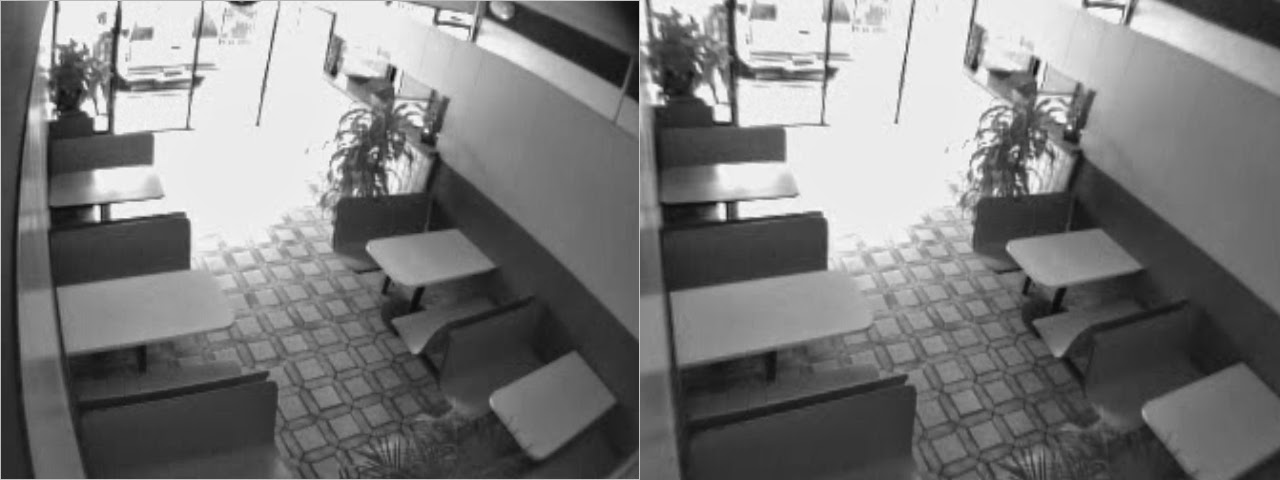
Correct Fisheye Distortion in FIVE

I've seen a lot of ADT installations using fisheye lenses lately. ADT must be having a sales promotion or something.

One of the updates to FIVE in the last year is the Correct Fisheye filter, found in the Edit filter group.

In the past, I would use the Undistort filter, but Correct Fisheye works a lot better / easier / faster on these low-end fisheye lenses I've been seeing.


In the case of the "full-frame" (180º) fisheye lenses in the ADT installations, I've found that Orthographic works the best. This isn't because ADT has been forthcoming with information about the mapping function of their chosen lenses. It's mainly been through my testing each function. You won't likely get information on the manufacturer's chosen mapping function.


As a side note, for the "circular fisheye" top-down (360º) lenses, use the Unroll filter for better results.

Back to the ADT cameras, here's the before/after image (Presentation>Compare Original). On the left is the original image and on the right is the corrected version. Correct Fisheye did a very good job in just two clicks of the mouse.


Enjoy.

Monday, April 13, 2015

It looks like the transition to Amazon.com is finished and my book, Forensic Photoshop, is now available there exclusively. Paperback and hardcover options are both available for immediate shipping.

As I've noted in the past, the book isn't based on a particular version of Photoshop. It's a workflow book ... what to do when, and why. As such, it's still relevant and informative for those still using Photoshop in their forensic work.

Thanks again for your continued support.

Friday, April 10, 2015

What's next for Adobe Audition CC?

Adobe has begun to release details about the upcoming changes to their Creative Cloud products. Click here to find out what's coming next in Adobe Audition CC.

Thursday, April 9, 2015

A bite mark matching advocacy group just conducted a study that discredits bite mark evidence

Here's an interesting article from the Washington Post about Forensic Odontology.

Check out this quote, "the problem with bite mark analysis was never the lack of a flow chart. The problem is that there has never been any real scientific research to support its two main underlying premises — that human dentition is unique, and that human skin is capable of registering and recording that uniqueness in a useful way. And the research that has been done strongly suggests those two premises are not true." Ouch!

Read the whole article here.

Wednesday, April 8, 2015

Coursera courses reviewed


Last week, I finished the Coursera course, Visual Perception and the Brain. This course was taught by Dale Purves, MD, of Duke University and is one of the growing number of on-line non-credit courses offered by leading universities and noted professors around the world.

I would recommend that DME analysts put this course on their to-do lists and watch for it to be offered again. There's a lot of good information delivered as part of the class.

That being said, if you've never taken an on-line university level course you may have some trouble with the format. You watch the video of each section's lecture. You're free to download and save it locally. You can also download and save the slides and a fairly accurate transcript of the lecture. There's an expectation that you'll dive in a little deeper and study each section's topic on your own prior to taking each section's test. The test questions aren't written directly from the lecture / slides and assume that you've done a bit of extra reading in order to gain a deeper understanding of the week's topic.

Coursera has a lot of classes available for free. In this world of shrinking budgets and doing more with less, you can't beat free classes.

Monday, April 6, 2015

Recovering image data from JPEG file fragments

This interesting paper was recently published by SPIE. SPIE is the international society of optics and photonics.

"A new technique for recovering fragmented data files can retrieve elements of a JPEG compressed image even when the file's header is unavailable."

"The most basic task of any file system is to manage and organize data in a storage volume. Each file in the store is allocated a list of blocks (the basic unit of access), and when we access a file, the system retrieves the data in sequence from the list. Correspondingly, removing the relevant entry deletes the item (note that in most systems, deleting simply means that data is overwritten over time by newly saved files, rather than actually removed). Figure 1 depicts the layout of files distributed across blocks of a storage medium, and provides a simplified view of the data structure used to track allocated blocks. When the information for a volume is corrupt or missing, it is only possible to recover files by analyzing the fragmented raw data, a process known as file carving."

"Today, file-carving tools play an important role in digital forensic investigations, where analyzing deleted files and salvaging data from damaged and faulty media are common procedures. However, when files are encoded and compressed (as with most multimedia files), recovery is dependent on the availability of the file header, which includes all the decoding parameters. If a file is partially intact with its header deleted, common carving techniques cannot recover any data. Here, we describe an algorithm1 that advances the latest developments in JPEG carving by introducing the ability to recover file fragments when the associated header is missing.

There are two main challenges associated with file carving. The first is the inability to lay out data blocks contiguously on the storage, as in the case of files b and f in Figure 1. Repeated execution of file operations, such as addition, deletion, and modification of files, over time leads to fragmentation of available free storage space. As a result, the newly generated files need to be broken into several parts to fit into the available unallocated blocks. Figure 1 illustrates this phenomenon, where files a and c are separated into two pieces. Even the new solid-state drives (which use integrated circuits, rather than disks, to store data) are susceptible to this phenomenon as they are designed to emulate the interface characteristics of hard disk drives.

The second challenge to successful file carving is that interpreting binary-formatted data requires the use of decoders, without which a block of data will reveal little or no information about the content of a file.

There has been significant recent progress in carving JPEG files, which are the most widely adopted still image compression standard today and commonly the subject of forensic investigations.2–6However, techniques for JPEG recovery still assume that a file header is always present. Without the header, the usual techniques cannot recover any data, even though the rest of the file may be intact. For example, in Figure 1, the fragments of files d, e, and g were overwritten by files c and f. Recovering an arbitrary chunk of compressed image data without the matching encoding metadata essentially requires reconstructing a new file header, which at least requires knowledge of entropy coding parameters and quantization tables, methods used during compression for downsampling the color information and image dimensions."

Click here to continue reading this paper on SPIE's web site.