Featured Post

Welcome to the Forensic Multimedia Analysis blog (formerly the Forensic Photoshop blog). With the latest developments in the analysis of m...

Wednesday, September 20, 2017

What you know vs. what you can prove

I had an interesting evening. A friend sent a link to a YouTube video, a recorded webinar for a "video analysis" product. I'll admit. I was curious. I watched it. Below is my commentary on what I saw.

The presenter outlined his workflow for working with video from a few different sources. The presentation turned to the difference between how Direct Show handles video playback vs. what's actually in the data stream. The presenter showed how Direct Show may not give you the best version of the data to work with. If you've been around LEVA for a while, you likely know this already. It's good information to know.

Then the presenter did a comparison of a corrected frame from the data stream vs. a frame from the video as played via the Direct Show codec - in Photoshop. He made an interesting statement that prompted me to write this post. He was clicking between the layers so that viewers could "see" that there was a difference between the two frames. The implication was that the viewer could clearly "see" the difference. He was making the point that one frame had more information / a more clear display of the information - illustrating it visually (demonstratively).

This got me thinking - does he know how people "see?"


I'll get to the difference between his workflow (using many tools) and Five (using one tool) in a bit. But first, I want to address his point about "clearly seeing."

I do not hide the fact that I am autistic. Thanks to the changes in the DSM, my original brain wiring diagnoses that were made during the reign of DSM IV now place me firmly on the autism spectrum in DSM V. Sensory Processing Disorder and Prosopagnosia have made life rather interesting; especially growing up in a time when doctors didn't understand these wiring issues at all. As an analyst, they present challenges. But they also present opportunities. Can a person doing manual facial comparison be accused of bias if they're face blind? Not sure. Never been asked. But I digress.

Let's not forget that much of what we do,  the majority of the work involves some sort of visual examination. According to just about every agency's entry rules, examiners must have normal color vision, depth perception, and sufficiently good corrected vision. Vision is acceptable if it is 20/20 or better uncorrected. If vision is uncorrected at 20/80 or better and can be corrected to 20/20 by the use of glasses or hard contacts, it is acceptable. If vision is uncorrected at 20/200 or better and can be corrected to 20/20 by the use of soft contacts, it is acceptable. Vision surgically corrected (such as by radial keratotomy or Lasik) to 20/20 is acceptable once visual acuity has stabilized. All of this is to say, how your mechanical devices (eyes, ears, brain) interact with your environment helps to form what you "know."

I've spent my academic life studying the sensory environment. My PhD dissertation focusses on the college sensory environment that is so hostile, autistic college students would rather drop out than stick it out. But again, I've studied and written extensively on the issue of what people perceive, so the presenter's statement struck me.

It also struck me from the standpoint of what we "know" vs. what we can prove.

The presenter took viewers on quite a tour of a hex editor, GraphStudio, his preferred "workflow engine," and Photoshop before making the statement that prompted this post. A lot of moving parts. Along the way, the story of how information is displayed and why it's important to "know" where differences can occur was driven home.

Yes, we can all agree that there are differences between how Direct Show shows things and how a raw look at the video shows things. It may be helpful to "see" this. But what if you don't perceive the world in the same way as the story teller.

Might there be another way to perform this experiment that doesn't rely on the viewer's perception matching that of the presenter?

Thankfully, with FIVE, there is.

The presenter started with Walmart (SN40) video being displayed via Direct Show. So, I'll start there too. SN40, via Direct Show, displays as 4 CIF.


Then, I used FIVE's conversion engine to copy the stream data into a fresh container.
It displays as 2 CIF.


I selected the same frame in each video and bookmarked them for export.


I brought these images back into FIVE for analysis.

The issue with 2 CIF is that, in general, every other line of resolution isn't actually recorded and needs to be restored via some valid and reliable process. FIVE's Line Doubling filter allows me to restore these lines. I can choose the interpolation method during this process. The presenter in the video chose a linear interpolation method to restore the lines (in Photoshop - not his "workflow engine"), so I did the same.


I've now restored the stream copy frame. I wanted not only to "see" the difference between frames ("what I know"), I wanted to compute the difference between frames ("what I can prove").

Again, staying in FIVE, I linked the the Direct Show frame with the Stream Copy frame with the Video Mixer (found in the Link filter group).


The filter settings for the Video Mixer contains three tabs. The first tab (Inputs) allows the user to choose which processing chains to link, and at what step in the chain.


The second tab (Blend) allows the user to choose what is done with these inputs. In our case, I want to Overlay the two images.


The third tab (Similarity) is where we transition from the demonstrative to the quantitative. Unlike Photoshop's Difference Blend Mode, FIVE doesn't just display a difference (is there a threshold where difference is present but not displayed by your monitor?) it computes similarity metrics.


With the Similarity Metrics enabled, FIVE computes the Sum of Absolute Difference (SAD), the Peak Signal to Noise Ratio (PSNR), Mean Structural Similarity, and the Correlation Coefficient. The actual difference, computed 4 different ways. You don't just "see" or "know" - you prove.


The reporting of this is done at the click of the mouse. FIVE has been keeping track of your processing and the results are complied and produced on demand - no typing your report. (My arthritic fingers thank the programmers each day.)


Reports in the PDF/a standard mean the greatest compatibility when dealing with customers. Click on the hyperlink on the report and read the explanation of what was done, the settings, and the academic/scientific source for the test. This means that FIVE's reports are fully compliant with ASTM's 2825-12. Are Photoshop's reports complaint? What about your "workflow engine? Hint, they are if you type them in such a way as to assure compliance. Who has time for that?

Total time for this experiment was under 5 minutes. I'm sure the presenter could have been faster than was displayed in the webinar, he was explaining things. But, he used a basket of tools - some free and some not free. He also didn't take the viewers time to compile an ASTM 2825-12 compliant report. Given the many tools used, I'm not sure how long that takes him to do.

When considering his proposed workflow, you need to consider the total cost of ownership of the whole basket as well as the cost of training on those tools. You also can factor how much time is spent/saved doing common tasks. I've noted before that prior to having FIVE, I could do about 6 cases per day. With FIVE, I could do about 30 per day. Given the amount of work in Los Angeles, this was huge.

For my test, I used one tool - Amped FIVE. I could do everything the presenter was doing in one tool, and more. I could move from the demonstrative to the quantitative - in the same tool.

Now, to be fair, I am retired now from police service and work full time for Amped Software. OK. But, the information presented here is reproducible. If you have FIVE and some Walmart video, you can do the same thing in this one amazing tool. Because I come from LE, I am always evaluating tools and workflows in terms of total cost of ownership. Money for training and tech is often hard to come by in government service and one wants the best value for the money spent. By this metric, Amped's tools and training offer the best value.

If you want more information about Amped's tools or training, head over to the web site.


Saturday, September 2, 2017

Changing times

I've been in the "video forensics" business for quite some time now. I've seen enough to notice trends in the industry. I've seen people come and go. Today, I want to comment on a coming trend that I believe will impact everyone in the business, LEOs and privateers alike.

Here's what I mean.

Going back to about 2006, the economy was booming and folks were happy. Then 2007 hit and the economy tanked. As belts tightened, people cut back on entertainment and other non-essential things. A result of this was major cut-backs in the movie business. Many out of work editors and producers entered the business of video forensics. They guessed that because of their knowledge of the tools - Avid MC, PremierePro, Final Cut, etc - they could go out there and compete for work, offering their services and "expertise" in video to the courts, attorneys, PIs, and the like. There were few success stories and a lot of colossal fails. Very few of these folks are still around.

Another trend is emerging.

In the push to assure future success, parents have been steering their kids to STEM degrees. Many have pursued and achieved doctorates in the STEM fields only to find that there is a glut of people on the market with such degrees (in my academic field, there's about a 600/1 ratio of applicants to jobs/grants). Some are leaving their degree field, using their expertise in experimental design and statistics (gained by every PhD) in a variety of useful ways (Think Moneyball).

A case* from Arizona last year serves as the canary in the video forensics coal mine. It's a firearms case, but all the issues can easily be applied to our field. In State v Romero (2016), the Arizona Supreme Court said that the trial court erred in not allowing the defense to call their "expert." The person in question wasn't a firearms examiner or a tool-mark examiner. He is an expert in Experimental Design, with a PhD in the discipline.

Here's some relevant parts of the ruling:

"...Dr. Haber was not offered to testify whether Powell had correctly analyzed the toolmarks on the shell casings. Instead, Dr. Haber, based on his expertise in the broader field of experimental design, criticized the scientific reliability of drawing conclusions by comparing tool marks."

"...Arizona Rule of Evidence 702 allows an expert witness to testify if, among other things, the witness is qualified and the expert’s “scientific, technical, or other specialized knowledge will help the trier of fact to understand the evidence . . . .” Trial courts serve as the “gatekeepers” of admissibility for expert testimony, with the aim of ensuring such testimony is reliable and helpful to the jury."

Hint, every state court and the US federal courts have a similar rule governing expert witnesses and their testimony.

"... The trial court here concluded that Dr. Haber was not qualified to testify as an expert in firearms identification. In affirming, the court of appeals noted that Dr. Haber, although having reviewed the literature on firearms identification, had not previously been retained as an expert on firearms identification, conducted a toolmark analysis, attempted to identify different firearms, or conducted research on firearms identification. 236 Ariz. at 458 ¶¶ 23-25, 341 P.3d at 500."

"... The issue, however, is not whether Dr. Haber was qualified as an expert in firearms identification, but instead whether he was qualified in the area of his proffered testimony — experimental design. Here, the trial court determined that Powell was qualified to offer an expert opinion that the shell casings were all fired from the same Glock. But Romero did not offer Dr. Haber as an expert in firearms identification to challenge whether Powell had correctly performed his analysis or formed his opinions. Instead, Dr. Haber’s testimony was proffered to help the jury understand how the methods used by firearms examiners in performing toolmark analysis differ from the scientific methods generally employed in designing experiments."

Did you catch that? Dr. Haber was retained to challenge the validity of the method used in the prosecution's examination - to illustrate "... how the methods used by firearms examiners in performing toolmark analysis differ from the scientific methods generally employed in designing experiments."

"... Under Rule 702, when one party offers an expert in a particular field (here, the State’s presentation of Powell as an expert in firearms identification) the opposing party is not restricted to challenging that expert by offering an expert from the same field or with the same qualifications. The trial court should not assess whether the opposing party’s expert is as qualified as — or more convincing than — the other expert. Instead, the court should consider whether the proffered expert is qualified and will offer reliable testimony that is helpful to the jury.  Cf. Bernstein, 237 Ariz. at 230 ¶ 18, 349 P.3d at 204 (noting that when the reliability of an expert’s opinion is a close question, the court should allow the jury to exercise its fact-finding function in assessing the weight and credibility of the evidence)."

"... The gist of Dr. Haber’s proffered testimony was that the methods generally used in conventional toolmark analysis fall short of scientific standards for experimental design. Dr. Haber’s testimony was therefore directed at the scientific weight that should be placed on the results of Powell’s tests. Such questions of weight are emphatically the province of the jury to determine. E.g., State v. Lehr, 201 Ariz. 509, 517 ¶¶ 24–29, 38 P.3d 1172, 1180 (2002). "

"... Apart from Dr. Haber’s qualifications, his testimony would not have been admissible unless it would have been helpful to the jury in understanding the evidence. Ariz. R. Evid. 702(a). The State presented Powell’s testimony that the indentations on shell casings demonstrated that the Glock had fired all the shells, including those at the murder scene, and the State argued that the toolmark comparisons demonstrated a match to “a reasonable degree of scientific certainty.” Dr. Haber’s testimony would have been helpful to the jury in understanding how the toolmark analysis differed from general scientific methods and in evaluating the accuracy of Powell’s conclusions regarding “scientific certainty.”"

"... The thrust of Dr. Haber’s testimony was that the methods underlying toolmark analysis (here comparing indentations and other marks on shell casings) are not based on the scientific method, but instead reflect subjective determinations by the examiner conducting the analysis. Haber would have explained that unlike experts who use other forms of forensic analysis rooted in the scientific method, firearms examiners do not follow an accepted sequential method for evaluating characteristics of fired shell casings and comparing them to control subjects. By describing the methods used by toolmark examiners, Dr. Haber’s testimony could have helped the jury assess how much weight to place on Powell’s “scientific” conclusion that the shell casings at the murder scene could only have been fired from the Glock found by the police when they stopped Romero." How big was the sample size in your experiment? How did you determine the appropriateness of that size? How did the casing's markings compare to a normal distribution of values derived from the sample / control subjects?

"... One of his critiques of the methodology used by firearms examiners is that they do not employ identifiable, standardized protocols." Show me the peer-reviewed, published source that describes the method used.

"... Dr. Haber’s testimony was intended to highlight that the conclusions drawn by firearms examiners from toolmarks do not result from the application of articulable standards and lack typical safeguards of the scientific method such as independent verification by other examiners. Thus, Dr. Haber’s testimony could have helped the jury to understand any eficiencies in the experimental design of toolmark analysis and to assess any suggestion that such analysis was “scientific.” Cf. Salazar-Mercado, 234 Ariz. at 594 ¶ 15, 325 P.3d at 1000 …" Who checked your work and signed-off on it? 

So why such a long post? I saw a video over on Deutsche Welle called "Crime fighting with video forensics." In it, the featured person made this statement: “each vehicle has a unique headlight spread pattern." Does it now? How does he know this? Did he conduct a study? Where is it published? Has he every been asked to prove out his methodology? What was the sample size of the experiment? How was the appropriate size for the sample calculated? How would his "headlight spread pattern" methodology stand up to cross-examination by an attorney prepared by someone with knowledge of experimental design? Remember, there are a lot of out-of-work PhDs out there? What would happen if Dr. Haber was the opposing expert in your case?

The Reddit Bureau of Investigation tackles the subject here. A link from that page contains the following quote, "... all the things your describing sound almost.... Imperfect? I mean, it scares me to think I might get pinned for a crime because I have a similar headlight spread as someone else … So what I'm asking is, are techniques like headlight spread and clothing identification taken very seriously in court? ..." According the the DW story, the matching of the "headlight spread pattern" did lead to a conviction in the highlighted case. The posts are about 5 years old. Plenty of time for someone to actually test this method and publish results - not just post questions on Reddit. But, I can't find any studies in the academic repositories.

Now, I may seem to be picking on one person. I'm not. I'm picking on the use of techniques that are called "science" but have no foundation in any science or the scientific method. I found police-led training on the subject with a simple Google search. Well-meaning folks will be exposed to this topic and begin to use it in their investigations - perhaps unaware of the challenges to it's validity that they may face if/when they testify as to their work.

Errors in conclusions and the use of untested methodologies threaten forensic science. It's not me saying this, it's the focus of the NAS Report. It's the reason the OSAC was created. If you're in the "video forensics" discipline, and you're giving your OPINION about something related to the evidence, PLEASE be sure that your opinion is grounded in valid and reliable science - science that you can quote when asked. For example, if you're using the Rule of Thirds to calculate the height of an unknown subject / object in a CCTV video, you will have problems under a capable cross examination. Where in academics / science can you find a paper that tells you how to employ this method for this purpose? Hint, you can't. If you're using Single View Metrology in your measurements, you'll easily find the source document for this technique as well as the many papers that cite this technique.

And this is where the weakness in many "analysts" work can be found. When giving your opinion, what is the source of your conclusion? Which paper? Which study? How about simply listing your references / sources in your report so there's no confusion as to the basis of your opinions?

My entry into grad school opened my eyes as to what I didn't know and what the various trade groups where I'd received my training couldn't prepare me for. My pathway to my dissertation had me laser focussed on stats, experimental design, sample sizes, validity, and defending my work in front of people who have gone down a similar path and know way more than me. It's humbling to defend one's work - to be cross-examined by such brilliant people. But, iron sharpens iron. I'm the better for it.

Rather than tell you, it'll be OK, I'm saying watch out. You're heading down an unsustainable path. If folks want to continue to use this method - "headlight spread pattern analysis," probability says that there's going to be a challenge. Do you want that to be you? Are you prepared for it?

Something to think about ...

*I'm not an attorney. This is not legal advice. This is not about one person or one case, but the use of untested / un-scientific techniques. Check your six. Relax. Breathe. Love.

Friday, May 26, 2017

Daubert or Frye?


Part of doing the work for Forensic Multimedia Analysis is the eventual testimonial experience. Depending on the state in which you work, or the state in which the case is being heard, different rules will apply.

In my state - Nevada, for example - to the extent that Daubert espouses a flexible approach to the admissibility of expert witness testimony, the Supreme Court of Nevada has held it is persuasive.  Higgs v. State, 222 P.3d 648, 126 Nev. Adv. Rep. 1, 2010 Nev. LEXIS 1 (Nev. 2010).

California, however, is a Frye State. People v. Leahy, 882 P.2d 321 (Cal. 1994). Rejected Daubert standard.

Next week, I'll be teaching in Rhode Island. RI R. Evid. Art. VII, Rule 702 adapted the post-Daubert standards determined by the Supreme Court.

For a quick check of your state's rules, click here.

Thursday, May 25, 2017

FFT for video - yes, video

Eliminating repeating pattern noise from images has been a pain for forensic analysts for quite some time. There are tons of freeware apps and plug-ins ranging in price from inexpensive to cost prohibitive Some of their limitations include: they only work on images, their reliability is spotty, you must document your work without quite knowing how the tool is doing what it's doing.

Imagine having to account for the frequency spikes in each frame of video. This has been the barrier to using FFT tools to fix noise in video. Until now ...

Enter Amped FIVE (Axon Five*). FFT has been a part of the tool set for quite some time. Last year, we added Automatic Selection functionality. Auto Selection Mode, automatically identifies frequencies to remove without user intervention. What's the big deal? VIDEO!!!

Check out the video below to see FFT with Auto Selection Mode in action.


For the most part, it's a one-click fix.


As folks buy cheap CCTV systems meant for an indoor installation and place the cameras and cables outside (in the weather), the components degrade, corrode, and create all sorts of problems for the vide signal. With our tools, including FFT with Auto Selection, you can restore the video accurately. Then, when finished, you'll find that our reporting functionality has kept track of your activities. Just generate the report. The ease of use of our reporting tool is second to none.

*The Axon Forensic Suite tools are powered by Amped Software technologies.

Wednesday, May 24, 2017

Unroll 360 degree camera views with one click

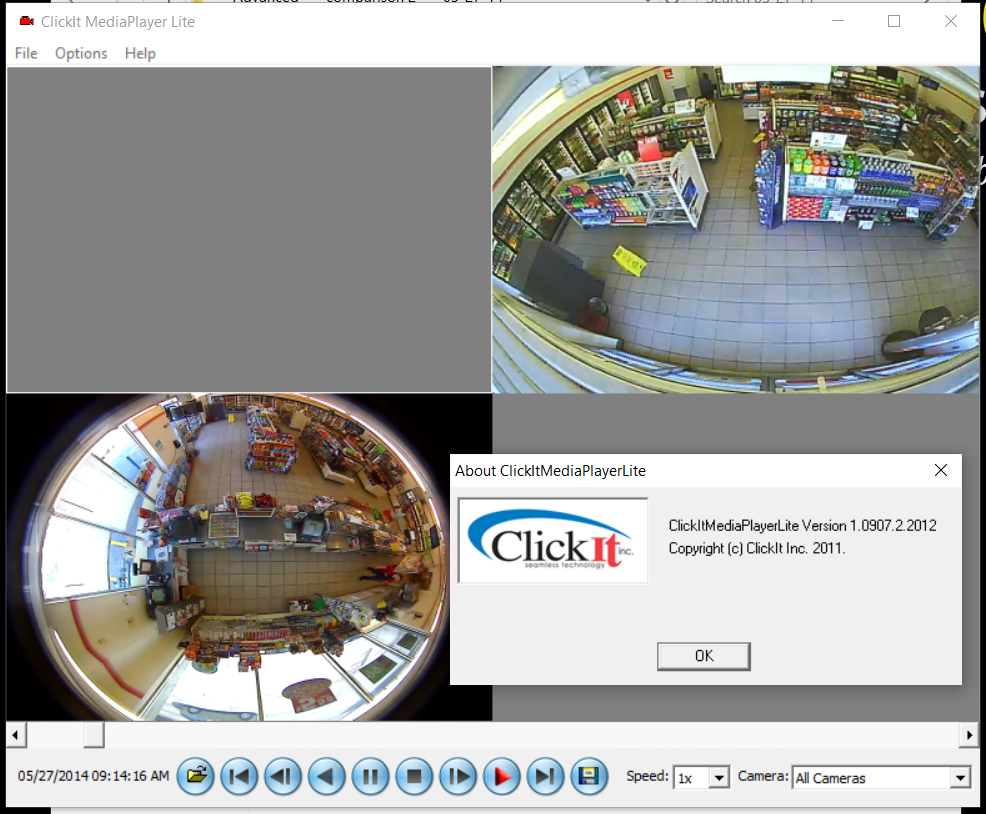
ClickIt DVR interface

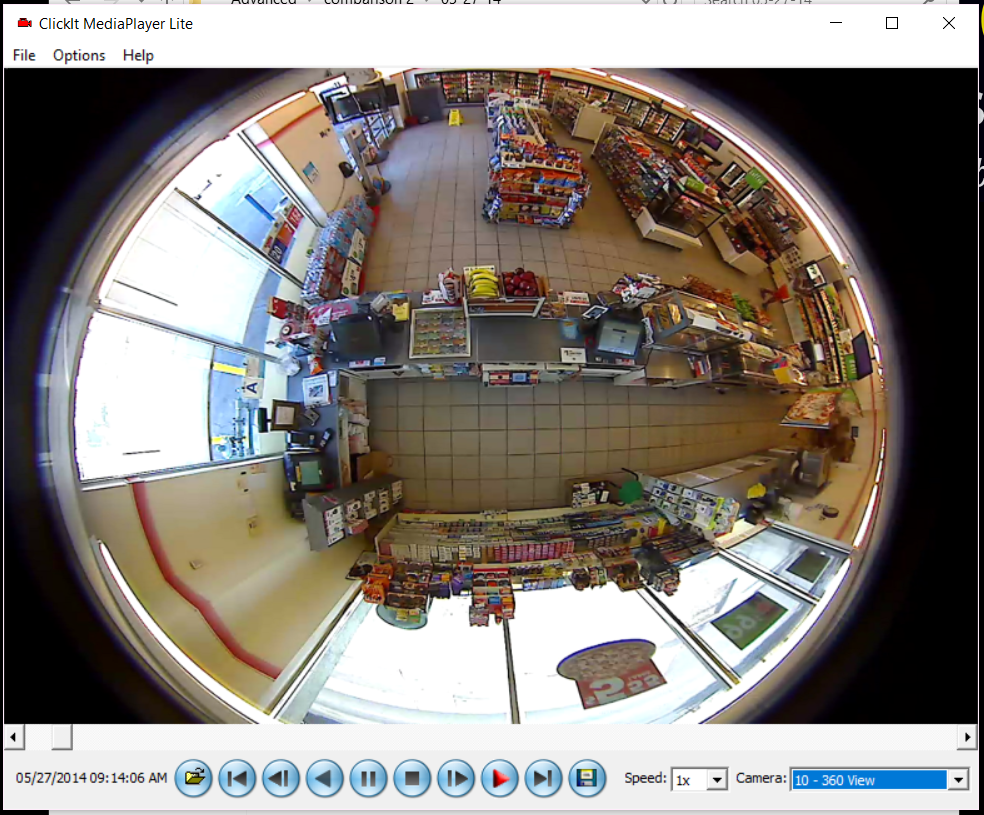
Many companies have made the decision to cover the interior of their establishments with as few cameras as possible. They do this with 360 degree camera, big fisheye lenses, or a combination of the two. They get to check the box of having CCTV. You get to try and fix this mess back in the lab.

ClickIt DVR 360 degree view camera

In this case, the ClickIt DVR allows the user to segregate camera views and output individual views as separate files. But, you're still left with that hideous 360 degree camera view.

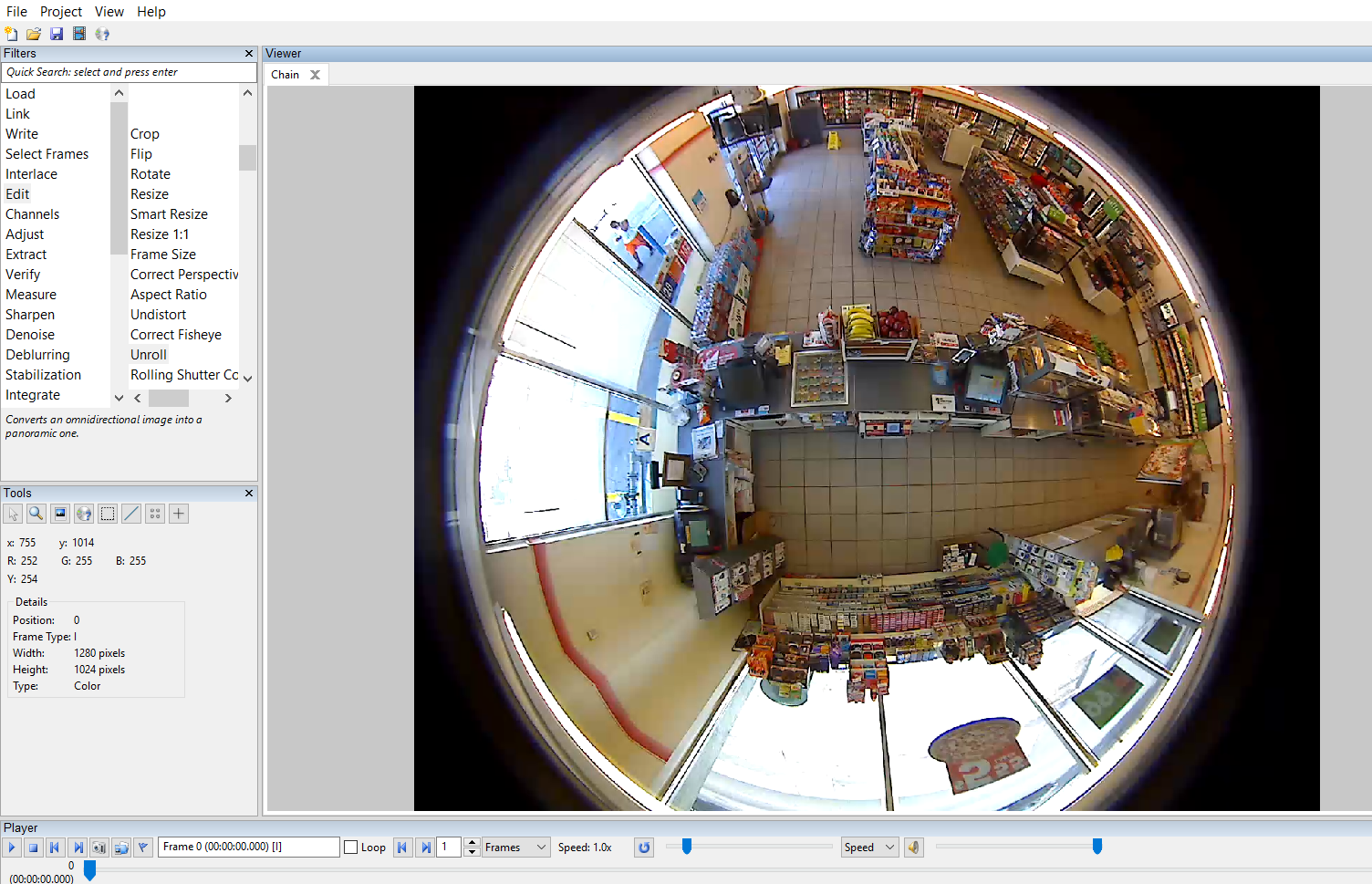
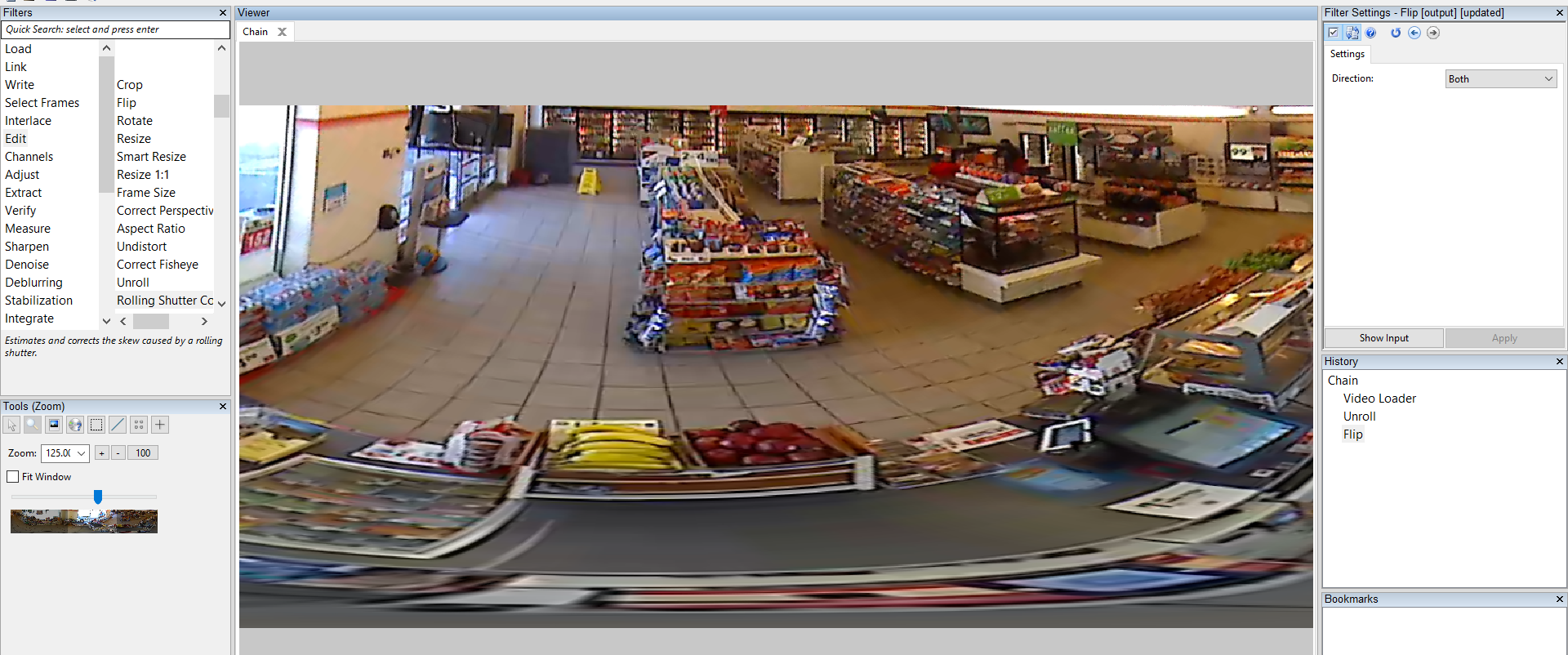
Not to worry, we've got you covered with Amped FIVE. There's a little gem of a filter that's been in the Edit filter group for a while now. It's called Unroll.


Unroll is one of the many "easy buttons" that are found in Amped Five. Let's take a look at what happens when you activate this powerful filter.


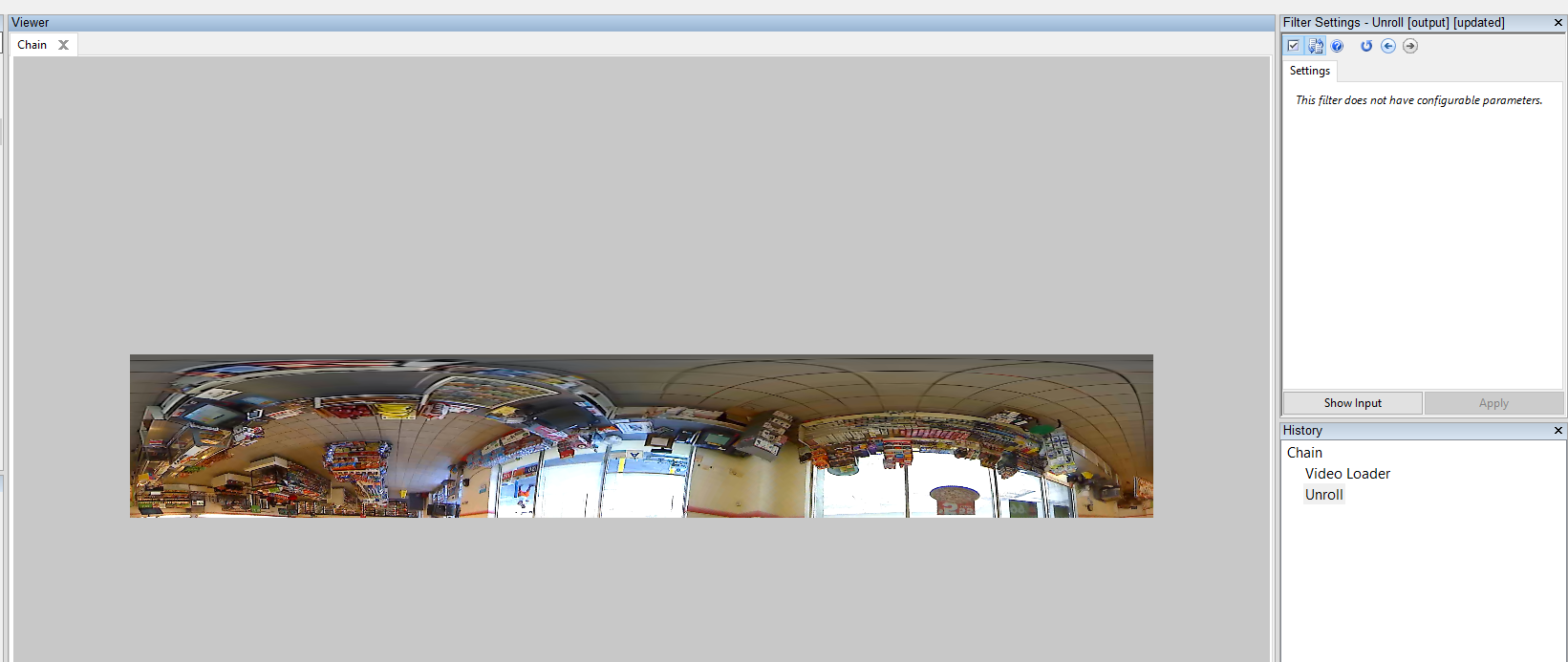
Upon activation of the Unroll filter, the file is unrolled into a panorama. It might be upside down / backwards. Don't worry, that's an easy fix as well. Check out the Flip filter, also in the Edit filter group. In this case, I flipped the file both horizontal and vertical (using the signage in the scene to judge the correct orientation).


In all, from conversion of format to a correctly oriented view, this fix took less than 2 minutes. That is the power of FIVE.

If you'd like more information about tools or training offerings, contact me today.

Tuesday, May 23, 2017

A report formatting tip for FIVE

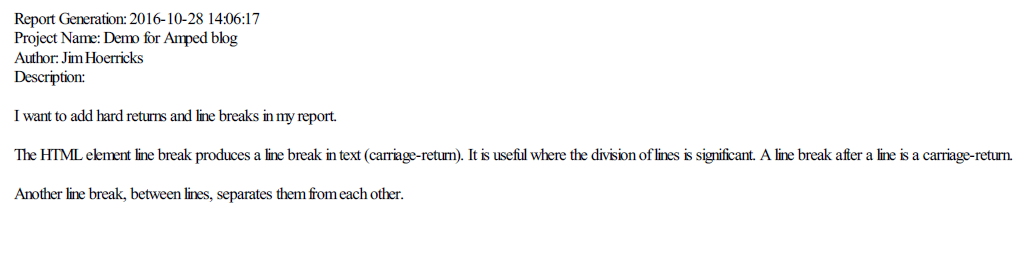
One of our customers called in to ask about the formatting of the reports that are generated in FIVE. Specially, she wanted to know why FIVE mashed all the sentences together and didn't allow her to format the Description field into paragraphs. I explained that it does. It's done in the Project Properties dialog box. Here's how:

report-formatting

Notice the line break in the text. That's how it's done. If you want a carriage return / line break, add the break at the end of your line. If you want a space in between lines, add one more as shown in the graphic above.

Then your report will look like this:

report-formatting-2

I would usually just add the question to be answered by the file and any scale or other necessary notes.

Hopefully, this tip helps you better organize your report's Description field.

Monday, May 22, 2017

Resourcefulness

Say what you want about him, Tony Robbins knows how to motivate people. Here's one of my favorite Robbins quotes: "Everything you people have told me; I didn't have the technology, I didn't have the right contacts, I didn't have the time, I didn't have the money. Those are resources. And so you're telling me, 'I failed because you didn't have the resources.' And I'm telling you what you already know. Resources are never the problem. It's a lack of resourcefulness. This is why you failed. Creativity, decisiveness, honesty, passion, love, these are human resources. When you engage these resources, you can get any other resources on earth. Resourcefulness is the ultimate human resource. If you don't have what you want, stop telling yourself a story; you don't have the money, you don't have time ... that's BS. It's because you haven't committed yourself where you would burn your boats. If you want to take the island, burn your boats. You will take the island. Because people, when it's either die or succeed, will tend to succeed."

Think about that for a moment.

As conversations in the media revolve around body worn cameras, and police agencies try to budget for not only the cameras but also the storage, private citizens and businesses are generating digital multimedia evidence (digital CCTV systems, mobile devices, on-line sources, and etc.) at a rate of almost 10:1 vs. BWC files. Yes, for every file generated by a body worn camera, roughly 10 digital CCTV files are being generated, retrieved, processed, and stored.

Agencies are investing lots of money around BWC. What about the retrieval, processing, analysis, and storage of digital multimedia evidence? If it accounts for 10x the amount of evidence files, shouldn't it at least get the same funding level as BWC? Sadly, it doesn't.

In my years in LE, I was able to find some very creative ways to kit out my lab. There's money (resources) in a lot of places. You not only have to know where to look, you have to know how to convince the people controlling those funds of the need to share it with you.

Monday, May 15, 2017

In praise of virtual machines and controlled installations of codecs and players

It's been quite a while since I've posted in the this space. I've been over on LinkedIn and the Amped Software blog. I just wanted to take a moment to mention what I've been up to lately.


Last month in the Advanced Processing Techniques class, controlled installation of codecs and players in a virtualized environment was one of the topics of discussion. You really get to see what havoc is wrought against your OS installation by controlling the installation and tracking the changes.

I rather prefer not to have to install players and codecs. That's the beauty of proxy files and Amped DVRConv / Amped FIVE. But when I have to install them, having the ability to work in virtual space is huge. Our licensing model means that the USB dongle can easily be accessed from within the space - making it easy to work with any of the Amped Software tools in virtualized environments.

Next month, I'll be presenting our tools at the Axon Accelerate Conference. You can click on the link to register. It's going to be a great event. Then, it's back to the office for more training sessions.

Enjoy.

Friday, November 18, 2016

Those who know don't tell and those who tell don't know.

The old Zen proverb, "Those who know don't tell and those who tell don't know," comes to mind when reviewing the many marketing websites for those trying to find work as video/image analysts for the many court districts around the US.

In most states, the evidence code defines the process whereby a person's testimony may be admitted and how that testimony will be treated. In California, for example, the EC notes,


  • "720. (a) A person is qualified to testify as an expert if he has special knowledge, skill, experience, training, or education sufficient to qualify him as an expert on the subject to which his testimony relates. Against the objection of a party, such special knowledge, skill, experience, training, or education must be shown before the witness may testify as an expert."
  • "721. (a) Subject to subdivision (b), a witness testifying as an expert may be cross-examined to the same extent as any other witness and, in addition, may be fully cross-examined as to (1) his or her qualifications, (2) the subject to which his or her expert testimony relates, and (3) the matter upon which his or her opinion is based and the reasons for his or her opinion."


There are many folks out there advertising themselves as "experts." For these folks, they've given themselves the title of "expert" for the purpose of marketing and helping their brand rise above the others in their field.

To be sure, only the Judge in a trial grants a person expert status. This status, as it relates to the testimony given, goes away once the person is finished with that trial. A person may give expert testimony in one trial, but not in another. If a person refers to themselves as an "expert," red flags should immediately go up.

Thus begins the process I call, Find the Charlatan. A charlatan is a person falsely claiming to have a special knowledge or skill; a fraud.

The common objections, at least in California, center around a witness' qualifications. "The trial court is not required to formally certify or qualify a witness as an expert. Evid. Code §§402, 801. Thus, it is unnecessary to “proffer” or “tender” the witness as an expert. Most judges, if asked to certify or qualify, will state merely that the witness is acceptable or may testify. This avoids giving the witness an imprimatur of undue credibility." (source) If, in checking on the witness' credentials, you find that a witness has improperly listed their testimony, that's another red flag. Remember, only the Judge may declare the witness an expert, and thus the testimony given as "expert testimony."

So how do these folks continue to get away with this false/misleading claim? No one checks or calls them on their activities.

  • Ask for a CV. Make sure that their record of testimony properly segregates testimony into general / expert. If it doesn't ask specifics as to the testimony given and any objections. 
  • Get transcripts / reports from prior testimony. Does the opinion offered in your case track with what they've said in the past? Does their listed training and experience track with previously submitted information? If not, why not? Sometimes, folks will try to say that their Fine Arts degree has an "emphasis" in some scientific discipline. This is very rarely the case, and they're likely embellishing their credentials.
  • Make sure that their training is actually training, not sitting in on a lecture. If they've offered training, make sure that they've trained people - not just presented topics as part of a lecture. Training peers or new employees is quite different from presenting information to a group of people who don't actually work in the discipline - a Bar association or a leadership conference for executives. If there was no syllabus or test involved, then it was likely an information session.
  • If they rely upon their college degree for the authority behind their opinion - get their transcripts and check their claims. If they refuse to let you have their transcripts, then they're likely hiding something. 

To put all of this into perspective, I've spent the week at LEVA's 2016 Training Conference. Some of the sessions are "training," some are "presentations." I presented information around redacting video footage from body worn cameras and in-car video, the technological and policy implications. Folks in my class weren't "trained" to redact footage. That's done at my Basic course in Henderson, or on a customer's site. Likewise for my presentation on image authentication. It's information, not training. If folks want training in image authentication, they can take the training course on that topic.

If you have a doubt about the person you wish to hire, there's likely a good reason. Google their name. Find out about them. Find out what others are saying about them. Ask questions of their peer groups. Find out if they've been discredited or had their testimony excluded in the past. Ask. Ask. Ask.

Enjoy.

Monday, November 7, 2016

Is Photoshop a verb?

I'm momentarily out of my self-imposed exile to post this brief note on my old friend, Photoshop.

When processing images and video for the court, many agencies will try to do more with less. They will make the mistake of thinking that standard commercial photo editors will be fine. The software is often very inexpensive or even free. But, would you trust your case to just any piece of software?

In courtrooms and the media, there’s a common term for modifying images and video in a nefarious or bad way: it’s called “Photoshopping.” Fashion models are Photoshopped. Advertisements contain fantastic Photoshopped compositions. So the question is: now that Photoshop is a verb and not a forensic tool, do you want your evidentiary images and video to be Photoshopped?


Is it legal?

There are two major legal “standards” to deal with in the US: Frye and Daubert. There are some variations to these, like California’s modified Frye (Kelly-Frye). Then there are the various evidence codes. Each state has its own evidence code. The US Federal Government has theirs as well.

The Frye Standard
Where novel scientific evidence is at issue, the Frye inquiry allows the judiciary to defer to scientific expertise precisely as to whether or not it has gained “general acceptance” in the relevant field. The trial court’s gatekeeper role in this respect is conservative, thus helping to keep “pseudoscience” out of the courtroom.
In Frye states, Amped Software products meet the “general acceptance” threshold. Amped Software technology is used by all major law enforcement agencies in the US (local, state, and federal), most of Canada’s LE agencies, and around the world, in more the 60 countries as of today.

The Daubert Standard

In Frye states, it’s usually enough for a practitioner to inform the court that the tool in question has “general acceptance.” In Daubert states, and with the US government in Federal Courts, the Daubert standard goes from “tell me” (Frye) to “show me” (Daubert). If there’s a question about a particular tool or technique, either side can request a “Daubert Hearing.” Within the hearing, the tool/technique is demonstrated and questions as to process, science, etc. are asked/answered. If the judge is satisfied that the tool/technique passes the test, then the evidence is admitted.

Daubert places a heavy emphasis on science and the scientific method.
Has the scientific theory or technique been empirically tested? According to K. Popper (1989) in The Growth of Scientific Knowledge, “the criterion on the scientific status of a theory is its falsifiability, refutability, and testability”.

In the case of Amped Software products, the answer is yes. The source of the algorithms is scientific / academic texts and papers. They’re all from peer-reviewed and publicly available sources. The scientific status of the theory / technique is covered in each referenced source. In the case of Amped FIVE, the source of the algorithm, publication date, etc., for all filters used are all included in the report generated by the user.
All trial courts make a preliminary determination of admissibility. This job involves a preliminary assessment of whether the evidence is relevant, competent, and material. In short, can the evidence be properly applied to the facts in this case? This is the traditional “gatekeeping” function of courts.
This has more to do with the competence of the user than the tool itself. Has the practitioner properly used his/her tool? Is the practitioner qualified / trained in the use of the tool? Amped Software has trained hundreds of practitioners all over the world. Thus, this part of the gatekeeping is satisfied with the training.
Has the scientific theory or technique been subjected to peer review and publication? This ensures that flaws in the methodology would have been detected and that the technique is finding its way into use via the literature.
Again, all of the algorithms in Amped Software products come from peer-reviewed publications.
Can the technique and its results be explained with sufficient clarity and simplicity so that the court and the jury can understand its plain meaning? This is just the Marx standard, which is assumed to be incorporated in Daubert as it was with Frye.
This is the real beauty of the reports generated by Amped Software products. Amped FIVE’s report, for example, gives the user the plain English explanation, the more detailed scientific/academic explanation, as well as the filter settings, and the reference source for each filter that is applied within the workflow. No other product on the market does this.

Federal Rules of Evidence (Rule 702)
General acceptance is not a necessary precondition to the admissibility of scientific evidence under the Federal Rules of Evidence (FRE), but the FRE – especially rule 702 – do assign the trial judge the task of ensuring that an expert’s testimony both rests on a reliable foundation and is relevant to the task at hand. Pertinent evidence based on scientifically valid principles will satisfy those demands..”

“If scientific, technical, or other specialized knowledge will assist the trier of fact to understand the evidence or to determine a fact in issue, a witness qualified as an expert by knowledge, skill, experience, training, or education, may testify thereto in the form of an opinion or otherwise, if (1) the testimony is based upon sufficient facts or data, (2) the testimony is the product of reliable principles and methods, and (3) the witness has applied the principles and methods reliably to the facts of the case.”
Not to beat the point to death, but Amped Software products more than meet this standard.

The thing that our customers love so much, is that the work that they do can be presented with such a rock-solid report, that gives them the confidence to present what they’ve done to the judge/jury. They don’t have to be a rocket scientist (though a few of our customers actually are). They just have to follow their training and confidently read from the report.

Q: I see that you’ve applied a Levels filter in step 4. Does that filter’s algorithm come from a peer-reviewed and published source.

A: Yes, indeed. It’s from Dr. Anil Jain’s 1989 textbook, Fundamentals of Digital Image Processing. You can find the algorithm’s discussion and description on page ...

It’s important to know that over 50% of the filters in Photoshop come from proprietary algorithms (internal, patented, secret). That number continues to grow as Adobe supports its main customers--professional photographers.

For those using freeware tools, where’s the references and support? It’s non-existent.

So here’s something to consider when working in law enforcement forensics where a mistake could either convict the innocent or free the guilty: don’t you want a rock-solid toolset that any court in the land would accept? Of course, you would.


For more information, or to request a quote, click here.

Note: the italicized text comes from Mark Stevens, LtCol USMC (Ret), Assistant Professor of Criminology, California State University Fresno, and his course on using multimedia evidence in trial.

Photoshop Copyright © 2016 Adobe Systems Incorporated

Sunday, November 1, 2015

Locard's Exchange Principle

Edmond Locard (1877–1966) studied law at the Institute of Legal Medicine in Lyon, France, and worked subsequently as an assistant to the forensic pioneer Alexandre Lacassagne prior to directing the forensic laboratory in Lyon, France. Locard's techniques proved useful to the French Secret Service during World War I (1914–1918), when Locard was able to determine where soldiers and prisoners had died by examining the stains on their uniforms.

Like Hans Gross and Alphonse Bertillon before him, Locard advocated the application of scientific methods and logic to criminal investigation and identification. Locard's work formed the basis for what is widely regarded as a cornerstone of the forensic sciences, Locard's Exchange Principle, which states that with contact between two items, there will be an exchange. It was Locard's assertion that when any person comes into contact with an object or another person, a cross-transfer of physical evidence occurs. By recognizing, documenting, and examining the nature and extent of this evidentiary exchange, Locard observed that criminals could be associated with particular locations, items of evidence, and victims. The detection of the exchanged materials is interpreted to mean that the two objects were in contact. This is the cause and effect principle reversed; the effect is observed and the cause is concluded.

Crime reconstruction involves examining the available physical evidence, those materials left at or removed from the scene, victim, or offender, for example hairs, fibers, and soil, as well as fingerprints, footprints, genetic markers (DNA), handwriting, video, audio, and images... These forensically established contacts are then considered in light of available and reliable witness, the victim, and a suspect's statements. From this, theories regarding the circumstances of the crime can be generated and falsified by logically applying the information of the established facts of the case.

Locard's publications make no mention of an "exchange principle," although he did make the observation "Il est impossible au malfaiteur d'agir avec l'intensité que suppose l'action criminelle sans laisser des traces de son passage." (It is impossible for a criminal to act, especially considering the intensity of a crime, without leaving traces of this presence.). The term "principle of exchange" first appears in Police and Crime-Detection, in 1940, and was adapted from Locard's observations.

Saturday, August 15, 2015

End of an era

It's with a touch of sadness and regret that I must end my run as your humble blogger. I will leave this site up for as long as Google allows, to serve as a reference. But no new posts will appear.

All the best and thanks.

Jim

Thursday, August 13, 2015

Error U44M1l210 - Adobe Creative Cloud Apps

I can't update the Adobe Creative Cloud apps on my MacBook Air. I keep getting the same error. I've been to the forums. Here's one thread full of frustrated customers. Here's another with a stupid solution.

Adobe's support has gone down the tubes over the years. SO GLAD I don't need the update right now. SO GLAD I use Amped FIVE for all of my forensic work now.

Monday, July 27, 2015

Prof. Alexander "Sandy" Allan

In the years since my book was published, people have asked about the dedication page. Who is "Sandy?" Professor Alexander "Sandy" Allan was my great uncle, my inspiration, and the guide to my academic and professional life. He passed away on July 10th.


Sandy Allan
October 21, 1926 - July 10, 2015

Sandy passed away at home, aged 88. Sandy was predeceased by his beloved wife, Marguerite (Gunton). He was a much-loved father to Cynthia Norrie (Alastair) and to Paul (Maggie) and a devoted grandfather to Elizabeth, Kate and Michael Allan. He was also the last survivor of all his siblings, Jean ("Bet"), Jim and Jack. Sandy was a passionate engineer. His career began with the Defence Research Board of Canada in 1950. In 1958 he became a Professor of Mechanical Engineering at the University of Toronto and for the next 29 years he inspired many students with his hands-on, practical approach to education. In 1970 Sandy was retained as a consultant in a high profile motor vehicle accident lawsuit that ultimately lead to a successful second career as a consulting engineer. He later founded Alexander Allan Engineering Services where he became an acknowledged expert in the reconstruction of motor-vehicular accidents. Sandy was born and raised in the east end of Toronto where he attended Danforth Collegiate and Technical Institute. He earned both an undergraduate degree (1949) and a Masters Degree (1953) in Applied Science at the University of Toronto. Always generous with his time and many talents, Sandy frequently found himself called upon by both family and friends to build something or to fix something which he always did with focus and determination. Sandy had a particular talent for photography and carpentry. Evidence of his wood-working skill can be found in the homes of family and friends throughout Ontario. While he enjoyed a long retirement, Sandy suffered a stroke in 2004 and had been confined to a wheelchair for nearly 12 years; however, he continued to pursue an active life of the mind and pursued interests in science, technology and business.

My first recollection of "Uncle Sandy" was when I was five years old. He was in town to visit us and my grandmother, his older sister. It was 1976 and Toronto had just acquired an MLB franchise. He came with a bunch of Blue Jays swag; hats, jerseys, pennants, etc. Living in SoCal, we became instant Blue Jays fans. I still am.

He told stories about his travels and his work. He was, at the time, about how old I am now. I remembered thinking, people pay him to do the things he loves to do, pay him to travel around and have a great time doing it. Wow. This is what I want to do. And so, through a long and circuitous path, I set about to do it.

Words can not adequately express the feelings that result from the loss of one such as my Uncle Sandy, and I've been at a loss for words as of late.

Soft and safe to thee, be thy resting-place!
Bright and glorious be thy rising from it!

Thursday, July 2, 2015

Spready joins Amped Software

Amped Software just announced that David Spreadborough, aka Spready, has joined their team.

Awesome news. Congrats to Spready and to Amped Software.

Thursday, June 25, 2015

Discovery issues with certain kinds of images

An intersting question came in regarding a problem often encountered by LE folks processing / redacting CP images for court. Obviously, you don't want to process them one at a time when there are hundreds of images to redact. The question was tossed around and here's a simple way to do it in FIVE courtesy of our friends at Amped Software.

  • Open a sequence of images (Load>Sequence Loader)
  • Redact by blackening the whole image (Presentation>Hide Selection), then choose blacken at 100%, then change the shape from round to square, then on the “selection” tab, click and then choose “whole image” from the dropdown.
  • Export the redacted images as another sequence (Write>Sequence Writer). Change the file name / location to be what you need it to be.
  • Generate your report (Project>Generate Report.
I know not many folks work with CP. I hope this helps.

Wednesday, June 24, 2015

Quality issues with body worn cameras

Amped Software's latest blog post features an article on the various quality issues associated with body worn camera recordings, and how their software can be used to fix them all.

Check it out here.

Thursday, June 11, 2015

Rolling Shutter Effect


"Rolling shutter is a method of image capture in which a still picture (in a still camera) or each frame of a video (in a video camera) is captured not by taking a snapshot of the entire scene at single instant in time but rather by scanning across the scene rapidly, either vertically or horizontally. In other words, not all parts of the image of the scene are recorded at exactly the same instant. (Though, during playback, the entire image of the scene is displayed at once, as if it represents a single instant in time.) This produces predictable distortions of fast-moving objects or rapid flashes of light. This is in contrast with "global shutter" in which the entire frame is captured at the same instant.

The "Rolling Shutter" can be either mechanical or electronic. The advantage of this method is that the image sensor can continue to gather photons during the acquisition process, thus effectively increasing sensitivity. It is found on many digital still and video cameras using CMOS sensors. The effect is most noticeable when imaging extreme conditions of motion or the fast flashing of light. While some CMOS sensors use a global shutter, the majority found in the consumer market utilize a rolling shutter.

CCDs (charge-coupled devices) are alternatives to CMOS sensors, which are generally more sensitive and more expensive. CCD-based cameras often use global shutters, which take a snapshot representing a single instant in time and therefore do not suffer from the motion artifacts caused by rolling shutters."


Thursday, June 4, 2015

Tuesday, June 2, 2015

File systems, thumb drives, and DVRs

I get a lot of help requests from LE employees trying to retrieve DME at crime scenes. Some of them work like this:

Officer: "I'm standing in front of the DVR. I'm trying to back-up the data but the DVR won't see my thumb drive. What am I doing wrong?"
Me: "What file system are you using on your thumb drive?"
Officer: "What do you mean?"

Officer: "I'm standing in front of the DVR. I'm trying to back-up the data and the DVR is asking if I want to format by USB stick. Should I click OK?"
Me: "Is the drive empty?
Officer: "I've got a bunch of case files on it."
Me: "Click cancel and get another drive."


I keep a bag of thumb drives of various sizes and formats. Some older systems won't accept a thumb drive with a capacity larger than 2gb formatted as FAT. Others won't accept anything larger than 4gb. However, 4gb is a nice size to carry as you'll want to move the files to WORM discs when you create the master evidentiary copy. Most people have DVD readers, so this bit of pre-file management will help you keep organized.

So, don't throw away those old jump drives. You may need them some day.

Friday, May 22, 2015

SWGDE Response to the Termination of SWGIT

Posted on behalf of James Darnell, SWGDE Chair:

The recent announcement that the Scientific Working Group on Imaging Technology (SWGIT) made the executive decision to cease operations was disappointing news to the members of the Scientific Working Group on Digital Evidence (SWGDE). In this exciting but challenging time of standardization efforts and quality assurance development, our sister SWG was a solid example of how people can contribute to an industry effort in addition to their normal work responsibilities. The SWGIT membership leaves an impressive legacy of numerous guidelines and best practices in the Forensic Video, Image Analysis, and Forensic Photography disciplines.

SWGDE was proud to work closely with SWGIT for many years. Together we produced several joint documents including the SWGDE/SWGIT Guidelines and Recommendations for Training, SWGDE/SWGIT Proficiency Test Program Guidelines, SWGDE/SWGIT Recommended Guidelines for Developing SOPs, and the SWGDE/SWGIT Digital & Multimedia Evidence Glossary. SWGDE is pleased to have had the opportunity to support SWGIT when we could, especially with joint meetings. SWGDE helped build and financially support the SWGIT website since its inception and will continue to do so.

In keeping with that tradition of cooperation and support, SWGDE will help continue the achievements of SWGIT's membership by inviting them to participate in three new standing committees created to address video, photography, and image forensics. We also invited them to bring any unfinished work items, topics and agenda items that need addressing, but it will ultimately be up to the new committee members to decide their agenda and priorities.

SWGDE's mission is to bring together organizations actively engaged in the field of digital and multimedia evidence in order to foster communication and cooperation as well as to ensure quality and consistency within the forensic community. So while it is difficult to see such a valuable member of our community dissolve, we hope that through our new committees, SWGDE will address the discipline specific needs formerly provided by SWGIT.

David Hallimore
SWGDE Outreach Committee Chair
https://www.swgde.org/

Security - Safety Korea 2015


South Korea's big security convention is next week. Security - Safety Korea 2015 is sure to feature the latest and greatest of Korean CCTV tech. This means that you can expect the usual flood of new Korean DVRs at retail outlets. It also means new codecs, new players, and (hopefully) some DVRs that will feature faster I/O options. Nothing's worse than an HD recorder with USB 1 output.

Monday, May 18, 2015

TASER to Acquire MediaSolv Corporation to Broaden Digital Evidence Management Solutions For Law Enforcement

Taser recently made an incredibly smart move, they acquired MediaSolv. This solves a serious issue for them and gives their customers an option of either cloud storage (Evidence.com) or local evidence management (MediaSolv Commander).

Here's the announcement.

Monday, May 11, 2015

Leaving unpowered SSDs in a warm room can kill your data fast

Many of us are in the business of collecting data from crime scenes. Some actually collect hard drives. This article from PCWorld highlights a new risk associated with unpowered SSD drives.

"A new research presentation shows that solid state drives can lose data over time if they aren’t powered on, especially in warmer environments. A powered-off drive in 104 degrees Fahrenheit may start seeing data loss after a couple of weeks.

The information comes from Seagate’s Alvin Cox, who as part of a presentation to the Joint Electron Device Engineering Council (JEDEC). Though the presentation is a couple months old, it was recently picked up by ZDNet, Slashdot and other sites.

Cox’s presentation shows basic performance requirements for both consumer and enterprise SSDs. It notes that consumer SSDs, when powered-off in 86 degrees Fahrenheit (30 degrees Celcius), should retain data for about a year. Bumping up the temperature by 9 degrees Fahrenheit (5 degrees Celcius) reduces the time of data retention by half. Store your SSD in 131 degree heat, and it might start losing data after a couple of days ..."

Click here for the whole story.

Thursday, May 7, 2015

Termination of SWGIT

This just in from SWGIT:

The Scientific Working Group on Imaging Technology (SWGIT) would like to thank the forensic community for the continued support, involvement, and participation in making this group and the documents we have provided over the last 18 years so very successful. The mission of the SWGIT has been to facilitate the integration of imaging technologies and systems within the criminal justice system (CJS) by providing best practices and guidelines for the capture, storage, processing, analysis, transmission, output, and archival of digital evidence. This mission has served our community well since the inception of the group in 1997. The SWGIT documents have been essential to developing laboratory and law enforcement best practices and guidelines across the United States as well as internationally. The documents have been used to demonstrate reliable scientific principles and methods in court and Daubert hearings.

The current economic climate has impacted the continued work of SWGIT. Due to a lack of funding revenue, SWGIT has made the decision to terminate operations. SWGIT’s website and social media will remain available as a continued valuable resource for all questions involving Forensic Video, Image Analysis, and Forensic Photography.
SWGIT documents will remain in effect and available on the SWGIT website, www.swgit.org. SWGIT has addressed concerns important to all members of the community including first responders, laboratory examiners, and managers of criminal justice organizations. Our website contains more than 20 recommendations and guidelines detailing procedures for digital photography, video and image processing, CCTV installations, documentation of image enhancement, and several other topics important in the current forensic environment. SWGIT was instrumental in the publication of two of our documents as ASTM standards, “Standard Guide for Image Processing” and “Standard Terminology for Digital and Multimedia Evidence Examination.”

As the forensic community moves forward, a goal of SWGIT is to continue to engage the entire law enforcement imaging community in the development of guidelines, best practices, and standards. In remaining true to that goal, SWGIT strongly encourages the members of our forensic disciplines to continue to support other professional groups that strive to provide such information.

SWGIT will continue to have an active web presence at www.swgit.org and on social media. Please see the social media links provided on our website.

Thank you again for making SWGIT such a long-standing success.

Melody Buba
Chair
Federal Bureau of Investigation

Cory Winar
Vice Chair
Eugene Police Department

Friday, May 1, 2015

How Are States Going to Pay for Those Police Body Cameras?

This just in from Governing.com: "The Police Executive Research Forum survey found most agencies spent between $800 and $1,200 per camera to purchase them, a daunting price tag for departments already strapped for cash.

But it is the ongoing costs that are the real challenge. The New Orleans Police Department plans to purchase 350 body cameras, but is budgeting $1.2 million over five years, mostly for data storage. Other departments, the police forum found, expect to spend $2 million for a few years of data storage.

In Iowa, the Des Moines Police Department is looking for $300,000 just to start a body camera program. Duluth, Minnesota’s initial $5,000 purchase of 84 cameras ballooned to about $78,000 for licensing and data storage. Last year, Duluth’s police budget was $19.1 million, while Des Moines spent more than $59 million on its police force.

Many states are debating the issues that surround police cameras without tackling the funding question, said Richard Williams, a criminal justice policy specialist with the NCSL. In many instances, he said, lawmakers are focused how long departments should have to keep video, and if or when recordings should be made public.

Miller, with the Police Executive Research Forum, said those issues are important, but that for police departments, cost is the overriding concern.

Officers could potentially record millions of videos a year, any number of which could be used as part of a criminal proceeding, a public records request or for another official purpose. The cost of downloading, logging, handling and storing all that video can be staggering.

“Most of the agencies that we worked with say the biggest issue is the backend data storage,” she said. “It can cost hundreds of thousands of dollars to store video each year.”

Costs were a stumbling block in Utah this year, where state lawmakers debated but didn’t pass body camera legislation. Meanwhile, some departments around the state are using the technology — and trying to meet the costs associated with it.

In Clearfield, Utah, a city of about 30,000 located 30 miles north of Salt Lake City, the police department has been using body cameras since 2010. But recently, data storage problems came to a head, and for a few weeks, the department was forced to use DVDs to store video because it ran out of computer server space.

“The more you use them, the more storage it takes, and the costs increase,” said Mike Stenquist, an assistant chief. “The public wants more, it also costs more. It creates a lot of problems.”

It’s not likely to get any better either, Stenquist said. Years ago, the department used older model cameras that needed to be recharged frequently and could only record two hours of video at a time, meaning officers had to return to the office frequently to download any recordings.

New models last longer and have greater storage capacity, he said. But now there’s another problem: The newer cameras record high-definition video, which means the video files are much larger, a reality that contributed to the department’s recent data crunch.

“The data just builds up,” Stenquist said. “Now that we have better cameras that record through a whole shift, it’s taking three or four times the data storage.”

Between cost concerns and public access questions, Stenquist said, it’s probably inevitable that state lawmakers will have to step in.

“It’s just become pretty muddy about what’s going to happen in the future,” he said. “There’s a lot of work to be done.”

Click here to read the whole story.

Tuesday, April 28, 2015

New NVIDIA drivers will no longer support older CUDA GPUs

This just in from Adobe: "Just to alert you, NVIDIA is starting to discontinue CUDA support for some older GPUs in their new driver releases. If you are still using one of these older cards, and need GPU support for Adobe applications, do not update your drivers while you look into a purchasing a new card.

If you need to reinstall NVIDIA drivers, see this web page."

Wednesday, April 22, 2015

a little humor

A photon checks into a hotel and the bellhop asks him if he has any luggage.

The photon replies, “No, I’m traveling light.”

Monday, April 20, 2015

Police Cameras Bring Problems of Their Own

This just in from the Wall Street Journal: "As more police agencies equip officers with body cameras in response to public pressure, authorities are discovering they create problems of their own: how to analyze, process and store the mountains of video each camera generates.

Prosecutors in northern Colorado recently spent hours poring over a dozen videos captured by police wearing cameras. The case? An arrest for drunk and disorderly conduct.

Clifford Riedel, Larimer County’s district attorney, said his office has been overwhelmed with footage from the 60 body cameras the Fort Collins Police Department uses, and will need to hire an additional technician to sort through it all. “There are just huge amounts of data being generated from cameras,” said Mr. Riedel. “It used to be that video on a case was the exception. Now it’s the rule.”

The movement gained new intensity after the police shooting last week of a fleeing man in South Carolina. While many experts inside and outside of law enforcement agree that body cameras—clipped to officers’ uniforms or glasses—help increase police transparency and may even improve police behavior, police departments and prosecutors are struggling with how to sift through, preserve and share the visual evidence.

On top of that, agencies need policies and personnel to respond to requests from journalists and the public to release video under freedom-of-information requests.

“The vast majority of places are still trying to figure this out,” said Michael White, a professor of criminology at Arizona State University who wrote a Justice Department report on body cameras.

Dr. White estimates that between 4,000 and 6,000 U.S. police departments, out of about 18,000 nationally, use body cameras. Officers generally turn them on when stopping a driver or responding to an incident.

Some departments use body cameras in addition to dashboard ones that have become common at many agencies, but result in less-useful footage because much police action takes place away from their vehicles. Body cameras—which cost hundreds of dollars each—typically result in much more video for departments to handle.

The push to require body cameras intensified nationally after last August’s shooting of Michael Brown, a black 18-year-old, by a white police officer in Ferguson, Mo. This week, after a bystander’s cellphone video surfaced showing a white South Carolina policeman fatally shooting an unarmed black man in his back, several prominent state lawmakers voice support for a bill to require all officers to wear cameras.

But the cost has given some officials pause, said Lindsay Miller, senior research associate at the Police Executive Research Forum and co-author of a Justice Department report on the topic. “The cameras themselves aren’t overly expensive, but the years and years of data storage you’re going to deal with—that can definitely be cost-prohibitive,” said Ms. Miller.

Many departments keep inconsequential video for 30 to 60 days. But if the footage is evidence in a criminal case, it must be kept longer; most states require that video in a homicide case be kept indefinitely, she said. Ms. Miller said an emerging consensus is that the benefits outweigh the costs. In limited studies, the cameras have shown promise in reducing use of force by police and citizen complaints—and that can save money spent investigating complaints and settling lawsuits, she said ..."

Keep reading at WSJ.com.

Tuesday, April 14, 2015

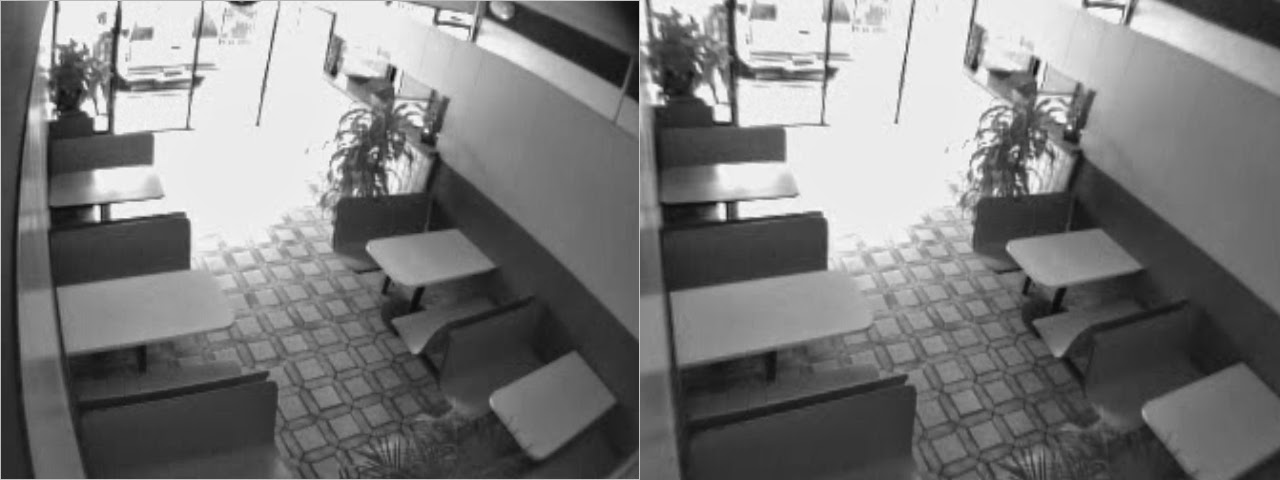
Correct Fisheye Distortion in FIVE

I've seen a lot of ADT installations using fisheye lenses lately. ADT must be having a sales promotion or something.

One of the updates to FIVE in the last year is the Correct Fisheye filter, found in the Edit filter group.

In the past, I would use the Undistort filter, but Correct Fisheye works a lot better / easier / faster on these low-end fisheye lenses I've been seeing.


In the case of the "full-frame" (180º) fisheye lenses in the ADT installations, I've found that Orthographic works the best. This isn't because ADT has been forthcoming with information about the mapping function of their chosen lenses. It's mainly been through my testing each function. You won't likely get information on the manufacturer's chosen mapping function.


As a side note, for the "circular fisheye" top-down (360º) lenses, use the Unroll filter for better results.

Back to the ADT cameras, here's the before/after image (Presentation>Compare Original). On the left is the original image and on the right is the corrected version. Correct Fisheye did a very good job in just two clicks of the mouse.


Enjoy.

Monday, April 13, 2015

It looks like the transition to Amazon.com is finished and my book, Forensic Photoshop, is now available there exclusively. Paperback and hardcover options are both available for immediate shipping.

As I've noted in the past, the book isn't based on a particular version of Photoshop. It's a workflow book ... what to do when, and why. As such, it's still relevant and informative for those still using Photoshop in their forensic work.

Thanks again for your continued support.

Friday, April 10, 2015

What's next for Adobe Audition CC?

Adobe has begun to release details about the upcoming changes to their Creative Cloud products. Click here to find out what's coming next in Adobe Audition CC.

Thursday, April 9, 2015

A bite mark matching advocacy group just conducted a study that discredits bite mark evidence

Here's an interesting article from the Washington Post about Forensic Odontology.

Check out this quote, "the problem with bite mark analysis was never the lack of a flow chart. The problem is that there has never been any real scientific research to support its two main underlying premises — that human dentition is unique, and that human skin is capable of registering and recording that uniqueness in a useful way. And the research that has been done strongly suggests those two premises are not true." Ouch!

Read the whole article here.

Wednesday, April 8, 2015

Coursera courses reviewed


Last week, I finished the Coursera course, Visual Perception and the Brain. This course was taught by Dale Purves, MD, of Duke University and is one of the growing number of on-line non-credit courses offered by leading universities and noted professors around the world.

I would recommend that DME analysts put this course on their to-do lists and watch for it to be offered again. There's a lot of good information delivered as part of the class.

That being said, if you've never taken an on-line university level course you may have some trouble with the format. You watch the video of each section's lecture. You're free to download and save it locally. You can also download and save the slides and a fairly accurate transcript of the lecture. There's an expectation that you'll dive in a little deeper and study each section's topic on your own prior to taking each section's test. The test questions aren't written directly from the lecture / slides and assume that you've done a bit of extra reading in order to gain a deeper understanding of the week's topic.

Coursera has a lot of classes available for free. In this world of shrinking budgets and doing more with less, you can't beat free classes.

Monday, April 6, 2015

Recovering image data from JPEG file fragments

This interesting paper was recently published by SPIE. SPIE is the international society of optics and photonics.

"A new technique for recovering fragmented data files can retrieve elements of a JPEG compressed image even when the file's header is unavailable."

"The most basic task of any file system is to manage and organize data in a storage volume. Each file in the store is allocated a list of blocks (the basic unit of access), and when we access a file, the system retrieves the data in sequence from the list. Correspondingly, removing the relevant entry deletes the item (note that in most systems, deleting simply means that data is overwritten over time by newly saved files, rather than actually removed). Figure 1 depicts the layout of files distributed across blocks of a storage medium, and provides a simplified view of the data structure used to track allocated blocks. When the information for a volume is corrupt or missing, it is only possible to recover files by analyzing the fragmented raw data, a process known as file carving."

"Today, file-carving tools play an important role in digital forensic investigations, where analyzing deleted files and salvaging data from damaged and faulty media are common procedures. However, when files are encoded and compressed (as with most multimedia files), recovery is dependent on the availability of the file header, which includes all the decoding parameters. If a file is partially intact with its header deleted, common carving techniques cannot recover any data. Here, we describe an algorithm1 that advances the latest developments in JPEG carving by introducing the ability to recover file fragments when the associated header is missing.

There are two main challenges associated with file carving. The first is the inability to lay out data blocks contiguously on the storage, as in the case of files b and f in Figure 1. Repeated execution of file operations, such as addition, deletion, and modification of files, over time leads to fragmentation of available free storage space. As a result, the newly generated files need to be broken into several parts to fit into the available unallocated blocks. Figure 1 illustrates this phenomenon, where files a and c are separated into two pieces. Even the new solid-state drives (which use integrated circuits, rather than disks, to store data) are susceptible to this phenomenon as they are designed to emulate the interface characteristics of hard disk drives.

The second challenge to successful file carving is that interpreting binary-formatted data requires the use of decoders, without which a block of data will reveal little or no information about the content of a file.

There has been significant recent progress in carving JPEG files, which are the most widely adopted still image compression standard today and commonly the subject of forensic investigations.2–6However, techniques for JPEG recovery still assume that a file header is always present. Without the header, the usual techniques cannot recover any data, even though the rest of the file may be intact. For example, in Figure 1, the fragments of files d, e, and g were overwritten by files c and f. Recovering an arbitrary chunk of compressed image data without the matching encoding metadata essentially requires reconstructing a new file header, which at least requires knowledge of entropy coding parameters and quantization tables, methods used during compression for downsampling the color information and image dimensions."

Click here to continue reading this paper on SPIE's web site.

Friday, April 3, 2015

LEVA Job Classification and Wage Study Results

This just in from LEVA: "The following Job Classification and Wage Study was completed in March of 2015 as part of a position audit. The survey focuses on particular job duties and functions performed by various analysts, technicians, and those who in some way handle digital multimedia evidence.

All information contained in this report was volunteered by those who responded to the survey invitation, knowing that they fit the subject matter criteria. It is being shared with the Forensic Digital Multimedia Evidence community due to numerous requests for the information.

LEVA thanks those who responded with data for Jordan Huslig of the Grand Junction, CO PD Crime Lab to conduct the research and providing the findings. Nice job Jordan!"

Click here to read the result and/or access the raw data.

Thursday, April 2, 2015

How to: Open Exe Files on A Mac

I recently had an .Exe video file that wouldn't capture using any/all available PC tools. I tried Omnivore, FIVE, and a few others. Nothing. Thank God for my trusty old MacBook Pro.

Here's an old video tutorial that's still relevant. It demonstrates using Wine / WineBottler to re-bundle the file into something that the Mac will recognize.

Wine / WineBottler worked like a charm on my video. Then, I used iShowU to do the screen capture.

Sometimes folks can't/won't mess with executable files and require the files to be "converted." Not all of them play nice with our state of the art systems. It's nice to see that the old tricks still work.

Enjoy.