When I read this story about a man who teaches people how to pass a polygraph test, I thought of my own multiple experiences with being polygraphed.
Regular readers know that I preach reliable / repeatable science. Polygraph exams are not scientific, they're art forms. They're investigative tools. I remember my last test. Here I am, all 6'7" and 345 lbs, with a blood pressure cuff that doesn't fit so it's down around my wrist, pneumo-tubes that are stretched beyond belief around my very large chest, and squirming in a special chair that I don't fit. I'm thinking, if the apparatus makes me this uncomfortable, and I can't sit comfortablly, how is this reliable or repeatable?
It's a game. It's a trick. The device is not a "lie detector." It just registers your biorhythms. It's the examiner who chooses to quiz you and drill down into certain questions. It's an investigative tool - nothing more.
To me, training someone to pass a polygraph is the same as those books that teach novice Photoshop users to pass the Photoshop ACE exam. It's hard for me to take the government seriously on this. Polygraph exams are tricks, nothing more. They play their games, and the examinee plays his. Fair's fair, I guess.
Tuesday, November 18, 2014


Monday, November 17, 2014
Shooting Incident Reconstruction
Over the weekend, I was honored to be invited to attend a Shooting Incident Reconstruction seminar taught by local firearms expert, Dr. Bruce Krell, PhD. I wasn't sure if I could spare the time to make it to the class, but the course announcement really got me interested. Here's a snippet:
During the morning, we will be in an air conditioned classroom.
During the afternoon, we will be out on a private shooting range.
NOTE: We don’t take a lunch break. The range does not have food facilities.
Bring your own lunch and plan to eat during the last half hour of the lecture.
The afternoon session may be hot and may also be windy.
My guess right now is that shorts and t-shirt might be appropriate.
But, bring a sweater in case you are too cold in the classroom.
Wear tennis shoes or hiking boots.
Please bring sun block and a baseball cap or a hat.
Bottled water would also be a good idea.
If you have shooting ear muffs, please bring them.
If not, don’t worry. We will have plenty of the soft ear plugs.
Some of you will be participating in some of the measurement tasks.
Some of you will be participating as actors in some of the reconstructions.
Some of the reconstructions may involve being on the ground, so if
you might be willing to volunteer, dress so that you don’t’ mind getting dirty.
We will be discussing some of the strategies for photo perspectives.
So, I will be taking photos of some sections of the reconstructions.
The first half of the course featured a ton of slides on the math and stats of trajectories, ejector patterns, ricochets, and so forth. He walked the class through several old cases, demonstrating how reconstructions are performed using all of the available reports and on-scene work. Then the class moved up to the range for some practical exercises.
In all, it was an enjoyable class.
If you're in the Los Angeles area and can make it to one of Dr. Krell's classes, you'll get a ton of useful information. Plus, you'll never look at a shooting incident in the same way again.
During the morning, we will be in an air conditioned classroom.
During the afternoon, we will be out on a private shooting range.
NOTE: We don’t take a lunch break. The range does not have food facilities.
Bring your own lunch and plan to eat during the last half hour of the lecture.
The afternoon session may be hot and may also be windy.
My guess right now is that shorts and t-shirt might be appropriate.
But, bring a sweater in case you are too cold in the classroom.
Wear tennis shoes or hiking boots.
Please bring sun block and a baseball cap or a hat.
Bottled water would also be a good idea.
If you have shooting ear muffs, please bring them.
If not, don’t worry. We will have plenty of the soft ear plugs.
Some of you will be participating in some of the measurement tasks.
Some of you will be participating as actors in some of the reconstructions.
Some of the reconstructions may involve being on the ground, so if
you might be willing to volunteer, dress so that you don’t’ mind getting dirty.
We will be discussing some of the strategies for photo perspectives.
So, I will be taking photos of some sections of the reconstructions.
The first half of the course featured a ton of slides on the math and stats of trajectories, ejector patterns, ricochets, and so forth. He walked the class through several old cases, demonstrating how reconstructions are performed using all of the available reports and on-scene work. Then the class moved up to the range for some practical exercises.
In all, it was an enjoyable class.
If you're in the Los Angeles area and can make it to one of Dr. Krell's classes, you'll get a ton of useful information. Plus, you'll never look at a shooting incident in the same way again.
Friday, November 14, 2014
How Courts Miss Bad Forensics
As a follow-up to yesterday's post, I received a link to this story - How Courts Miss Bad Forensics.
This story will really piss you off. It pissed me off. Here are some excerpts:
"Despite Hayne’s impossible workload (over about 20 years he performed on average 1,200 to 1,800 autopsies per year, by his own admission), his lack of board certification, and the fact that he has on multiple occasions given testimony that other medical examiners have said ranged from implausible to malpractice, to date no court has rejected Hayne as an expert witness. While some courts have overturned a handful of convictions that were based on his testimony, they’ve only done so in the most egregious instances. Where Hayne has given plausible testimony, or even implausible-but-not-completely-nutty testimony, the courts have generally refused to intervene.
But if Hayne isn’t a credible witness, he isn’t a credible witness. If he has shown that he’s willing to say outrageous things in a few cases, has lied about his certification, and has been shown to be sloppy and unprofessional in his work, the cases in which he gave plausible but debatable testimony (and was opposed by a more competent medical examiner) should be seen just as tainted as those in which his testimony was transparently ridiculous."
"So far, the courts haven’t agreed. But a two-word phrase makes last week’s ruling different than all of the others.
The evidence shows the witness for Louisiana, Dr. Steven Hayne, a now-discredited Mississippi coroner, lied about his qualifications as an expert and thus gave unreliable testimony about the cause of death.
To my knowledge, this is the first time a court has acknowledged that Hayne has been broadly “discredited.” The acknowledgment is significant because of what the panel does next. Under federal law, in order to obtain a new trial based on newly discovered evidence, a convicted person must show that the evidence is either new or could not have been discovered at trial, that had the evidence been available at trial the jury would likely have convicted, and must file his petition based on the new evidence within a year of when the evidence “could have been discovered through the exercise of due diligence.”
The essence of the ruling in this case is that because the defendant missed a deadline, it simply doesn’t matter that Hayne may not be a credible witness. Shocking and sad.
Read the whole article. See for yourself what happens when the courts fail to police themselves.
This story will really piss you off. It pissed me off. Here are some excerpts:
"Despite Hayne’s impossible workload (over about 20 years he performed on average 1,200 to 1,800 autopsies per year, by his own admission), his lack of board certification, and the fact that he has on multiple occasions given testimony that other medical examiners have said ranged from implausible to malpractice, to date no court has rejected Hayne as an expert witness. While some courts have overturned a handful of convictions that were based on his testimony, they’ve only done so in the most egregious instances. Where Hayne has given plausible testimony, or even implausible-but-not-completely-nutty testimony, the courts have generally refused to intervene.
But if Hayne isn’t a credible witness, he isn’t a credible witness. If he has shown that he’s willing to say outrageous things in a few cases, has lied about his certification, and has been shown to be sloppy and unprofessional in his work, the cases in which he gave plausible but debatable testimony (and was opposed by a more competent medical examiner) should be seen just as tainted as those in which his testimony was transparently ridiculous."
"So far, the courts haven’t agreed. But a two-word phrase makes last week’s ruling different than all of the others.
The evidence shows the witness for Louisiana, Dr. Steven Hayne, a now-discredited Mississippi coroner, lied about his qualifications as an expert and thus gave unreliable testimony about the cause of death.
To my knowledge, this is the first time a court has acknowledged that Hayne has been broadly “discredited.” The acknowledgment is significant because of what the panel does next. Under federal law, in order to obtain a new trial based on newly discovered evidence, a convicted person must show that the evidence is either new or could not have been discovered at trial, that had the evidence been available at trial the jury would likely have convicted, and must file his petition based on the new evidence within a year of when the evidence “could have been discovered through the exercise of due diligence.”
The essence of the ruling in this case is that because the defendant missed a deadline, it simply doesn’t matter that Hayne may not be a credible witness. Shocking and sad.
Read the whole article. See for yourself what happens when the courts fail to police themselves.
Thursday, November 13, 2014
George Reis and the Frye Hearing
Along the lines of who are these people anyways, George Reis writes about his experiences with one of the members of the LA County Superior Court's list.
"That ‘expert’ has testified 25 times in the past, but has had no training in Forensic Video Analysis or in any Comparative Science. His work experience was only peripherally related to video analysis. He does not have any certifications in video analysis, photographic analysis, or anything related to these fields.
His methods in video analysis and in comparisons are not considered best practices by any peers, any forensic organization, or in any publications. Additionally, his comparison method is a method that the Facial Identification Scientific Working Group (FISWG) specifically states is not appropriate for comparisons. Further, he identified artifacts as being features, which the Scientific Working Group for Imaging Technology (SWGIT) points out is something that should not be done."
...
"So, the next time a public defender in Los Angeles needs an expert, he or she will take a look at the approved list and see this expert’s name. That public defender may not have the time to search out the background of that expert, but instead may just assume that because he is on the list, he must be competent. It is a frightening situation. I hope that the LA Superior Courts will review the criteria used for placing (and retaining) individuals onto their experts panel."
...
Wow. Where do we start with the needed reforms?
"That ‘expert’ has testified 25 times in the past, but has had no training in Forensic Video Analysis or in any Comparative Science. His work experience was only peripherally related to video analysis. He does not have any certifications in video analysis, photographic analysis, or anything related to these fields.
His methods in video analysis and in comparisons are not considered best practices by any peers, any forensic organization, or in any publications. Additionally, his comparison method is a method that the Facial Identification Scientific Working Group (FISWG) specifically states is not appropriate for comparisons. Further, he identified artifacts as being features, which the Scientific Working Group for Imaging Technology (SWGIT) points out is something that should not be done."
...
"So, the next time a public defender in Los Angeles needs an expert, he or she will take a look at the approved list and see this expert’s name. That public defender may not have the time to search out the background of that expert, but instead may just assume that because he is on the list, he must be competent. It is a frightening situation. I hope that the LA Superior Courts will review the criteria used for placing (and retaining) individuals onto their experts panel."
...
Wow. Where do we start with the needed reforms?
Wednesday, November 12, 2014
It's free, but ...
On Monday, I wrote about Ski's article on reducing JPEG artifacts. As a follow up, I went to the Foray web site and downloaded their free ForayJPGArtifactReductionTool. It's a saved action file that you can load into Photoshop that automates the steps outlined in Ski's article.
When I loaded the action file, I noticed a few things about the steps that I want to share with you.

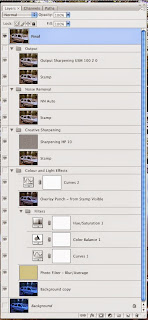
When I loaded the action file, I noticed a few things about the steps that I want to share with you.

- All of the work is done to the Background layer. Can you articulate why this is a bad idea?
- The image is resized. Can you articulate why?
- Since all the work is done to the Background layer, how are you controlling the complimentary color artifacts that result from Unsharp Mask? I would have expected that the script would create a copy of the layer and changed the blending mode, or worked in LAB mode and just worked on the L channel.
- You already know how I feel about Auto Adjustments.
I would have hoped that the Layers Panel looked something like this when the action was completed.

Sadly, it wasn't.
So, caveat emptor. Just because it's free doesn't mean you should use it.
Tuesday, November 11, 2014
A Toast to the Flag
"A Toast to the Flag"
by John J. Daly - 1917
Here's to the red of it--
There's not a thread of it,
No, nor a shred of it
In all the spread of it
From foot to head.
But heroes bled for it,
Faced steel and lead for it,
Precious blood shed for it,
Bathing it Red!
Here's to the white of it--
Thrilled by the sight of it,
Who knows the right of it,
But feels the might of it
Through day and night?
Womanhood's care for it
Made manhood dare for it,
Purity's prayer for it
Keeps it so white!
Here's to the blue of it--
Beauteous view of it,
Heavenly hue of it,
Star-spangled dew of it
Constant and true;
Diadems gleam for it,
States stand supreme for it,
Liberty's beam for it
Brightens the blue!
Here's to the whole of it--
Stars, stripes and pole of it,
Body and soul of it,
O, and the roll of it,
Sun shinning through;
Hearts in accord for it,
Swear by the sword for it,
Thanking the Lord for it,
Red White and Blue!
To all the readers who have served their nation in armed service in the cause of freedom, many thanks from a grateful populace.
Monday, November 10, 2014
Mitigating Artifacts of JPG Compression in Digital Images
Over on Forensic Magazine, Foray's David “Ski” Witzke attempts to tackle the subject of crappy JPEG images. After reading his very long treatise on using older versions of Photoshop to try and reduce the many problems you'd run into with JPEG images, I'm so glad for my copy of FIVE.


The Deblocking filter works great in reducing the appearance of JPEG blocks. Using FIVE means that I don't have to go through a tortured series of steps as described in Ski's article, with the accompanying mess trying to explain the steps to a jury.

Remember, with FIVE, you get the plain English explanation, the details, the parameters, and the academic reference from which the process/filter is derived all in your report. With FIVE, your report is built in the background as you go.
No offense to Ski. His company sells Photoshop plug-ins (among other things), so he's going to be bound to what Adobe gives him to work with. But, reading Ski's article reminded me how happy I am that I've switched from Photoshop to FIVE for my forensic science work.
Friday, November 7, 2014
Think and Live
Those that know me well know that I train Krav Maga. Krav Maga is the official self defense and hand to hand combat system of the Israeli Defense Forces (IDF), and has evolved to include training for use by Special Forces and paramilitary teams, as well as police and law enforcement, in addition to the general public. The principles that define Krav Maga allow students of all ages, ability, and walks of life to quickly and effectively learn the techniques and skills necessary to deal with violent encounters. Krav Maga’s principles allow an individual to adapt to situations ranging from combat and fighting to street attacks under high levels of stress.
Founded on real world experience and demands, Krav Maga is primarily focused on the use of natural movements and reactions for defense. The goal of Krav Maga is to bring individuals, both men and woman of all body types and physical abilities, to a high level of proficiency in a short amount of time. The natural and intuitive nature of Krav Maga leads to high retention of learned skills, and natural, almost reflexive, deployment in stressful situations. Physical fitness and strength are also part of Krav Maga training, preparing the body and mind for dealing with life threatening situations, and everyday life. Krav Maga is the most effective system that focuses on defending yourself while quickly and effectively devastating your opponent.
It's true that violence is everywhere in our society. The amount and frequency of violent crimes in our big cities are staggering statistics. Awareness is key - being aware of your surroundings. Those of us in law enforcement may get a little self-defense / hand-to-hand training. But, how many continue that training beyond the Academy?
To that end, a friend of mine is producing a set of films to help spread the word about the prevalence of violence in our society and the importance of simple common sense techniques to assure that you're not the next statistic. I encourage you to visit the site featured below. At a minimum, watch the first movie. You'll be glad you did.
If you find it in your heart to do so, join me in supporting this worthy cause. Let's help increase awareness and help prepare folks to face a society that's growing more violent each year.
Thanks.
Founded on real world experience and demands, Krav Maga is primarily focused on the use of natural movements and reactions for defense. The goal of Krav Maga is to bring individuals, both men and woman of all body types and physical abilities, to a high level of proficiency in a short amount of time. The natural and intuitive nature of Krav Maga leads to high retention of learned skills, and natural, almost reflexive, deployment in stressful situations. Physical fitness and strength are also part of Krav Maga training, preparing the body and mind for dealing with life threatening situations, and everyday life. Krav Maga is the most effective system that focuses on defending yourself while quickly and effectively devastating your opponent.
It's true that violence is everywhere in our society. The amount and frequency of violent crimes in our big cities are staggering statistics. Awareness is key - being aware of your surroundings. Those of us in law enforcement may get a little self-defense / hand-to-hand training. But, how many continue that training beyond the Academy?
To that end, a friend of mine is producing a set of films to help spread the word about the prevalence of violence in our society and the importance of simple common sense techniques to assure that you're not the next statistic. I encourage you to visit the site featured below. At a minimum, watch the first movie. You'll be glad you did.
If you find it in your heart to do so, join me in supporting this worthy cause. Let's help increase awareness and help prepare folks to face a society that's growing more violent each year.
Thanks.
Thursday, November 6, 2014
NCMF - Sean Coetzee Memorial Scholarship
This just in from the National Center for Media Forensics:
Sean Coetzee Memorial Scholarship
We are making progress in our fundraising efforts for the Sean Coetzee Memorial Scholarship. So far, $3,500 of the $10,000 goal has been raised from the generosity and effort of many individuals. But we still need your help to meet our goal by extended deadline of December 10, 2014! Tax deductible donations can be made in any amount, and every dollar counts.
This is our first scholarship campaign in honor of our student and colleague Sean Coetzee, who passed away quite suddenly in August 2013. We would be very grateful for your gift to support students who will carry on Sean's legacy. You may use the online donation form at www.cufund.org/SeanCoetzee.
Sean Coetzee was committed to the field of media forensics and his accomplishment during his time in the graduate program at the University of Colorado Denver was outstanding. It was clear to everyone who interacted with Sean that his dedication to and knowledge of the field was not only strong - it was contagious. The Sean Coetzee Memorial Fund has been established at the University of Colorado Denver to support students who demonstrate an appreciation for ethics in media forensics and to carry on the legacy of Sean who cared deeply about the field and helping others to achieve their best.
Thank you for your generosity in helping make the Sean Coetzee Memorial Scholarship a reality!
READ MORE
Sean Coetzee Memorial Scholarship
We are making progress in our fundraising efforts for the Sean Coetzee Memorial Scholarship. So far, $3,500 of the $10,000 goal has been raised from the generosity and effort of many individuals. But we still need your help to meet our goal by extended deadline of December 10, 2014! Tax deductible donations can be made in any amount, and every dollar counts.
This is our first scholarship campaign in honor of our student and colleague Sean Coetzee, who passed away quite suddenly in August 2013. We would be very grateful for your gift to support students who will carry on Sean's legacy. You may use the online donation form at www.cufund.org/SeanCoetzee.
Sean Coetzee was committed to the field of media forensics and his accomplishment during his time in the graduate program at the University of Colorado Denver was outstanding. It was clear to everyone who interacted with Sean that his dedication to and knowledge of the field was not only strong - it was contagious. The Sean Coetzee Memorial Fund has been established at the University of Colorado Denver to support students who demonstrate an appreciation for ethics in media forensics and to carry on the legacy of Sean who cared deeply about the field and helping others to achieve their best.
Thank you for your generosity in helping make the Sean Coetzee Memorial Scholarship a reality!
READ MORE
Friday, October 31, 2014
Court Rules Police Can Force Users to Unlock iPhones With Fingerprints, But Not Passcodes
This just in from MacRumors.com, "A Circuit Court judge in Virginia has ruled that fingerprints are not protected by the Fifth Amendment, a decision that has clear privacy implications for fingerprint-protected devices like newer iPhones and iPads.
According to Judge Steven C. Fucci, while a criminal defendant can't be compelled to hand over a passcode to police officers for the purpose of unlocking a cellular device, law enforcement officials can compel a defendant to give up a fingerprint.
The Fifth Amendment states that "no person shall be compelled in any criminal case to be a witness against himself," which protects memorized information like passwords and passcodes, but it does not extend to fingerprints in the eyes of the law, as speculated by Wired last year."
Keep reading the article by clicking here.
According to Judge Steven C. Fucci, while a criminal defendant can't be compelled to hand over a passcode to police officers for the purpose of unlocking a cellular device, law enforcement officials can compel a defendant to give up a fingerprint.
The Fifth Amendment states that "no person shall be compelled in any criminal case to be a witness against himself," which protects memorized information like passwords and passcodes, but it does not extend to fingerprints in the eyes of the law, as speculated by Wired last year."
Keep reading the article by clicking here.
Monday, October 27, 2014
Strengthening Forensic Science in the US
The Organization of Scientific Area Committees (OSAC) began sending out letters to subject matter experts a few weeks ago. OSAC is part of an initiative by NIST and the Department of Justice to strengthen forensic science in the United States.

Of particular interest to the readers of this blog, the IT/Multimedia Scientific Area Committee (SAC) has named and published its committee Chairs. The IT/Multimedia SAC consists of the Speaker Recognition, Imaging Technologies, Digital Evidence, and Facial Identification subcommittees.

I've been telling you that this is coming since the NAS report was published a few years ago. Well. Here it is.
The next press release from the OSAC should contain the names of the subcommittee members as well as the dates/locations for the first SAC meetings.
Enjoy.

Of particular interest to the readers of this blog, the IT/Multimedia Scientific Area Committee (SAC) has named and published its committee Chairs. The IT/Multimedia SAC consists of the Speaker Recognition, Imaging Technologies, Digital Evidence, and Facial Identification subcommittees.

I've been telling you that this is coming since the NAS report was published a few years ago. Well. Here it is.
The next press release from the OSAC should contain the names of the subcommittee members as well as the dates/locations for the first SAC meetings.
Enjoy.
Friday, October 24, 2014
Amped FIVE Update: new tutorials, DVR formats, and more
Amped Software announced another update today. "First of all the IFrame seek added in the previous version has been improved to work on all filters (with the exception of Frame Selectors).
As usual, we had a lot of our users requesting the conversion of specific DVR formats. In this update we added 3 new DVR formats (PAR, MGV, DRV). PAR and DRV, were already supported but we added a new sub-type as many times files with the same extension actually come in many different flavors. Thanks a lot to everybody who is contributing to the development with requests!
We’ve also included the DVR Screen Capture tool to make it easier to grab the selection of the area.
A lot of our users don’t do actual casework on workstations connected to the Internet. For this reason we just added a message in the menu item Help > Check for Updates On Line which will give you the link where to check if your version is up to date from the browser on another PC.
Finally, we’ve added and updated tutorials to include screenshots from the latest version. Amped FIVE has come a long way since they were written!"
Enjoy.
As usual, we had a lot of our users requesting the conversion of specific DVR formats. In this update we added 3 new DVR formats (PAR, MGV, DRV). PAR and DRV, were already supported but we added a new sub-type as many times files with the same extension actually come in many different flavors. Thanks a lot to everybody who is contributing to the development with requests!
We’ve also included the DVR Screen Capture tool to make it easier to grab the selection of the area.
A lot of our users don’t do actual casework on workstations connected to the Internet. For this reason we just added a message in the menu item Help > Check for Updates On Line which will give you the link where to check if your version is up to date from the browser on another PC.
Finally, we’ve added and updated tutorials to include screenshots from the latest version. Amped FIVE has come a long way since they were written!"
Enjoy.
Thursday, October 23, 2014
LEEDIR in use in Pumpkin Riot Probe
This just in from the AP: "Police in New Hampshire are using a relatively new application to collect photos and videos they hope will lead to arrests following weekend chaos at a pumpkin festival.
More than 80 people were arrested after parties got out of hand Saturday in Keene, leading to property destruction and injuries. Police in riot gear used tear gas and pepper balls to control crowds as large as 2,000 people.
Keene police have created a LEEDIR account, or Large Emergency Event Digital Information Repository, where people can send images and videos directly from their smartphones to police.
More than 100 people have already sent files as the investigation by several police agencies continues.
LEEDIR is an online and mobile app that can be activated after a major emergency."
More than 80 people were arrested after parties got out of hand Saturday in Keene, leading to property destruction and injuries. Police in riot gear used tear gas and pepper balls to control crowds as large as 2,000 people.
Keene police have created a LEEDIR account, or Large Emergency Event Digital Information Repository, where people can send images and videos directly from their smartphones to police.
More than 100 people have already sent files as the investigation by several police agencies continues.
LEEDIR is an online and mobile app that can be activated after a major emergency."
Wednesday, October 22, 2014
FIVE updated
The recent update to Amped Software's FIVE brings a welcome refresh of the Filters panel.

As you scroll down the filter group (left side), the individual filters move along with you - justified to assure that they're in view when you highlight a specific group.
I know, it's a little thing. But it's the little things that make life worth while.
Use the Check for Updates feature to make sure that you have the latest version. There's usually the inclusion of new file format support as a wee bonus.
Enjoy.

As you scroll down the filter group (left side), the individual filters move along with you - justified to assure that they're in view when you highlight a specific group.
I know, it's a little thing. But it's the little things that make life worth while.
Use the Check for Updates feature to make sure that you have the latest version. There's usually the inclusion of new file format support as a wee bonus.
Enjoy.
Tuesday, October 21, 2014
Codes of Ethics
Given Sunday's post about the many people out there claiming to be experts in Forensic Video Analysis, I began wondering if the courts could/should enforce a Code of Ethics.
I think many of the organizations out there for people that do what we do have some sort of statement about ethics or an actual Code of Ethics. The IACIS, for example, has theirs on their membership page.
IACIS Code of Ethics
IACIS members must demonstrate and maintain the highest standards of ethical conduct.
IACIS members must:
I think many of the organizations out there for people that do what we do have some sort of statement about ethics or an actual Code of Ethics. The IACIS, for example, has theirs on their membership page.
IACIS Code of Ethics
IACIS members must demonstrate and maintain the highest standards of ethical conduct.
IACIS members must:
- Maintain the highest level of objectivity in all forensic examinations and accurately present the facts involved.
- Thoroughly examine and analyze the evidence in a case.
- Conduct examinations based upon established, validated principles.
- Render opinions having a basis that is demonstratively reasonable.
- Not withhold any findings, whether inculpatory or exculpatory, that would cause the facts of a case to be misrepresented or distorted.
- Never misrepresent credentials, education, training, and experience or membership status.
How incredibly refreshing.
But, can an examiner accurately present the facts involved if they don't understand the science behind the tools and techniques that they employ? Can an examiner thoroughly examine and analyze the evidence if they don't have the appropriate tools - or those tools are out of date? Can "it just doesn't look right to me" be an established and valid principle? Is demonstratively reasonable too much to ask? Does your inclusion on the Superior Court's list of experts sufficient proof of your training, experience, and education?
To pull something like this off at the Superior Court level, it would take a court panel and judge that invests a bit of time to see what's out there in terms of gear, what the science says, who's doing what, and etc.
I understand that the Courts are massively overworked. But, if you put a list out there, it should mean something. Sadly, the video/image section of LA County's list needs a bit of trimming.
Monday, October 20, 2014
Turning a filter on or off in Amped FIVE
At a recent training session, the topic of what to do with filters if you've used them but don't want to have them influence what's being displayed - but you still want them on your report.
Obviously, you can throw filters away. But, in doing so, the filter's settings won't appear on the report.

In the Filter Settings box (top right) you'll see a small check box. This is the On/Off button. Check in the box, the filter's on and the settings are reflected in the workflow. No check in the box, and the settings are not reflected.
Where this comes in handy is when you're using an edge detection filter, like Sobel, and you don't want your image/video looking like a modern art masterpiece. Once you've found your edges and performed task that required knowing the location of the edges (like Measure 1D, etc), turn the filter off. In this way, your filter use is reflected in the report.
Think of this like turning on/off layers in Photoshop.

Many thanks to John U. from the SLC PD for taking the initiative to install and try the program ahead of the training, and for actually reading the support documentation and watching the training videos. Also, thanks to John for making my time at SLC run smooth. It's always nice to hit the ground running.
BTW, if you're interested in bringing a training session to your agency, just send a note. 2015 is going to a busy training year, but there's still some openings in my calendar.
Obviously, you can throw filters away. But, in doing so, the filter's settings won't appear on the report.
In the Filter Settings box (top right) you'll see a small check box. This is the On/Off button. Check in the box, the filter's on and the settings are reflected in the workflow. No check in the box, and the settings are not reflected.
Where this comes in handy is when you're using an edge detection filter, like Sobel, and you don't want your image/video looking like a modern art masterpiece. Once you've found your edges and performed task that required knowing the location of the edges (like Measure 1D, etc), turn the filter off. In this way, your filter use is reflected in the report.
Think of this like turning on/off layers in Photoshop.
Many thanks to John U. from the SLC PD for taking the initiative to install and try the program ahead of the training, and for actually reading the support documentation and watching the training videos. Also, thanks to John for making my time at SLC run smooth. It's always nice to hit the ground running.
BTW, if you're interested in bringing a training session to your agency, just send a note. 2015 is going to a busy training year, but there's still some openings in my calendar.
Friday, October 17, 2014
New Partnership Provides Law Enforcement With Digital Evidence Solution
Homeland Security Today recently featured a story on the partnership between MediaSolv and Amped Software. Whilst it's true that no single vendor provides an end to end solution for our digital evidence needs, this new partnership gets really close. When you factor MediaSolv's work with Cellebrite into the equation, MediaSolv looks even better. Check out the article here.
Wednesday, October 8, 2014
Forensic Focus asks Amped Software, can you get that license plate?
This just in from Forensic Focus: "We find ourselves analyzing new surveillance videos almost every day, and in most cases we can either solve the problem very quickly or understand (even quicker) that there is no information to recover in the video. In special cases though, where something very specific and strange happened, or the problem is very complex, it can take a lot of time.
As always… Pareto principle: you solve 80% of the cases in 20% of the time, and, well, 20% of the cases takes 80% of the time. In our own work, the right numbers are probably 95% to 5%, but the idea still holds.
With our experience in working on several thousand cases, we can estimate whether an image or video contains some information and is worth processing, or not, very quickly. In this article, we will describe some of the tests that can be done to quickly tell if you can get that license plate!"
Continue reading the article over on Forensic Focus.
As always… Pareto principle: you solve 80% of the cases in 20% of the time, and, well, 20% of the cases takes 80% of the time. In our own work, the right numbers are probably 95% to 5%, but the idea still holds.
With our experience in working on several thousand cases, we can estimate whether an image or video contains some information and is worth processing, or not, very quickly. In this article, we will describe some of the tests that can be done to quickly tell if you can get that license plate!"
Continue reading the article over on Forensic Focus.
Tuesday, October 7, 2014
New SWGDE Draft Posted for Public Comment
This just in ...
The Scientific Working Group on Digital Evidence (SWGDE) is pleased to announce the posting of a new draft document for public review and comment: "SWGDE Best Practices for Handling Damaged Mobile Devices" at https://www.swgde.org/
In accordance with SWGDE policy, draft documents will be posted for a minimum of 60 days for public comment. The first page of each draft document gives instructions on how to submit feedback to our Secretary via an email to secretary@swgde.org mailto:secretary@swgde.org All feedback received prior to our next meeting in January 2015 will be reviewed by the appropriate subcommittee at that meeting.
At the conclusion of our last meeting, SWGDE voted to release the following documents as Approved versions after considering and incorporating feedback received during the public comment period. However, as noted on the cover page of each document, "SWGDE encourages stakeholder participation in the preparation of documents. Suggestions for modifications are welcome and must be forwarded to the Secretary in writing at secretary@swgde.org"
Digital and Multimedia Evidence (Digital Forensics) as a Forensic Science Discipline v2
SWGDE Best Practices for Computer Forensics v3.1 SWGDE Best Practices for Handling Damaged Hard Drives v1 SWGDE Capture of Live Systems v2 SWGDE Focused Collection and Examination of Digital Evidence v1 SWGDE Mac OS X Tech Notes v1.1 SWGDE Recommended Guidelines for Validation Testing v2 SWGDE Best Practices for Forensic Audio v2 These recently approved documents are available for download on the Current Documents page of the SWGDE website: https://www.swgde.org/ documents/Current%20Documents
We appreciate your participation as SWGDE continues its mission to bring together organizations actively engaged in the field of digital and multimedia evidence to foster communication and cooperation as well as ensuring quality and consistency within the forensic community. Anyone interested in receiving regular updates via email is encouraged to sign up for the SWGDE NewsBytes newsletter here: https://www.swgde.org/ newsletter/newsletterSignUp
Thank you,
David Hallimore
SWGDE Outreach Committee Chair
SWGDE https://www.swgde.org/
The Scientific Working Group on Digital Evidence (SWGDE) is pleased to announce the posting of a new draft document for public review and comment: "SWGDE Best Practices for Handling Damaged Mobile Devices" at https://www.swgde.org/
In accordance with SWGDE policy, draft documents will be posted for a minimum of 60 days for public comment. The first page of each draft document gives instructions on how to submit feedback to our Secretary via an email to secretary@swgde.org mailto:secretary@swgde.org All feedback received prior to our next meeting in January 2015 will be reviewed by the appropriate subcommittee at that meeting.
At the conclusion of our last meeting, SWGDE voted to release the following documents as Approved versions after considering and incorporating feedback received during the public comment period. However, as noted on the cover page of each document, "SWGDE encourages stakeholder participation in the preparation of documents. Suggestions for modifications are welcome and must be forwarded to the Secretary in writing at secretary@swgde.org"
Digital and Multimedia Evidence (Digital Forensics) as a Forensic Science Discipline v2
SWGDE Best Practices for Computer Forensics v3.1 SWGDE Best Practices for Handling Damaged Hard Drives v1 SWGDE Capture of Live Systems v2 SWGDE Focused Collection and Examination of Digital Evidence v1 SWGDE Mac OS X Tech Notes v1.1 SWGDE Recommended Guidelines for Validation Testing v2 SWGDE Best Practices for Forensic Audio v2 These recently approved documents are available for download on the Current Documents page of the SWGDE website: https://www.swgde.org/ documents/Current%20Documents
We appreciate your participation as SWGDE continues its mission to bring together organizations actively engaged in the field of digital and multimedia evidence to foster communication and cooperation as well as ensuring quality and consistency within the forensic community. Anyone interested in receiving regular updates via email is encouraged to sign up for the SWGDE NewsBytes newsletter here: https://www.swgde.org/ newsletter/newsletterSignUp
Thank you,
David Hallimore
SWGDE Outreach Committee Chair
SWGDE https://www.swgde.org/
Wednesday, October 1, 2014
Are law enforcement agencies tone deaf?
Over at the Washington Post, there's been a series of articles quoting various current and former law enforcement officials and politicians predicting doom, gloom, and madness if Apple and Google go through with their plans to include encryption into their next generation of operating systems. In the latest article, the outgoing US Attorney General essentially asks companies to do it for the children. "Attorney General Eric H. Holder Jr. said on Tuesday that new forms of encryption capable of locking law enforcement officials out of popular electronic devices imperil investigations of kidnappers and sexual predators, putting children at increased risk."
The do it for the children card has been so over-used that folks are tired of hearing of it. Here's why regular folks want encryption:
The do it for the children card has been so over-used that folks are tired of hearing of it. Here's why regular folks want encryption:
- It has been documented that law enforcement agencies in the US have downloaded the contents of mobile phones or otherwise searched the phones during routine traffic stops. 1 2 3 4 5 6 7 8 9
- What is the retention policy of the data police acquire at a routine traffic stop? If you aren't charged with an offense, if no ticket is issued, what happens to the data? How long do they keep it? Do they merge the data into a massive government database? 1 2 3 Ask your local PD. Call a few times. See how different each response is.
- How secure is your personal data once it's in the hands of law enforcement? 1 2 3
Again, ordinary folks are concerned about their privacy and the protection of their personal information. The fact that the DOJ and other agencies don't understand this, or don't care, further worries the average person.
In the US, the person is sovereign and free. Our Constitution places limits on what our government can do to us. The people have the power and our Constitution binds the government, limiting it to only those authorized activities.We're innocent until proven guilty. Not providing your mobile phone to law enforcement during a routine traffic stop is not proof of guilt, or even cause of reasonable suspicion. When the agents of the government make big moves outside of their Constitutionally limited areas, folks are going to seek a way to protect themselves. It's simple, actually.
Before pulling the do it for the children card, LE agencies should have solid policies governing when/how data collection can take place, what's going to happen to the data, and how the data will be protected - as well as a way for a citizen to appeal to have their data removed from the system without expense.
But right now, folks just aren't buying what the DOJ is selling. They will, however, be buying what Apple and Google is selling.
Subscribe to:
Posts (Atom)