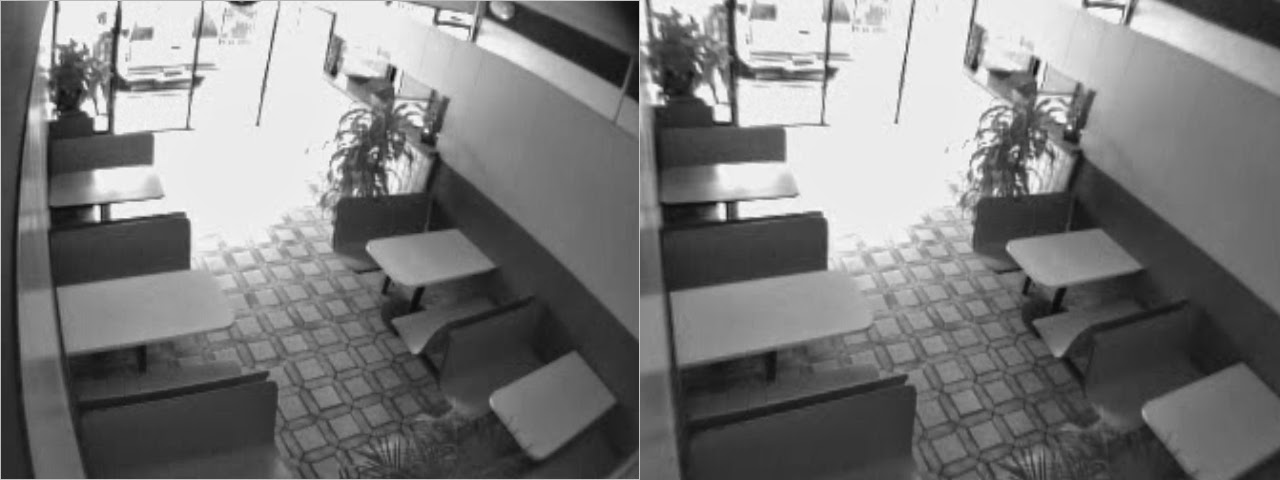
I've seen a lot of ADT installations using fisheye lenses lately. ADT must be having a sales promotion or something.
One of the updates to FIVE in the last year is the Correct Fisheye filter, found in the Edit filter group.
In the past, I would use the Undistort filter, but Correct Fisheye works a lot better / easier / faster on these low-end fisheye lenses I've been seeing.
In the case of the "full-frame" (180º) fisheye lenses in the ADT installations, I've found that Orthographic works the best. This isn't because ADT has been forthcoming with information about the mapping function of their chosen lenses. It's mainly been through my testing each function. You won't likely get information on the manufacturer's chosen mapping function.
As a side note, for the "circular fisheye" top-down (360º) lenses, use the Unroll filter for better results.
Back to the ADT cameras, here's the before/after image (Presentation>Compare Original). On the left is the original image and on the right is the corrected version. Correct Fisheye did a very good job in just two clicks of the mouse.
Enjoy.
This blog is no longer active and is maintained for archival purposes. It served as a resource and platform for sharing insights into forensic multimedia and digital forensics. Whilst the content remains accessible for historical reference, please note that methods, tools, and perspectives may have evolved since publication. For my current thoughts, writings, and projects, visit AutSide.Substack.com. Thank you for visiting and exploring this archive.
Featured Post
Welcome to the Forensic Multimedia Analysis blog (formerly the Forensic Photoshop blog). With the latest developments in the analysis of m...
Tuesday, April 14, 2015
Monday, April 13, 2015
It looks like the transition to Amazon.com is finished and my book, Forensic Photoshop, is now available there exclusively. Paperback and hardcover options are both available for immediate shipping.
As I've noted in the past, the book isn't based on a particular version of Photoshop. It's a workflow book ... what to do when, and why. As such, it's still relevant and informative for those still using Photoshop in their forensic work.
Thanks again for your continued support.
Friday, April 10, 2015
What's next for Adobe Audition CC?
Adobe has begun to release details about the upcoming changes to their Creative Cloud products. Click here to find out what's coming next in Adobe Audition CC.
Thursday, April 9, 2015
A bite mark matching advocacy group just conducted a study that discredits bite mark evidence
Here's an interesting article from the Washington Post about Forensic Odontology.
Check out this quote, "the problem with bite mark analysis was never the lack of a flow chart. The problem is that there has never been any real scientific research to support its two main underlying premises — that human dentition is unique, and that human skin is capable of registering and recording that uniqueness in a useful way. And the research that has been done strongly suggests those two premises are not true." Ouch!
Read the whole article here.
Check out this quote, "the problem with bite mark analysis was never the lack of a flow chart. The problem is that there has never been any real scientific research to support its two main underlying premises — that human dentition is unique, and that human skin is capable of registering and recording that uniqueness in a useful way. And the research that has been done strongly suggests those two premises are not true." Ouch!
Read the whole article here.
Wednesday, April 8, 2015
Coursera courses reviewed
Last week, I finished the Coursera course, Visual Perception and the Brain. This course was taught by Dale Purves, MD, of Duke University and is one of the growing number of on-line non-credit courses offered by leading universities and noted professors around the world.
I would recommend that DME analysts put this course on their to-do lists and watch for it to be offered again. There's a lot of good information delivered as part of the class.
That being said, if you've never taken an on-line university level course you may have some trouble with the format. You watch the video of each section's lecture. You're free to download and save it locally. You can also download and save the slides and a fairly accurate transcript of the lecture. There's an expectation that you'll dive in a little deeper and study each section's topic on your own prior to taking each section's test. The test questions aren't written directly from the lecture / slides and assume that you've done a bit of extra reading in order to gain a deeper understanding of the week's topic.
Coursera has a lot of classes available for free. In this world of shrinking budgets and doing more with less, you can't beat free classes.
Monday, April 6, 2015
Recovering image data from JPEG file fragments
This interesting paper was recently published by SPIE. SPIE is the international society of optics and photonics.
"A new technique for recovering fragmented data files can retrieve elements of a JPEG compressed image even when the file's header is unavailable."
"The most basic task of any file system is to manage and organize data in a storage volume. Each file in the store is allocated a list of blocks (the basic unit of access), and when we access a file, the system retrieves the data in sequence from the list. Correspondingly, removing the relevant entry deletes the item (note that in most systems, deleting simply means that data is overwritten over time by newly saved files, rather than actually removed). Figure 1 depicts the layout of files distributed across blocks of a storage medium, and provides a simplified view of the data structure used to track allocated blocks. When the information for a volume is corrupt or missing, it is only possible to recover files by analyzing the fragmented raw data, a process known as file carving."
"Today, file-carving tools play an important role in digital forensic investigations, where analyzing deleted files and salvaging data from damaged and faulty media are common procedures. However, when files are encoded and compressed (as with most multimedia files), recovery is dependent on the availability of the file header, which includes all the decoding parameters. If a file is partially intact with its header deleted, common carving techniques cannot recover any data. Here, we describe an algorithm1 that advances the latest developments in JPEG carving by introducing the ability to recover file fragments when the associated header is missing.
There are two main challenges associated with file carving. The first is the inability to lay out data blocks contiguously on the storage, as in the case of files b and f in Figure 1. Repeated execution of file operations, such as addition, deletion, and modification of files, over time leads to fragmentation of available free storage space. As a result, the newly generated files need to be broken into several parts to fit into the available unallocated blocks. Figure 1 illustrates this phenomenon, where files a and c are separated into two pieces. Even the new solid-state drives (which use integrated circuits, rather than disks, to store data) are susceptible to this phenomenon as they are designed to emulate the interface characteristics of hard disk drives.
The second challenge to successful file carving is that interpreting binary-formatted data requires the use of decoders, without which a block of data will reveal little or no information about the content of a file.
There has been significant recent progress in carving JPEG files, which are the most widely adopted still image compression standard today and commonly the subject of forensic investigations.2–6However, techniques for JPEG recovery still assume that a file header is always present. Without the header, the usual techniques cannot recover any data, even though the rest of the file may be intact. For example, in Figure 1, the fragments of files d, e, and g were overwritten by files c and f. Recovering an arbitrary chunk of compressed image data without the matching encoding metadata essentially requires reconstructing a new file header, which at least requires knowledge of entropy coding parameters and quantization tables, methods used during compression for downsampling the color information and image dimensions."
Click here to continue reading this paper on SPIE's web site.
"A new technique for recovering fragmented data files can retrieve elements of a JPEG compressed image even when the file's header is unavailable."
"The most basic task of any file system is to manage and organize data in a storage volume. Each file in the store is allocated a list of blocks (the basic unit of access), and when we access a file, the system retrieves the data in sequence from the list. Correspondingly, removing the relevant entry deletes the item (note that in most systems, deleting simply means that data is overwritten over time by newly saved files, rather than actually removed). Figure 1 depicts the layout of files distributed across blocks of a storage medium, and provides a simplified view of the data structure used to track allocated blocks. When the information for a volume is corrupt or missing, it is only possible to recover files by analyzing the fragmented raw data, a process known as file carving."
"Today, file-carving tools play an important role in digital forensic investigations, where analyzing deleted files and salvaging data from damaged and faulty media are common procedures. However, when files are encoded and compressed (as with most multimedia files), recovery is dependent on the availability of the file header, which includes all the decoding parameters. If a file is partially intact with its header deleted, common carving techniques cannot recover any data. Here, we describe an algorithm1 that advances the latest developments in JPEG carving by introducing the ability to recover file fragments when the associated header is missing.
There are two main challenges associated with file carving. The first is the inability to lay out data blocks contiguously on the storage, as in the case of files b and f in Figure 1. Repeated execution of file operations, such as addition, deletion, and modification of files, over time leads to fragmentation of available free storage space. As a result, the newly generated files need to be broken into several parts to fit into the available unallocated blocks. Figure 1 illustrates this phenomenon, where files a and c are separated into two pieces. Even the new solid-state drives (which use integrated circuits, rather than disks, to store data) are susceptible to this phenomenon as they are designed to emulate the interface characteristics of hard disk drives.
The second challenge to successful file carving is that interpreting binary-formatted data requires the use of decoders, without which a block of data will reveal little or no information about the content of a file.
There has been significant recent progress in carving JPEG files, which are the most widely adopted still image compression standard today and commonly the subject of forensic investigations.2–6However, techniques for JPEG recovery still assume that a file header is always present. Without the header, the usual techniques cannot recover any data, even though the rest of the file may be intact. For example, in Figure 1, the fragments of files d, e, and g were overwritten by files c and f. Recovering an arbitrary chunk of compressed image data without the matching encoding metadata essentially requires reconstructing a new file header, which at least requires knowledge of entropy coding parameters and quantization tables, methods used during compression for downsampling the color information and image dimensions."
Click here to continue reading this paper on SPIE's web site.
Friday, April 3, 2015
LEVA Job Classification and Wage Study Results
This just in from LEVA: "The following Job Classification and Wage Study was completed in March of 2015 as part of a position audit. The survey focuses on particular job duties and functions performed by various analysts, technicians, and those who in some way handle digital multimedia evidence.
All information contained in this report was volunteered by those who responded to the survey invitation, knowing that they fit the subject matter criteria. It is being shared with the Forensic Digital Multimedia Evidence community due to numerous requests for the information.
LEVA thanks those who responded with data for Jordan Huslig of the Grand Junction, CO PD Crime Lab to conduct the research and providing the findings. Nice job Jordan!"
Click here to read the result and/or access the raw data.
All information contained in this report was volunteered by those who responded to the survey invitation, knowing that they fit the subject matter criteria. It is being shared with the Forensic Digital Multimedia Evidence community due to numerous requests for the information.
LEVA thanks those who responded with data for Jordan Huslig of the Grand Junction, CO PD Crime Lab to conduct the research and providing the findings. Nice job Jordan!"
Click here to read the result and/or access the raw data.
Thursday, April 2, 2015
How to: Open Exe Files on A Mac
I recently had an .Exe video file that wouldn't capture using any/all available PC tools. I tried Omnivore, FIVE, and a few others. Nothing. Thank God for my trusty old MacBook Pro.
Here's an old video tutorial that's still relevant. It demonstrates using Wine / WineBottler to re-bundle the file into something that the Mac will recognize.
Wine / WineBottler worked like a charm on my video. Then, I used iShowU to do the screen capture.
Sometimes folks can't/won't mess with executable files and require the files to be "converted." Not all of them play nice with our state of the art systems. It's nice to see that the old tricks still work.
Enjoy.
Here's an old video tutorial that's still relevant. It demonstrates using Wine / WineBottler to re-bundle the file into something that the Mac will recognize.
Wine / WineBottler worked like a charm on my video. Then, I used iShowU to do the screen capture.
Sometimes folks can't/won't mess with executable files and require the files to be "converted." Not all of them play nice with our state of the art systems. It's nice to see that the old tricks still work.
Enjoy.
Thursday, March 26, 2015
More S-FIVE news
This just in:
The S-FIVE project will organize an international workshop about Forensic Image and Video Enhancement on June 15-18, in Brussels, Belgium. The maximum number of participants to this workshop will be limited, but EU attendees can be partially funded by the Prevention of and Fight against Crime Programme, European Commission - Directorate-General Home Affairs (through the ENFSI Monopoly 2011 Programme).
The S-FIVE webpages will continue to evolve further, but:
More details on how to apply for (funded) participation to the workshop are now available via the S-FIVE project website.
Sincerely,
The S-FIVE project team,
http://s-five.eu/
info@s-five.eu
The S-FIVE project is a project funded by the Prevention of and Fight against Crime Programme;
European Commission - Directorate-General Home Affairs, through the European Network of Forensic Science Institutes (ENFSI) Monopoly 2011 programme "Improving Forensic Methodologies across Europe" (IFMAE).
The S-FIVE project will organize an international workshop about Forensic Image and Video Enhancement on June 15-18, in Brussels, Belgium. The maximum number of participants to this workshop will be limited, but EU attendees can be partially funded by the Prevention of and Fight against Crime Programme, European Commission - Directorate-General Home Affairs (through the ENFSI Monopoly 2011 Programme).
The S-FIVE webpages will continue to evolve further, but:
More details on how to apply for (funded) participation to the workshop are now available via the S-FIVE project website.
Sincerely,
The S-FIVE project team,
http://s-five.eu/
info@s-five.eu
The S-FIVE project is a project funded by the Prevention of and Fight against Crime Programme;
European Commission - Directorate-General Home Affairs, through the European Network of Forensic Science Institutes (ENFSI) Monopoly 2011 programme "Improving Forensic Methodologies across Europe" (IFMAE).
Wednesday, March 25, 2015
Forensic Photoshop Book moves to Amazon
After many years of pushing up against the behemoth that is Amazon, my publisher and Amazon are finally at the point of reasonableness. Thus, it is with a bit of nervousness that I announce that my book, Forensic Photoshop, will be available for purchase exclusively on Amazon.com starting next week.
I realize that the book has been in print for quite a while. But, if you stop to consider that the way law enforcement uses Photoshop hasn't changed since the book came out ... it's still relevant. It's not a collection of tips and tricks. It's not based on a specific version of Photoshop. It's a book about workflow; and the workflow hasn't changed.
I appreciate all of the support. I never imagined that the book would do so well. Stay tuned for the official Amazon links to get your copy, if you haven't already.
Enjoy.
I realize that the book has been in print for quite a while. But, if you stop to consider that the way law enforcement uses Photoshop hasn't changed since the book came out ... it's still relevant. It's not a collection of tips and tricks. It's not based on a specific version of Photoshop. It's a book about workflow; and the workflow hasn't changed.
I appreciate all of the support. I never imagined that the book would do so well. Stay tuned for the official Amazon links to get your copy, if you haven't already.
Enjoy.
Monday, March 23, 2015
Free web version of Signal Processing for Communications
I know folks like to build their libraries. But, it can get expensive. Recently, I came across this free web version of Prandoni & Vetterli's Signal Processing for Communications. They also have a PDF version available for free downloading. This page offers their reasoning for offering their text for free, along with a link if you'd care to donate to support their cause.
Enjoy.
Enjoy.
Friday, March 20, 2015
Draft law mandates CCTV use
Here's an interesting article from Kuwait City, "Cabinet OKs Law On Surveillance Cameras
KUWAIT CITY: The Council of Ministers has approved the draft law which has been submitted by the Deputy Prime Minister and Minister of Interior Sheikh Mohammad Al- Khalid for the installation of security surveillance cameras, reports Al-Anba daily.
The daily added, during the first phase 15 cameras will be installed at vital places and this exercise will be followed by the installation of cameras at other places as the need arises. According to the draft law, the owners of these so-called vital places will be obliged to install security cameras with a capacity of storing data for not less than 120 days.
The draft law stipulates three years imprisonment for any person found tampering with the recorded data by the surveillance cameras, for not saving the data or publishing any of the contents. Sources said what is recorded by these cameras shall be considered tangible proof in the event of any crime, assault or theft.
According to the draft law these cameras must also be installed at hotels, banks, and sports and cultural clubs, youth centers, entertainment centers such as recreational parks, shopping malls, commercial complexes, residential complexes, and banks, jewelry shops, jewelry stores, hospitals, clinics, and motels."
Notice the glaring omission? No hint about standards. You can't balance an equation by working just one side of the equal sign.
KUWAIT CITY: The Council of Ministers has approved the draft law which has been submitted by the Deputy Prime Minister and Minister of Interior Sheikh Mohammad Al- Khalid for the installation of security surveillance cameras, reports Al-Anba daily.
The daily added, during the first phase 15 cameras will be installed at vital places and this exercise will be followed by the installation of cameras at other places as the need arises. According to the draft law, the owners of these so-called vital places will be obliged to install security cameras with a capacity of storing data for not less than 120 days.
The draft law stipulates three years imprisonment for any person found tampering with the recorded data by the surveillance cameras, for not saving the data or publishing any of the contents. Sources said what is recorded by these cameras shall be considered tangible proof in the event of any crime, assault or theft.
According to the draft law these cameras must also be installed at hotels, banks, and sports and cultural clubs, youth centers, entertainment centers such as recreational parks, shopping malls, commercial complexes, residential complexes, and banks, jewelry shops, jewelry stores, hospitals, clinics, and motels."
Notice the glaring omission? No hint about standards. You can't balance an equation by working just one side of the equal sign.
Thursday, March 19, 2015
Cyber CSI: the challenges of digital forensics
This just in from Richard Boddington at TheConversation.com: "Forensics is changing in the digital age, and the legal system is still catching up when it comes to properly employing digital evidence.
Broadly speaking, digital evidence is information found on a wide range of electronic devices that is useful in court because of its probative value. It’s like the digital equivalent of a fingerprint or a muddy boot.
However, digital evidence tendered in court often fails to meet the same high standards expected of more established forensics practices, particularly in ensuring the evidence is what it purports to be.
Technology changes evidence
This is not the first time that technology has impacted the way evidence is gathered and presented in courts. And it’s not the first time that there have been problems in the way new evidence is used ..."
To continue reading this article, click here.
Broadly speaking, digital evidence is information found on a wide range of electronic devices that is useful in court because of its probative value. It’s like the digital equivalent of a fingerprint or a muddy boot.
However, digital evidence tendered in court often fails to meet the same high standards expected of more established forensics practices, particularly in ensuring the evidence is what it purports to be.
Technology changes evidence
This is not the first time that technology has impacted the way evidence is gathered and presented in courts. And it’s not the first time that there have been problems in the way new evidence is used ..."
To continue reading this article, click here.
Wednesday, March 18, 2015
S-FIVE Collaborative Exercise
I received the following invitation from the S-FIVE project team. They've asked that I share the information here.
---
Dear colleagues,
With this e-mail the S-FIVE project team wishes to invite you to participate to its:
Collaborative Exercise on Forensic Image and Video Enhancement.
The exercise consists of four subparts related to:
Image extraction, Focal and Motion Deblur, and Superresolution.
The final deadline for submission of results will be Fri., April 24.
Please feel free to forward this e-mail to any colleagues, tool vendors or academic contacts that may be interested in participating to this exercise.
Sincerely,
The S-FIVE project team,
http://s-five.eu/
info@s-five.eu
The S-FIVE project is a project funded by the Prevention of and Fight against Crime Programme;
European Commission - Directorate-General Home Affairs, through the European Network of Forensic Science Institutes (ENFSI) Monopoly 2011 programme “Improving Forensic Methodologies across Europe” (IFMAE).
---
Enjoy
---
Dear colleagues,
With this e-mail the S-FIVE project team wishes to invite you to participate to its:
Collaborative Exercise on Forensic Image and Video Enhancement.
The exercise consists of four subparts related to:
Image extraction, Focal and Motion Deblur, and Superresolution.
The final deadline for submission of results will be Fri., April 24.
Please feel free to forward this e-mail to any colleagues, tool vendors or academic contacts that may be interested in participating to this exercise.
Sincerely,
The S-FIVE project team,
http://s-five.eu/
info@s-five.eu
The S-FIVE project is a project funded by the Prevention of and Fight against Crime Programme;
European Commission - Directorate-General Home Affairs, through the European Network of Forensic Science Institutes (ENFSI) Monopoly 2011 programme “Improving Forensic Methodologies across Europe” (IFMAE).
---
Enjoy
Tuesday, March 17, 2015
Vehicle Examiner announcement from DME Forensicsis
The folks over at DME Forensics announced the impending beta of their newest adventure, Vehicle Examiner. It seems, from the announcement, that they've taken the Digital Automotive Image System and given the concept a bit of modernization. But, unlike the DIAS, I doubt that Vehicle Examiner will be free to law enforcement.
If you're interested in getting involved in their upcoming beta program, head over to the Vehicle Examiner web site and sign up for their newsletter.
Monday, March 16, 2015
Hertz puts cameras in its rental cars
Yes, you read the headline correctly. Hertz is putting cameras in their rental cars. But, they say that they have no plans to use them ... whatever that means.
Check out the details from Fusion.net.
Monday, March 9, 2015
Friday, February 27, 2015
New training course available
New training course available:
BASIC FORENSIC MULTIMEDIA ANALYSIS WITH AMPED FIVE
This is a practical course on Amped Five.
Description:
Basic Forensic Multimedia Analysis with Amped FIVE Professional
Expectations and Goals:
Graduates will acquire basic level training in the techniques and skills necessary to perform examinations, clarifications, and analyses on digital multimedia evidence in a “forensic science” setting as well as to package, deliver, and present those findings in their local courtroom context. The focus on this course is practical usage of FIVE for forensic video and image analysis.
Dates:
April 21-23, 2015
Location:
Memphis, Tennessee (Memphis PD is host agency)
Instructor:
Jim Hoerricks
For details or to sign up, click here. Seats are limited.
For any questions, email training@ampedsoftware.us or call (866) 547-0099 Ext. 101.
BASIC FORENSIC MULTIMEDIA ANALYSIS WITH AMPED FIVE
This is a practical course on Amped Five.
Description:
Basic Forensic Multimedia Analysis with Amped FIVE Professional
Expectations and Goals:
Graduates will acquire basic level training in the techniques and skills necessary to perform examinations, clarifications, and analyses on digital multimedia evidence in a “forensic science” setting as well as to package, deliver, and present those findings in their local courtroom context. The focus on this course is practical usage of FIVE for forensic video and image analysis.
Dates:
April 21-23, 2015
Location:
Memphis, Tennessee (Memphis PD is host agency)
Instructor:
Jim Hoerricks
For details or to sign up, click here. Seats are limited.
For any questions, email training@ampedsoftware.us or call (866) 547-0099 Ext. 101.
Thursday, February 26, 2015
SWGDE News
This just in from SWGDE:
The Scientific Working Group on Digital Evidence (SWGDE) is pleased to announce the posting of the following four new draft documents for public review and comment at https://www.swgde.org/ documents/Released%20For% 20Public%20Comment
SWGDE Best Practices for the Recovery of Data from CCTV Digital Video Recorders (version 1.0)
SWGDE Mac OS X Tech Notes (version 1.2)
SWGDE Best Practices for Forensic Audio (revision 2.20)
SWGDE-SWGIT Glossary (version 2.8)
The draft "SWGDE Best Practices for Handling Damaged Mobile Devices" document released for public review and comment last September is still in draft status and remains open for comments: https://www.swgde.org/documents/Released%20For%20Public%20Comment/2014-09-08%20SWGDE%20Best%20Practices%20for%20Handling%20Damaged%20Mobile%20Devices
In accordance with SWGDE policy, draft documents will be posted for a minimum of 60 days for public comment. The first page of each draft document gives instructions on how to submit feedback to our Secretary via an email to secretary@swgde.org All feedback received prior to our next meeting in June 2015 will be reviewed by the appropriate subcommittee at that meeting.
At the conclusion of our last meeting, SWGDE voted to re-release the "SWGDE Establishing Confidence in Digital Forensic Results by Error Mitigation Analysis" document as an Approved version 1.5 making some minor grammatical/stylistic changes to it. However, as noted on the cover page of all our documents, "SWGDE encourages stakeholder participation in the preparation of documents. Suggestions for modifications are welcome and must be forwarded to the Secretary in writing at secretary@swgde.org"
All approved documents are available for download on the Current Documents page of the SWGDE website: https://www.swgde.org/ documents/Current%20Documents
We appreciate your participation as SWGDE continues its mission to bring together organizations actively engaged in the field of digital and multimedia evidence to foster communication and cooperation as well as ensuring quality and consistency within the forensic community. Anyone interested in receiving regular updates via email is encouraged to sign up for the SWGDE NewsBytes newsletter here: https://www.swgde.org/ newsletter/newsletterSignUp
Thank you,
David Hallimore
SWGDE Outreach Committee Chair
https://www.swgde.org/
The Scientific Working Group on Digital Evidence (SWGDE) is pleased to announce the posting of the following four new draft documents for public review and comment at https://www.swgde.org/ documents/Released%20For% 20Public%20Comment
SWGDE Best Practices for the Recovery of Data from CCTV Digital Video Recorders (version 1.0)
SWGDE Mac OS X Tech Notes (version 1.2)
SWGDE Best Practices for Forensic Audio (revision 2.20)
SWGDE-SWGIT Glossary (version 2.8)
The draft "SWGDE Best Practices for Handling Damaged Mobile Devices" document released for public review and comment last September is still in draft status and remains open for comments: https://www.swgde.org/documents/Released%20For%20Public%20Comment/2014-09-08%20SWGDE%20Best%20Practices%20for%20Handling%20Damaged%20Mobile%20Devices
In accordance with SWGDE policy, draft documents will be posted for a minimum of 60 days for public comment. The first page of each draft document gives instructions on how to submit feedback to our Secretary via an email to secretary@swgde.org All feedback received prior to our next meeting in June 2015 will be reviewed by the appropriate subcommittee at that meeting.
At the conclusion of our last meeting, SWGDE voted to re-release the "SWGDE Establishing Confidence in Digital Forensic Results by Error Mitigation Analysis" document as an Approved version 1.5 making some minor grammatical/stylistic changes to it. However, as noted on the cover page of all our documents, "SWGDE encourages stakeholder participation in the preparation of documents. Suggestions for modifications are welcome and must be forwarded to the Secretary in writing at secretary@swgde.org"
All approved documents are available for download on the Current Documents page of the SWGDE website: https://www.swgde.org/ documents/Current%20Documents
We appreciate your participation as SWGDE continues its mission to bring together organizations actively engaged in the field of digital and multimedia evidence to foster communication and cooperation as well as ensuring quality and consistency within the forensic community. Anyone interested in receiving regular updates via email is encouraged to sign up for the SWGDE NewsBytes newsletter here: https://www.swgde.org/ newsletter/newsletterSignUp
Thank you,
David Hallimore
SWGDE Outreach Committee Chair
https://www.swgde.org/
Monday, February 16, 2015
A big update to Amped FIVE
Amped Software announced a big update today. Along with some bug fixes, this update includes batch conversion, fish eye correction, and a few other niceties. If your support contract is current, use the feature in the Help menu to check for the latest update.
Enjoy.
Enjoy.
Friday, February 6, 2015
Thursday, February 5, 2015
Facial recognition technology: How well does it work?
This just in from the BBC: "The revelation that police are holding a database of around 18 million mugshots has provoked an examination of the balance between civil liberties and catching criminals. But how effective is the technology?
Not as good as many people think, according to the Metropolitan Police officer in charge of the force's central forensic image team.
The system used by the force works by taking measurements between various points on people's faces in order to build up a picture of what they look like.
That is then matched against two databases - one holding mugshots taken of people who have been arrested and the other containing images from outside sources, such as CCTV.
'Super recognisers'
The main problem, Det Ch Insp Mick Neville told the BBC, is that most images are not of a good enough quality to produce any sort of match.
"With the vast majority of CCTV images, it will not work - in 18 months, we have had fewer than 10 hits."
That did not compare well against human performance. Mr Neville said he recently brought 90 "super recognisers" - people who are particularly adept at facial recognition - to Scotland Yard. "We had the best part of 300 IDs over three evenings," he said.
He added that, of the 4,000 images loaded on to the database following the 2011 London riots, only one has actually been matched to a person.
He was speaking after BBC Newsnight reported that many of the people whose images were being held by the police were innocent."
Continue reading the article by clicking here.
Not as good as many people think, according to the Metropolitan Police officer in charge of the force's central forensic image team.
The system used by the force works by taking measurements between various points on people's faces in order to build up a picture of what they look like.
That is then matched against two databases - one holding mugshots taken of people who have been arrested and the other containing images from outside sources, such as CCTV.
'Super recognisers'
The main problem, Det Ch Insp Mick Neville told the BBC, is that most images are not of a good enough quality to produce any sort of match.
"With the vast majority of CCTV images, it will not work - in 18 months, we have had fewer than 10 hits."
That did not compare well against human performance. Mr Neville said he recently brought 90 "super recognisers" - people who are particularly adept at facial recognition - to Scotland Yard. "We had the best part of 300 IDs over three evenings," he said.
He added that, of the 4,000 images loaded on to the database following the 2011 London riots, only one has actually been matched to a person.
He was speaking after BBC Newsnight reported that many of the people whose images were being held by the police were innocent."
Continue reading the article by clicking here.
Wednesday, February 4, 2015
Coming soon
I've been working on some videos to help folks working in image analysis - some special cases - working with Amped FIVE and a few other tools. Stay tuned. I'll post them here and over on my YouTube channel.
If you have any special requests for techniques, or to highlight a particular tool/filter, let me know.
Wednesday, January 28, 2015
Thank you
I simply want to say thanks and I love you....
But please don't say you love me back, or that you love my page, or that I am great, or the best, or any of that, because then I will think that you think I am posting this just to get feedback and feel good about myself. Which isn't true. I just want to say I love you all very much and thank you for being a part of my life. And if you think: 'Well, how can she love me; she doesn't even know me?" Then you are likely Aspie, logical thinker, or don't read my blog. hehehe Anyhow, Thank you for being here....
I simply want to say thanks and I love you...
(If you must post something, post a heart or smile)
Tuesday, January 20, 2015
Libavcodec bug threatens Windows XP VLC users
This just in from PCWorld.com:
"Watch out Windows XP diehards: if you run the open source media player VLC you may be vulnerable to malicious attacks. A bug discovered in November affecting VLC was recently made public on Full Disclosure, a security-focused mailing list.
The reported bug (dubbed CVE-2014-9597) allows a specially crafted video file with the FLV file extension opened in VLC 2.1.5 to corrupt memory. This could then allow the attacker to execute any code they want on the target machine. The vulnerability was tested on Windows XP SP3.
Why this matters: A bug that affects Windows XP may not be much of a worry for most users as XP’s user base has been slowly declining. But there are still some diehards holding on to the OS—around 18 percent of PC users worldwide run XP, according to Net Market Share.
While the bug apparently affects VLC users, it doesn’t appear to be an issue with VLC itself. Instead, the bug is caused by libavcodec, Jean-Baptiste Kempf, president of VideoLAN, the non-profit behind VLC, confirmed to PCWorld. Libavcodec is a third-party code library for encoding and decoding video and audio, maintained by FFmpeg. Kempf also said that he was unable to replicate the bug on Windows.
Whether or not the bug is a serious concern for users, the threat may not be long lived anyway. Kempf says the second release candidate for VLC version 2.2.0 fixes the issue. Concerned XP users can download and try out the release candidate from VideoLan."
"Watch out Windows XP diehards: if you run the open source media player VLC you may be vulnerable to malicious attacks. A bug discovered in November affecting VLC was recently made public on Full Disclosure, a security-focused mailing list.
The reported bug (dubbed CVE-2014-9597) allows a specially crafted video file with the FLV file extension opened in VLC 2.1.5 to corrupt memory. This could then allow the attacker to execute any code they want on the target machine. The vulnerability was tested on Windows XP SP3.
Why this matters: A bug that affects Windows XP may not be much of a worry for most users as XP’s user base has been slowly declining. But there are still some diehards holding on to the OS—around 18 percent of PC users worldwide run XP, according to Net Market Share.
While the bug apparently affects VLC users, it doesn’t appear to be an issue with VLC itself. Instead, the bug is caused by libavcodec, Jean-Baptiste Kempf, president of VideoLAN, the non-profit behind VLC, confirmed to PCWorld. Libavcodec is a third-party code library for encoding and decoding video and audio, maintained by FFmpeg. Kempf also said that he was unable to replicate the bug on Windows.
Whether or not the bug is a serious concern for users, the threat may not be long lived anyway. Kempf says the second release candidate for VLC version 2.2.0 fixes the issue. Concerned XP users can download and try out the release candidate from VideoLan."
Monday, January 19, 2015
Stop Believing TV’s Lies: The Real Truth About "Enhancing" Images
This just in from How-To-Geek: "You’ve seen it over and over. The FBI uses their advanced technology to “enhance” a blurry image, and find a villain’s face in the worst possible footage. Well, How-To Geek is calling their bluff. Read on to see why.
It’s one of the most common tropes in television and movies, but is there any possibility a government agency could really have the technology to find faces where there are only blurry pixels? We’ll make the argument that not only is it impossible with current technology, but it is very unlikely to ever be a technology we’ll ever see. Stick around to see us put this trope under the lenses of science and technology, and prove it wrong once and for all."
Click here to read the whole article.
It’s one of the most common tropes in television and movies, but is there any possibility a government agency could really have the technology to find faces where there are only blurry pixels? We’ll make the argument that not only is it impossible with current technology, but it is very unlikely to ever be a technology we’ll ever see. Stick around to see us put this trope under the lenses of science and technology, and prove it wrong once and for all."
Click here to read the whole article.
Wednesday, January 14, 2015
The end of the CCTV era?
This just in from the BBC: "Twenty years ago the government backed a major expansion of the CCTV network - now funds are being cut and cameras shut off. Is the UK's CCTV boom over, asks Rachel Argyle.
In 1994, the Conservative government launched the Partners Against Crime initiative, with Home Secretary Michael Howard saying he was "absolutely convinced that CCTV has a major part to play in helping detect, and reduce crimes and to convict criminals".
The next year the CCTV Challenge Competition fund was started to encourage local authorities to set up surveillance schemes - the Home Office and local authorities invested £120m in CCTV systems within three years.
The UK has one of the largest CCTV networks in the world. But as cash-strapped councils look for cost-saving measures, the effectiveness of public CCTV is under scrutiny.
Dyfed-Powys police are set to cut funding to monitor CCTV following an independent report set up by Police and Crime Commissioner Christopher Salmon. The force covers over half of Wales and just under half a million people.
The report found that the removal of Powys Country Council CCTV did not result in a significant rise in crime or anti-social behaviour and there is little evidence that CCTV deters violent or alcohol-related crime. Salmon says the police will direct funds where the public want them, with "more bobbies on the beat".
These cuts are not an isolated case.
Cornwall was one of the first local authorities to cut their CCTV budget back in April 2011 - by £350,000. Denbighshire council will stop their funding and make a saving of £200,000 from 2016-17. Anglesey Council scrapped its CCTV altogether last year but following a successful charitable trust bid it will now be run by the island's five town councils. In Derby, 48 cameras in the city centre may be switched off.
Other areas are scaling back. Birmingham's 250 CCTV cameras will no longer be monitored around the clock and CCTV managers across the country face redundancy.
Police are under similar financial strain. Thames Valley Police could reduce its CCTV funding for the city from £225,000 annually, to as little as £50,000 by 2018.
A Freedom of Information request by Labour MP Gloria de Piero in March 2013, found that one in five councils had cut the number of CCTV cameras on the streets since the last election.
Supporters of CCTV point to the success of cameras in identifying suspects in high-profile cases, such as Robert Thompson and Jon Venables in the murder of toddler James Bulger, the Boston Marathon bombing, the London 7 July 2005 attacks and the 2011 UK riots. CCTV was crucial in the hunt for the Charlie Hebdo attackers.
But campaigners against CCTV believe it violates personal privacy and question its effectiveness.
"Britain's crime rate is not significantly lower than comparable countries that do not have such vast surveillance," says Emma Carr, director of Big Brother Watch.
The pressure group welcomes that budgetary restraints may make authorities look more closely at whether CCTV is really working. Carr adds: "Councils that reduce the number of ineffective CCTV cameras, diverting resources to where they will keep the public safer, are to be praised."
Charles Farrier, spokesperson for No CCTV, is a little more apprehensive. "The alleged cost-cutting is leading to a restructuring rather than a real reduction of camera surveillance." He points out that budget cuts will see others jump to the rescue. "Often the solutions offered are merging control rooms or taking the cameras out of the hands of democratic local bodies and into management by private companies driven by a profit motive," he added. He calls for an urgent public debate.
For some people, there's a more human alternative to fighting crime with increased CCTV. Farrier believes the solution lies in the findings of a 2013 report entitled Fortress Britain, published by the New Economics Foundation, which found that residents on an estate in London felt that "knowing people" was the key to creating trust.
"We no longer have park keepers, bus conductors, toilet attendants - people there to help act as a glue to hold the community together. Now we abdicate that responsibility to a machine. Surely instead of spending money on surveillance cameras it should be spent on proven strategies or encourage more people to walk, talk, and problem solve in their own communities?"
There has been much research into the effectiveness of CCTV as a crimefighting tool during the boom years.
A study entitled the Effects of Closed Circuit Television Surveillance on Crime (2008) found that CCTV schemes had little effect on crime deterrence, other than car crime ..."
Click here to keep reading the article.
In 1994, the Conservative government launched the Partners Against Crime initiative, with Home Secretary Michael Howard saying he was "absolutely convinced that CCTV has a major part to play in helping detect, and reduce crimes and to convict criminals".
The next year the CCTV Challenge Competition fund was started to encourage local authorities to set up surveillance schemes - the Home Office and local authorities invested £120m in CCTV systems within three years.
The UK has one of the largest CCTV networks in the world. But as cash-strapped councils look for cost-saving measures, the effectiveness of public CCTV is under scrutiny.
Dyfed-Powys police are set to cut funding to monitor CCTV following an independent report set up by Police and Crime Commissioner Christopher Salmon. The force covers over half of Wales and just under half a million people.
The report found that the removal of Powys Country Council CCTV did not result in a significant rise in crime or anti-social behaviour and there is little evidence that CCTV deters violent or alcohol-related crime. Salmon says the police will direct funds where the public want them, with "more bobbies on the beat".
These cuts are not an isolated case.
Cornwall was one of the first local authorities to cut their CCTV budget back in April 2011 - by £350,000. Denbighshire council will stop their funding and make a saving of £200,000 from 2016-17. Anglesey Council scrapped its CCTV altogether last year but following a successful charitable trust bid it will now be run by the island's five town councils. In Derby, 48 cameras in the city centre may be switched off.
Other areas are scaling back. Birmingham's 250 CCTV cameras will no longer be monitored around the clock and CCTV managers across the country face redundancy.
Police are under similar financial strain. Thames Valley Police could reduce its CCTV funding for the city from £225,000 annually, to as little as £50,000 by 2018.
A Freedom of Information request by Labour MP Gloria de Piero in March 2013, found that one in five councils had cut the number of CCTV cameras on the streets since the last election.
Supporters of CCTV point to the success of cameras in identifying suspects in high-profile cases, such as Robert Thompson and Jon Venables in the murder of toddler James Bulger, the Boston Marathon bombing, the London 7 July 2005 attacks and the 2011 UK riots. CCTV was crucial in the hunt for the Charlie Hebdo attackers.
But campaigners against CCTV believe it violates personal privacy and question its effectiveness.
"Britain's crime rate is not significantly lower than comparable countries that do not have such vast surveillance," says Emma Carr, director of Big Brother Watch.
The pressure group welcomes that budgetary restraints may make authorities look more closely at whether CCTV is really working. Carr adds: "Councils that reduce the number of ineffective CCTV cameras, diverting resources to where they will keep the public safer, are to be praised."
Charles Farrier, spokesperson for No CCTV, is a little more apprehensive. "The alleged cost-cutting is leading to a restructuring rather than a real reduction of camera surveillance." He points out that budget cuts will see others jump to the rescue. "Often the solutions offered are merging control rooms or taking the cameras out of the hands of democratic local bodies and into management by private companies driven by a profit motive," he added. He calls for an urgent public debate.
For some people, there's a more human alternative to fighting crime with increased CCTV. Farrier believes the solution lies in the findings of a 2013 report entitled Fortress Britain, published by the New Economics Foundation, which found that residents on an estate in London felt that "knowing people" was the key to creating trust.
"We no longer have park keepers, bus conductors, toilet attendants - people there to help act as a glue to hold the community together. Now we abdicate that responsibility to a machine. Surely instead of spending money on surveillance cameras it should be spent on proven strategies or encourage more people to walk, talk, and problem solve in their own communities?"
There has been much research into the effectiveness of CCTV as a crimefighting tool during the boom years.
A study entitled the Effects of Closed Circuit Television Surveillance on Crime (2008) found that CCTV schemes had little effect on crime deterrence, other than car crime ..."
Click here to keep reading the article.
Thursday, January 8, 2015
What's wrong with Photoshop?
Long time Photoshop users know that in order to get the most out of Photoshop, you'll need a pretty nice workstation with the "right" video card. Adobe explains why:
"The advantages of using a compatible video card (GPU) with Photoshop are better performance and access to more features. In this document, you will quickly find out everything you need to know about how Photoshop uses the Video Card (GPU) in your system including troubleshooting steps and features that have been recently updated to take advantage of the GPU.
This document provides a quick reference guide to video card usage in Photoshop. Some features require a compatible video card. If the video card or its driver is defective or unsupported, those features don’t work. Other features use the video card for acceleration; if the card or driver is defective, those features run slowly."
The GPU Sniffer
"To help guard against Photoshop crashes related to bad GPU hardware or drivers, Photoshop employs a small program called the GPU Sniffer. Every time Photoshop launches, Photoshop launches the sniffer. The sniffer runs rudimentary tests of the GPU and reports the results to Photoshop. If the sniffer crashes or reports a failure status to Photoshop, Photoshop doesn't use the GPU. The Use Graphics Hardware checkbox in the Performance panel of the Preferences is deselected and disabled.
The first time the sniffer fails, Photoshop displays a dialog indicating that it has detected a problem with the GPU. On subsequent launches, the dialog doesn't appear.
If you correct the problem, either by replacing the video card or by updating the driver, then the sniffer passes on the next launch. The Use Graphics Hardware checkbox is enabled and returned to its previous state (enabled or disabled)."
"The advantages of using a compatible video card (GPU) with Photoshop are better performance and access to more features. In this document, you will quickly find out everything you need to know about how Photoshop uses the Video Card (GPU) in your system including troubleshooting steps and features that have been recently updated to take advantage of the GPU.
This document provides a quick reference guide to video card usage in Photoshop. Some features require a compatible video card. If the video card or its driver is defective or unsupported, those features don’t work. Other features use the video card for acceleration; if the card or driver is defective, those features run slowly."
The GPU Sniffer
"To help guard against Photoshop crashes related to bad GPU hardware or drivers, Photoshop employs a small program called the GPU Sniffer. Every time Photoshop launches, Photoshop launches the sniffer. The sniffer runs rudimentary tests of the GPU and reports the results to Photoshop. If the sniffer crashes or reports a failure status to Photoshop, Photoshop doesn't use the GPU. The Use Graphics Hardware checkbox in the Performance panel of the Preferences is deselected and disabled.
The first time the sniffer fails, Photoshop displays a dialog indicating that it has detected a problem with the GPU. On subsequent launches, the dialog doesn't appear.
If you correct the problem, either by replacing the video card or by updating the driver, then the sniffer passes on the next launch. The Use Graphics Hardware checkbox is enabled and returned to its previous state (enabled or disabled)."
Wednesday, January 7, 2015
Mrs. Lincoln, I Presume? Well, as It Turns Out ...
You might have missed this one, but it's an interesting article on authentication and hoaxes.
"For 32 years, a portrait of a serene Mary Todd Lincoln hung in the governor’s mansion in Springfield, Ill., signed by Francis Bicknell Carpenter, a celebrated painter who lived at the White House for six months in 1864.
The story behind the picture was compelling: Mrs. Lincoln had Mr. Carpenter secretly paint her portrait as a surprise for the president, but he was assassinated before she had a chance to present it to him.
Now it turns out that both the portrait and the touching tale accompanying it are false.
The canvas, which was purchased by Abraham Lincoln’s descendants before being donated to the state’s historical library in the 1970s, was discovered to be a hoax when it was sent to a conservator for cleaning, said James M. Cornelius, the curator of the Lincoln library and museum in Springfield. The museum is planning to present its findings at a lecture on April 26.
“It was a scam to defraud the Lincoln family,” Mr. Cornelius said.
The Lincolns were not the only ones fooled. Ever since The New York Times announced the portrait’s discovery in 1929, on Feb. 12, Lincoln’s birthday, historians and the public have assumed it depicted Mary Todd Lincoln. It was reproduced in The Chicago Tribune and National Geographic, and versions of it still illustrate at least two biographies, including the latest paperback edition of Carl Sandburg’s 1932 “Mary Lincoln: Wife and Widow.”
In reality, the painting depicts an unknown woman and was created by an anonymous 19th-century artist, said Barry Bauman, the independent conservator who uncovered the fraud. The con, however, dates to the late 1920s, when the portrait was recast as that of Mrs. Lincoln, he said.
Mr. Bauman identifies the culprit behind the scam as Ludwig Pflum, who rechristened himself Lew Bloom and was given to the kind of self-invention that America became famous for during the industrial era. He worked as a jockey, circus clown, boxer and vaudevillian before settling on art collecting.
When he died less than a year after the painting’s public unveiling, an obituary in a Reading, Pa., newspaper noted that he “dabbled in oil paintings.” Apparently he dabbled more than anyone at the time realized ..."
Click here to keep reading the article.
"For 32 years, a portrait of a serene Mary Todd Lincoln hung in the governor’s mansion in Springfield, Ill., signed by Francis Bicknell Carpenter, a celebrated painter who lived at the White House for six months in 1864.
The story behind the picture was compelling: Mrs. Lincoln had Mr. Carpenter secretly paint her portrait as a surprise for the president, but he was assassinated before she had a chance to present it to him.
Now it turns out that both the portrait and the touching tale accompanying it are false.
The canvas, which was purchased by Abraham Lincoln’s descendants before being donated to the state’s historical library in the 1970s, was discovered to be a hoax when it was sent to a conservator for cleaning, said James M. Cornelius, the curator of the Lincoln library and museum in Springfield. The museum is planning to present its findings at a lecture on April 26.
“It was a scam to defraud the Lincoln family,” Mr. Cornelius said.
The Lincolns were not the only ones fooled. Ever since The New York Times announced the portrait’s discovery in 1929, on Feb. 12, Lincoln’s birthday, historians and the public have assumed it depicted Mary Todd Lincoln. It was reproduced in The Chicago Tribune and National Geographic, and versions of it still illustrate at least two biographies, including the latest paperback edition of Carl Sandburg’s 1932 “Mary Lincoln: Wife and Widow.”
In reality, the painting depicts an unknown woman and was created by an anonymous 19th-century artist, said Barry Bauman, the independent conservator who uncovered the fraud. The con, however, dates to the late 1920s, when the portrait was recast as that of Mrs. Lincoln, he said.
Mr. Bauman identifies the culprit behind the scam as Ludwig Pflum, who rechristened himself Lew Bloom and was given to the kind of self-invention that America became famous for during the industrial era. He worked as a jockey, circus clown, boxer and vaudevillian before settling on art collecting.
When he died less than a year after the painting’s public unveiling, an obituary in a Reading, Pa., newspaper noted that he “dabbled in oil paintings.” Apparently he dabbled more than anyone at the time realized ..."
Click here to keep reading the article.
Tuesday, January 6, 2015
Validation of forensic images for assurance of digital evidence integrity
Here's an interesting paper from Murdoch University in Australia.
"The reliability of digital evidence is an important consideration in legal cases requiring sound validation. To ensure its reliability, digital evidence requires the adoption of reliable processes for the acquisition, preservation, and analysis of digital data. To undertake these tasks, the courts expect digital forensic practitioners to possess specialised skills, experience, and use sound forensic tools and processes. The courts require that the reliability of digital evidence can be verified with supporting documentation; notably acquisition process logs and a chain of custody register, confirming that the process of recovering and protecting the evidence was based on sound scientific principles.
In typical cases the digital evidence has been ‘preserved’ in a special file or ‘container’ that has been declared to be secure on the basis that it is not possible to tamper with the contents of the container or the information supporting the contents (metadata) without this act being discovered. However, through the use of a freely available open source library, libewf, it has been discovered that the most commonly used forensic container format, Encase Evidence File Format, also known by its file extension .E01, can be manipulated to circumvent validation by forensic tools. This digital forensic container contains an embedded forensic image of the acquired device and metadata fields containing information about the data that was acquired, the circumstances of the acquisition, and details about the device from which the forensic image was acquired. It has been found that both the forensic image and the metadata associated with that image can be freely altered using simple file editors and open source software.
Exploiting these weaknesses within the Encase Evidence File format results in a forensic container that can be altered but fails to provide any evidence that this has occurred. In practice the original device is often unavailable, damaged, or otherwise unable to provide independent validation of the data held in the container. In such situations, it would be difficult, if not impossible, to determine which of two forensic containers held the original record of the evidence.
As part of a proof of concept, existing libewf code was manipulated to allow for legitimate metadata to be attached to a compromised and altered forensic image with recalculated hashes and data integrity checksums. Without incontrovertible records of the original data’s hash value, this manipulation might only be detected by an independent third party holding a copy of the original forensic container’s metadata and hashes for comparison. While hashes and metadata held by an interested party could also potentially be altered or declared unreliable, an uninterested party would be able to provide a more reliable set of hashes that could be used to validate the unaltered container.
In order to add to the body of knowledge supporting digital forensics as a scientific discipline this research has brought into question a fundamental assumption about the reliability of a fundamental method currently used to collect and validate digital evidence. Further research is required to determine the whether processes can be designed to enhance the detection of contaminated images."
"The reliability of digital evidence is an important consideration in legal cases requiring sound validation. To ensure its reliability, digital evidence requires the adoption of reliable processes for the acquisition, preservation, and analysis of digital data. To undertake these tasks, the courts expect digital forensic practitioners to possess specialised skills, experience, and use sound forensic tools and processes. The courts require that the reliability of digital evidence can be verified with supporting documentation; notably acquisition process logs and a chain of custody register, confirming that the process of recovering and protecting the evidence was based on sound scientific principles.
In typical cases the digital evidence has been ‘preserved’ in a special file or ‘container’ that has been declared to be secure on the basis that it is not possible to tamper with the contents of the container or the information supporting the contents (metadata) without this act being discovered. However, through the use of a freely available open source library, libewf, it has been discovered that the most commonly used forensic container format, Encase Evidence File Format, also known by its file extension .E01, can be manipulated to circumvent validation by forensic tools. This digital forensic container contains an embedded forensic image of the acquired device and metadata fields containing information about the data that was acquired, the circumstances of the acquisition, and details about the device from which the forensic image was acquired. It has been found that both the forensic image and the metadata associated with that image can be freely altered using simple file editors and open source software.
Exploiting these weaknesses within the Encase Evidence File format results in a forensic container that can be altered but fails to provide any evidence that this has occurred. In practice the original device is often unavailable, damaged, or otherwise unable to provide independent validation of the data held in the container. In such situations, it would be difficult, if not impossible, to determine which of two forensic containers held the original record of the evidence.
As part of a proof of concept, existing libewf code was manipulated to allow for legitimate metadata to be attached to a compromised and altered forensic image with recalculated hashes and data integrity checksums. Without incontrovertible records of the original data’s hash value, this manipulation might only be detected by an independent third party holding a copy of the original forensic container’s metadata and hashes for comparison. While hashes and metadata held by an interested party could also potentially be altered or declared unreliable, an uninterested party would be able to provide a more reliable set of hashes that could be used to validate the unaltered container.
In order to add to the body of knowledge supporting digital forensics as a scientific discipline this research has brought into question a fundamental assumption about the reliability of a fundamental method currently used to collect and validate digital evidence. Further research is required to determine the whether processes can be designed to enhance the detection of contaminated images."
Monday, January 5, 2015
A Coursera Course on Visual Perception Starts January 7th
This just in from the Scientific American:
"For those of you who don’t know what Coursera is, it’s one of several apps/websites that provides courses online. It’s an amazing system allowing for thousands of students to participate and view the same lectures. Such courses are generically referred to as MOOCs: Massive Open Online Courses. Coursera and its competitors, such as edX could potentially change the educational landscape by bringing the highest-quality education and lecturers to the general public, anywhere in the world, cheaply or even for free. No longer will aspiring students have to compete for an entire childhood before achieving entry into the world’s best universities to see these lectures: they can simply login to view the same lectures that are offered to the intelligentsia.
There’s a new 8-week course available on visual perception taught by Dale Purves of Duke University. It’s available for free and starts on January 7th, 2015. Purves’s approach to visual perception is exciting because it’s a bit different than the usual approach. Sensation and perception courses usually try to explain perception in terms of reconstructing the physical world. That is, the world exists, it has properties that can be measured with a visual system, and those measurements are then used to reconstruct a representation of the world in the brain based on those measurements. Visual illusions—where the perception doesn’t match the reality—in this model are errors in measurement: where the visual system gets it wrong. Sounds great, right? The problem is that our perception is not an accurate representation of the world (as Purves’s course will show), even when it could be based on the quality of the sensation. That is, our visual systems sometimes perceive illusions even when its measurements are accurate.
Purves considers that the visual system is instead working to solve an inverse problem… it’s trying to build a model of the world that will help the observer survive and reproduce (rather than to reconstruct the physical world accurately). What this means is that we can continue to work within the world (or, our model of the world) even in the absence of direct measurement. For example, to perceive the lightness of an object, the standard view of vision—as a reconstructive process—would be that the photoreceptors of the eye count photons that arrive from the object and report them so that we can reconstruct the object we’re viewing. That’s great except that—as Purves’s and his colleagues’ own lab work have perhaps shown best—lightness perception conflates the reflectance of the object (what color its surface is painted and how well it reflects photons that emanate from the light source), with the illumination of the object (how much light actually arrives from the light source), and transmittance of the object (how much light is either generated by the object directly… or travels through a through a transparent object from behind that object). All the visual system knows is the result of all of these object properties. But the object’s appearance nevertheless depends critically on knowing the contributions of all of these separate sources of photons. So what’s a brain to do? Purves’s view is that the visual system must guess at what the world looks like based on fitting its data to an internal, already-formed model of the world. Where does the model come from? From past empirical experience with the world. By experiencing and learning about objects throughout your life you adjust your model of the world to account for the frequency by which a given pattern of photoreceptor responses correlates to a given object. In this sense, genetically transmitted knowledge about the model also contribute to one’s empirical knowledge. So much of our model may be hardwired into our brains at birth, and your life tweaks your model as you go.
Many of Purves’s insights in visual science have correctly challenged the status quo and he is one of the finest phenomenologists in the world (a phenomenologist is a scientist who develops visual illusions for the purpose of drawing insight into visual processing in the brain). The image presented here is a terrific example. Notice that the orange and brown chips on the Rubik’s cube appear to be different colors that are reflecting different amounts of light (the orange chip is in the shade). Actually: the orange and brown chips are exactly the same color but are interpreted by your brain differently because they appear to have different levels of illumination. Don’t believe me? Print this image out on a printer, and cut the orange and brown chips out with scissors and compare them directly: they are exactly the same and only appear differently here due to their context."
So join me as a student in this course in January! It’s certain to be illuminating.
"For those of you who don’t know what Coursera is, it’s one of several apps/websites that provides courses online. It’s an amazing system allowing for thousands of students to participate and view the same lectures. Such courses are generically referred to as MOOCs: Massive Open Online Courses. Coursera and its competitors, such as edX could potentially change the educational landscape by bringing the highest-quality education and lecturers to the general public, anywhere in the world, cheaply or even for free. No longer will aspiring students have to compete for an entire childhood before achieving entry into the world’s best universities to see these lectures: they can simply login to view the same lectures that are offered to the intelligentsia.
There’s a new 8-week course available on visual perception taught by Dale Purves of Duke University. It’s available for free and starts on January 7th, 2015. Purves’s approach to visual perception is exciting because it’s a bit different than the usual approach. Sensation and perception courses usually try to explain perception in terms of reconstructing the physical world. That is, the world exists, it has properties that can be measured with a visual system, and those measurements are then used to reconstruct a representation of the world in the brain based on those measurements. Visual illusions—where the perception doesn’t match the reality—in this model are errors in measurement: where the visual system gets it wrong. Sounds great, right? The problem is that our perception is not an accurate representation of the world (as Purves’s course will show), even when it could be based on the quality of the sensation. That is, our visual systems sometimes perceive illusions even when its measurements are accurate.
Purves considers that the visual system is instead working to solve an inverse problem… it’s trying to build a model of the world that will help the observer survive and reproduce (rather than to reconstruct the physical world accurately). What this means is that we can continue to work within the world (or, our model of the world) even in the absence of direct measurement. For example, to perceive the lightness of an object, the standard view of vision—as a reconstructive process—would be that the photoreceptors of the eye count photons that arrive from the object and report them so that we can reconstruct the object we’re viewing. That’s great except that—as Purves’s and his colleagues’ own lab work have perhaps shown best—lightness perception conflates the reflectance of the object (what color its surface is painted and how well it reflects photons that emanate from the light source), with the illumination of the object (how much light actually arrives from the light source), and transmittance of the object (how much light is either generated by the object directly… or travels through a through a transparent object from behind that object). All the visual system knows is the result of all of these object properties. But the object’s appearance nevertheless depends critically on knowing the contributions of all of these separate sources of photons. So what’s a brain to do? Purves’s view is that the visual system must guess at what the world looks like based on fitting its data to an internal, already-formed model of the world. Where does the model come from? From past empirical experience with the world. By experiencing and learning about objects throughout your life you adjust your model of the world to account for the frequency by which a given pattern of photoreceptor responses correlates to a given object. In this sense, genetically transmitted knowledge about the model also contribute to one’s empirical knowledge. So much of our model may be hardwired into our brains at birth, and your life tweaks your model as you go.
Many of Purves’s insights in visual science have correctly challenged the status quo and he is one of the finest phenomenologists in the world (a phenomenologist is a scientist who develops visual illusions for the purpose of drawing insight into visual processing in the brain). The image presented here is a terrific example. Notice that the orange and brown chips on the Rubik’s cube appear to be different colors that are reflecting different amounts of light (the orange chip is in the shade). Actually: the orange and brown chips are exactly the same color but are interpreted by your brain differently because they appear to have different levels of illumination. Don’t believe me? Print this image out on a printer, and cut the orange and brown chips out with scissors and compare them directly: they are exactly the same and only appear differently here due to their context."
So join me as a student in this course in January! It’s certain to be illuminating.
Friday, January 2, 2015
Why does Adobe Premiere Pro modify original footage/asset files
The following scenario was featured over on StackExchange.
Background:
So I am puzzled: these are supposed to be the same file.
Why would there be a need for Adobe Premiere Pro to modify the footage? What does it do to the file? Would it not be better to create a separate file if necessary?
The answer to the user's question is featured here:
"It's all about this setting, "Write XMP ID To Files On Import" - which confirms that Adobe Premiere Pro is deliberately modifying the .mov file."
These posts give some background as to why having this setting enabled would be beneficial: one benefit being to be able to skip conforming files by matching the conformed file with the original using the embedded XMP tag:
http://helpx.adobe.com/premiere-pro/using/preferences.html#WSE3BD4A43-7022-4fe6-97F5-95313935347B
http://www.dvinfo.net/forum/adobe-creative-suite/498627-why-premiere-modifying-video-files.html
https://forums.creativecow.net/thread/205/876064
---
Can you imagine what would happen on the witness stand if you didn't know this was happening to your files, and the opposing attorney asked you a series of very specific questions about your Premiere Pro (of Avid) work flow? OTS software does a lot of stuff to your files without telling you. That's the peril in using it for your forensic science work. It's yet another reason I've ditched the commercial editors in favor of software purpose built for our industry.
Background:
- A colleague had given me a large 33Gb .mov for use in a project, I put this file on a backup drive.
- I made an identical copy of this 33Gb .mov file and placed it in a folder that I'd use to work on a Premiere Pro Project.
- I ran Adobe Premiere Pro CS6 and dragged in the 33Gb .mov file into the Sequence (imported it)
- Premiere Pro CS6 started conforming the file.
- After it had finished, I noticed that it's Modified Date was just now i.e different to the Modified Date on the original copy of the file on the backup drive (see step 1)
- I ran a BeyondCompare check between the .mov file on the backup drive (see step 1) and the one that the Premiere Pro project was using (step 2, 3) and Beyond Compare reported they were different.
So I am puzzled: these are supposed to be the same file.
Why would there be a need for Adobe Premiere Pro to modify the footage? What does it do to the file? Would it not be better to create a separate file if necessary?
The answer to the user's question is featured here:
"It's all about this setting, "Write XMP ID To Files On Import" - which confirms that Adobe Premiere Pro is deliberately modifying the .mov file."
These posts give some background as to why having this setting enabled would be beneficial: one benefit being to be able to skip conforming files by matching the conformed file with the original using the embedded XMP tag:
http://helpx.adobe.com/premiere-pro/using/preferences.html#WSE3BD4A43-7022-4fe6-97F5-95313935347B
http://www.dvinfo.net/forum/adobe-creative-suite/498627-why-premiere-modifying-video-files.html
https://forums.creativecow.net/thread/205/876064
---
Can you imagine what would happen on the witness stand if you didn't know this was happening to your files, and the opposing attorney asked you a series of very specific questions about your Premiere Pro (of Avid) work flow? OTS software does a lot of stuff to your files without telling you. That's the peril in using it for your forensic science work. It's yet another reason I've ditched the commercial editors in favor of software purpose built for our industry.
Thursday, January 1, 2015
Content analysis and confirmation bias
I was binging on Discovery Channel shows and flipping between football games today. BTW, happy new year.
I was amazed to watch as the people featured looked at pictures and video and described what they thought was in the video - a body, a tool, a hieroglyph, a UFO, and etc. I wasn't convinced. It seemed that all the pictures contained exactly what the producer wanted to see, but critical or scientifically based content analysis was never performed.
Confirmation bias refers to a type of selective thinking whereby one tends to notice and to look for what confirms one's beliefs, and to ignore, not look for, or undervalue the relevance of what contradicts one's beliefs.
As an example of this, most people reading this will look at the picture and think "egg and french fries (chips)." But, if you thought that when you saw the image, you'd be wrong. The photo above features apple slices and a half of a peach on yogurt.
And this is the problem when the untrained eye and brain engage in content analysis. They can both be fooled quite easily.
I was amazed to watch as the people featured looked at pictures and video and described what they thought was in the video - a body, a tool, a hieroglyph, a UFO, and etc. I wasn't convinced. It seemed that all the pictures contained exactly what the producer wanted to see, but critical or scientifically based content analysis was never performed.
Confirmation bias refers to a type of selective thinking whereby one tends to notice and to look for what confirms one's beliefs, and to ignore, not look for, or undervalue the relevance of what contradicts one's beliefs.
As an example of this, most people reading this will look at the picture and think "egg and french fries (chips)." But, if you thought that when you saw the image, you'd be wrong. The photo above features apple slices and a half of a peach on yogurt.
And this is the problem when the untrained eye and brain engage in content analysis. They can both be fooled quite easily.
Wednesday, December 31, 2014
Monday, December 29, 2014
A rebuttal to the case against encryption
In an article over on SC Magazine UK, a senior Met investigator argues against the use of encryption.
"In any democratic society we need to provide law enforcement with a right to obtain information authorised by a judge, based on a clear suspicion, in cases involving serious crime or terrorism. This applies to the offline world and should also apply to the online world."
“Full encryption of communication and storage online will make life very easy for the criminals and terrorists and very difficult for law enforcement and law abiding citizens. We have to find the right balance between security and freedom - and this balance has to be set by citizens in a political and ethical discussion on the trade-offs.”
Remember, of course, that in the UK there's a completely different legal system than here in the US.
In the US, you have the right to remain silent, including the right not to present evidence which may incriminate you (5th Amendment).
"The Fifth Amendment creates a number of rights relevant to both criminal and civil legal proceedings. In criminal cases, the Fifth Amendment guarantees the right to a grand jury, forbids “double jeopardy,” and protects against self-incrimination. It also requires that “due process of law” be part of any proceeding that denies a citizen “life, liberty or property” and requires the government to compensate citizens when it takes private property for public use."
We also enjoy protection against unreasonable searches and seizures (4th Amendment).
"The Fourth Amendment originally enforced the notion that “each man’s home is his castle”, secure from unreasonable searches and seizures of property by the government. It protects against arbitrary arrests, and is the basis of the law regarding search warrants, stop-and-frisk, safety inspections, wiretaps, and other forms of surveillance, as well as being central to many other criminal law topics and to privacy law."
Put these two together.
You have the right to remain silent and to protect yourself from self-incrimination. Encryption can be seen as a digital affirmation of that right.
You have the right to be protected against unreasonable searches and seizures. The problem with setting up weak protection schemes, or "trap doors" that law enforcement can open when it deems necessary is that it is simply weak protection. Hackers can and do exploit weak protection.
"Now just as then, the FBI is trying to convince the world that some fantasy version of security is possible—where "good guys" can have a back door or extra key to your home but bad guys could never use it. Anyone with even a rudimentary understanding of security can tell you that's just not true. So the "debate" Comey calls for is phony, and we suspect he knows it. Instead, Comey wants everybody to have weak security, so that when the FBI decides somebody is a "bad guy," it has no problem collecting personal data.
That's bad science, it's bad law, it's bad for companies serving a global marketplace that may not think the FBI is always a "good guy," and it's bad for every person who wants to be sure that their data is as protected as possible—whether from ordinary criminals hacking into their email provider, rogue governments tracking them for politically organizing, or competing companies looking for their trade secrets."
If you run a business, you must keep your customer data private and protected from being distributed against your customers' wishes. Think about the data breaches that happened to Target, Home Depot, and Sony for an example of how weak physical and digital security combined to negatively affect millions of people's lives.
So where does that leave us? Here's an analogy. California passed a law recently created a "civil right to clean drinkable water." Many believed that this meant they'd never have to pay their water bills again. After all, water was now a human right. But, the law mandates that water delivered must be clean and safe. The law did not create a civil right to "water pressure." The law did not mandate that water be delivered to you, just that if it was delivered that it be safe and clean.
Courts may order that data be seized. So take it. Use it as is. If you can crack the encryption, great. If not, (for the time being) the US Constitution sill allows me to remain silent and to choose to not incriminate myself. Given that we in the US are innocent until proven guilty, once you remove the 5th Amendment's protections you might as well be done the concept of freedom as we know it. Without the 5th Amendment's protections, we will be living in a "police state." I'm not about to go down that road willingly.
Just like you can't be a little bit pregnant, you can't encrypt a file just a little bit. Thus, I say full encryption is great. Encryption protects freedom of communication. Encryption protects property. Encryption was a proper response to government and industry's mishandling of private data.
"In any democratic society we need to provide law enforcement with a right to obtain information authorised by a judge, based on a clear suspicion, in cases involving serious crime or terrorism. This applies to the offline world and should also apply to the online world."
“Full encryption of communication and storage online will make life very easy for the criminals and terrorists and very difficult for law enforcement and law abiding citizens. We have to find the right balance between security and freedom - and this balance has to be set by citizens in a political and ethical discussion on the trade-offs.”
Remember, of course, that in the UK there's a completely different legal system than here in the US.
In the US, you have the right to remain silent, including the right not to present evidence which may incriminate you (5th Amendment).
"The Fifth Amendment creates a number of rights relevant to both criminal and civil legal proceedings. In criminal cases, the Fifth Amendment guarantees the right to a grand jury, forbids “double jeopardy,” and protects against self-incrimination. It also requires that “due process of law” be part of any proceeding that denies a citizen “life, liberty or property” and requires the government to compensate citizens when it takes private property for public use."
We also enjoy protection against unreasonable searches and seizures (4th Amendment).
"The Fourth Amendment originally enforced the notion that “each man’s home is his castle”, secure from unreasonable searches and seizures of property by the government. It protects against arbitrary arrests, and is the basis of the law regarding search warrants, stop-and-frisk, safety inspections, wiretaps, and other forms of surveillance, as well as being central to many other criminal law topics and to privacy law."
Put these two together.
You have the right to remain silent and to protect yourself from self-incrimination. Encryption can be seen as a digital affirmation of that right.
You have the right to be protected against unreasonable searches and seizures. The problem with setting up weak protection schemes, or "trap doors" that law enforcement can open when it deems necessary is that it is simply weak protection. Hackers can and do exploit weak protection.
"Now just as then, the FBI is trying to convince the world that some fantasy version of security is possible—where "good guys" can have a back door or extra key to your home but bad guys could never use it. Anyone with even a rudimentary understanding of security can tell you that's just not true. So the "debate" Comey calls for is phony, and we suspect he knows it. Instead, Comey wants everybody to have weak security, so that when the FBI decides somebody is a "bad guy," it has no problem collecting personal data.
That's bad science, it's bad law, it's bad for companies serving a global marketplace that may not think the FBI is always a "good guy," and it's bad for every person who wants to be sure that their data is as protected as possible—whether from ordinary criminals hacking into their email provider, rogue governments tracking them for politically organizing, or competing companies looking for their trade secrets."
If you run a business, you must keep your customer data private and protected from being distributed against your customers' wishes. Think about the data breaches that happened to Target, Home Depot, and Sony for an example of how weak physical and digital security combined to negatively affect millions of people's lives.
So where does that leave us? Here's an analogy. California passed a law recently created a "civil right to clean drinkable water." Many believed that this meant they'd never have to pay their water bills again. After all, water was now a human right. But, the law mandates that water delivered must be clean and safe. The law did not create a civil right to "water pressure." The law did not mandate that water be delivered to you, just that if it was delivered that it be safe and clean.
Courts may order that data be seized. So take it. Use it as is. If you can crack the encryption, great. If not, (for the time being) the US Constitution sill allows me to remain silent and to choose to not incriminate myself. Given that we in the US are innocent until proven guilty, once you remove the 5th Amendment's protections you might as well be done the concept of freedom as we know it. Without the 5th Amendment's protections, we will be living in a "police state." I'm not about to go down that road willingly.
Just like you can't be a little bit pregnant, you can't encrypt a file just a little bit. Thus, I say full encryption is great. Encryption protects freedom of communication. Encryption protects property. Encryption was a proper response to government and industry's mishandling of private data.
Tuesday, December 23, 2014
Hackers and Conspiracies
A few people have asked me about my opinion of the Sony hack, the Interview, and the prospect that we may be in the beginning stages of a Cyber War with North Korea. I don't really have an opinion, as such. So, I'll offer my version of a conspiracy theory as a response.
Here it is:
It is no secret that Sony has a history of being hacked. It is no secret that the bilge that Hollywood is generating isn't putting butts in seats like it used to. It's no secret that the big movie stars make a ton of money. So, if you were the CEO of Sony (the one in Japan, not the one here who made inappropriate e-mail comments about our President), what would you do if you were hemorrhaging money, had a horribly sophomoric/moronic movie that would likely not break even, and wanted to cut a few stars loose? Blame North Korea.
Maybe someone hacked Sony, maybe they didn't. Blaming North Korea means no one will know for sure. That's beside the point now. With the on-again / off-again release notices about the Interview, the media has assured us that it's our patriotic duty to go out and see this film ("up yours Kim!"). With this duty in mind, Sony will reap much better revenues on this film that it ever would have with a "normal" release. Win - Sony.
The "hard to work with" hollywood stars will also have their incomes readjusted. They'll also get to cut a bit of dead weight at the top of Sony US corporate with the release of a few e-mails to the media. Win - Sony.
There'll be a few settlements of law suits, but now Sony is the "victim" of the dreaded North Koreans. How can you blame the victim? Win - Sony.
I'm sorry if this seems like a B-Movie screenplay, but it all seems too convenient.
Here it is:
It is no secret that Sony has a history of being hacked. It is no secret that the bilge that Hollywood is generating isn't putting butts in seats like it used to. It's no secret that the big movie stars make a ton of money. So, if you were the CEO of Sony (the one in Japan, not the one here who made inappropriate e-mail comments about our President), what would you do if you were hemorrhaging money, had a horribly sophomoric/moronic movie that would likely not break even, and wanted to cut a few stars loose? Blame North Korea.
Maybe someone hacked Sony, maybe they didn't. Blaming North Korea means no one will know for sure. That's beside the point now. With the on-again / off-again release notices about the Interview, the media has assured us that it's our patriotic duty to go out and see this film ("up yours Kim!"). With this duty in mind, Sony will reap much better revenues on this film that it ever would have with a "normal" release. Win - Sony.
The "hard to work with" hollywood stars will also have their incomes readjusted. They'll also get to cut a bit of dead weight at the top of Sony US corporate with the release of a few e-mails to the media. Win - Sony.
There'll be a few settlements of law suits, but now Sony is the "victim" of the dreaded North Koreans. How can you blame the victim? Win - Sony.
I'm sorry if this seems like a B-Movie screenplay, but it all seems too convenient.
Monday, December 22, 2014
PhotoDetective - first look
A few weeks ago, I alerted you to a Kickstarter campaign around a new image authentication product called PhotoDetective. Well, I've put my copy through a few tests and it's time to share the results.
The program is quite simple to use. It has a very clean/lean interface - almost too lean. It has a few of the basic authentication algorithms that you've come to expect. But, nothing fancy. No reporting. What you see is what you get.
Your basic Exif tools are there. You can export the info to a text file.
It's all menu driven.
Some of the filters are self explanatory, some aren't (if you're unfamiliar with the science of authentication). There's no title to the results - if you want to screen capture your resulting images.
There's also no comparative function. Sure, it gives you a basic look at the QT - but you'll have to do the work to make sure it's right.
Now, the results:
The program is quite simple to use. It has a very clean/lean interface - almost too lean. It has a few of the basic authentication algorithms that you've come to expect. But, nothing fancy. No reporting. What you see is what you get.
Your basic Exif tools are there. You can export the info to a text file.
It's all menu driven.
Some of the filters are self explanatory, some aren't (if you're unfamiliar with the science of authentication). There's no title to the results - if you want to screen capture your resulting images.
There's also no comparative function. Sure, it gives you a basic look at the QT - but you'll have to do the work to make sure it's right.
Now, the results:
- For my cut/delete/paint over tests - it found the problems rather easily as long as they were blatant. For my more subtly changed images, I found what I was looking for only because I knew where I was looking. I could probably fool the average user into a false negative (a false conclusion of no evidence of tampering).
- For my cut/paste tests - again, it did well with the blatant examples and not so well with the subtle ones.
To be sure, there's nothing wrong (per se) with the program. It's very basic in its functionality. The problem will come when people buy this as their only tool. As I noted above, it could lead to a lot of false negatives when wielded by an untrained user.
In all, limited but not bad for $30 when used by a trained analyst. In untrained hands ... OMG.
Friday, December 19, 2014
Restoring stripped EXIF data
There's an interesting discussion happening over on Forensic Focus. It deals with the recoverability of stripped EXIF data. I get this type of question often, can stripped EXIF data be recovered? Here's a good explanation to add to your arsenal:
"If data are stripped, they are stripped, and gone to the heaven of bytes, wherever it is, forever, may they R.I.P.
Seriously, you can consider the JPEG format as a sort of "zip archive" with inside it a number of files, of which some are mandatory and some are optional:
Typically an EXIF stripper does remove the actual bytes containing the data (if you prefer after having gone through an EXIF stripper usually the filesize becomes smaller, so there is no way that they can be recovered).
BUT there are tens or maybe hundreds of tools that are said to "strip metadata" and the "some sort of EXIF stripper" is way too vague to allow for an actual answer, it is entirely possible that the one or the other tool "leaves behind" some data, and as well it is possible to add to an image "custom" metadata and one (or the other) tool may simply miss them."
"If data are stripped, they are stripped, and gone to the heaven of bytes, wherever it is, forever, may they R.I.P.
Seriously, you can consider the JPEG format as a sort of "zip archive" with inside it a number of files, of which some are mandatory and some are optional:
- the actual image compressed data is mandatory
- the thumbnail preview is optional (and can be stripped)
- the EXIF data is optional and contains in itself any number of (still optional) metadata fields (can be stripped selectively or "as a whole")
Typically an EXIF stripper does remove the actual bytes containing the data (if you prefer after having gone through an EXIF stripper usually the filesize becomes smaller, so there is no way that they can be recovered).
BUT there are tens or maybe hundreds of tools that are said to "strip metadata" and the "some sort of EXIF stripper" is way too vague to allow for an actual answer, it is entirely possible that the one or the other tool "leaves behind" some data, and as well it is possible to add to an image "custom" metadata and one (or the other) tool may simply miss them."
Thursday, December 18, 2014
OSAC Subcommittee on Imaging Technologies
The OSAC subcommittees have announced their membership rosters. The Imaging Technologies Subcommittee's list can be found here. It's my privilege and quite the honor to be selected to serve on this subcommittee. I'm sure that there'll be a ton of work to do.
Wednesday, December 17, 2014
NIST Forensic Science Standards Inventory Now Available Online
This just in from NIST: "NIST’s Organization of Scientific Area Committees (OSAC) is taking the first steps toward developing an OSAC Registry of Approved Standards and an OSAC Registry of Approved Guidelines.
Independent scientific working groups, standards development organizations, professional organizations and government entities have developed many standards and guidelines for use by the forensic science community. In order to capture and build upon this work, NIST Forensic Science Program staff members have compiled an inventory of these existing documents. The inventory is available to download from the OSAC Catalog of Standards and Guidelines web page as a sortable Excel spreadsheet file. It contains the titles and source information for 730 standards, guidelines and related documents. The inventory also lists web addresses for documents that are available online.
This inventory is intended to serve as a resource to the forensic science community and a foundation for the future work of the Organization and Scientific Area Committees. The current version is the result of a scan of all known forensic science organizations, associations and standards development organizations, in addition to the results of a data call to each of the 21 independent forensic science scientific working groups. The catalog contains all applicable forensic science standards, guidelines, best practices, protocols and policies.
OSAC subcommittees will review each document's relevance and validity to its forensic science discipline. The subcommittees will make recommendations on which of the existing documents should be adopted, in part or whole, by OSAC. They will also identify gaps for which new standards and guidelines should be developed.
Subcommittee recommendations will be discussed during the first public meetings of OSAC's five Scientific Area Committees, to be held Feb. 16 and 17, 2015, during the annual meeting of the American Academy of Forensic Sciences, in Orlando, Fla.
Go to the OSAC Catalog of Standards and Guidelines web page for more information and to download the spreadsheet file.
Independent scientific working groups, standards development organizations, professional organizations and government entities have developed many standards and guidelines for use by the forensic science community. In order to capture and build upon this work, NIST Forensic Science Program staff members have compiled an inventory of these existing documents. The inventory is available to download from the OSAC Catalog of Standards and Guidelines web page as a sortable Excel spreadsheet file. It contains the titles and source information for 730 standards, guidelines and related documents. The inventory also lists web addresses for documents that are available online.
This inventory is intended to serve as a resource to the forensic science community and a foundation for the future work of the Organization and Scientific Area Committees. The current version is the result of a scan of all known forensic science organizations, associations and standards development organizations, in addition to the results of a data call to each of the 21 independent forensic science scientific working groups. The catalog contains all applicable forensic science standards, guidelines, best practices, protocols and policies.
OSAC subcommittees will review each document's relevance and validity to its forensic science discipline. The subcommittees will make recommendations on which of the existing documents should be adopted, in part or whole, by OSAC. They will also identify gaps for which new standards and guidelines should be developed.
Subcommittee recommendations will be discussed during the first public meetings of OSAC's five Scientific Area Committees, to be held Feb. 16 and 17, 2015, during the annual meeting of the American Academy of Forensic Sciences, in Orlando, Fla.
Go to the OSAC Catalog of Standards and Guidelines web page for more information and to download the spreadsheet file.
Tuesday, December 16, 2014
BPG - a New Image Format
This just in from Petapixel.com: "JPEG is a remarkably resilient file format. Despite having many upstart formats attempt to dethrone it over the years — including JPEG 2000 and Google’s WebP — the JPEG is still used by nearly 70% of websites and is holding strong in popularity.
Now there’s a new competitor in the ring. It’s called BPG (Better Portable Graphics), and it’s a format designed and advocated by notable French programmer Fabrice Bellard (creator of FFmpeg and QEMU).
One of the big advantages BPG has over JPEG is its ability to deliver similar image quality as JPEG at about half the file size.
Bellard created BPG after a Mozilla study concluded that the video encoding standard HEVC (i.e. H.265) outperformed other technologies. BPG is based on a subset of HEVC technologies.
One of the challenges with introducing new formats is getting browser developers on board with built-in support. So far, developers interested in using the .bpg format will need to use some special Javascript code to load the images.
If Bellard has his way, we may one day be opting for BPG when saving our files, just like PNG is now the preferred format for certain static graphics rather than GIF."
Click here to see the examples and comparisons of this new format.
Now there’s a new competitor in the ring. It’s called BPG (Better Portable Graphics), and it’s a format designed and advocated by notable French programmer Fabrice Bellard (creator of FFmpeg and QEMU).
One of the big advantages BPG has over JPEG is its ability to deliver similar image quality as JPEG at about half the file size.
Bellard created BPG after a Mozilla study concluded that the video encoding standard HEVC (i.e. H.265) outperformed other technologies. BPG is based on a subset of HEVC technologies.
One of the challenges with introducing new formats is getting browser developers on board with built-in support. So far, developers interested in using the .bpg format will need to use some special Javascript code to load the images.
If Bellard has his way, we may one day be opting for BPG when saving our files, just like PNG is now the preferred format for certain static graphics rather than GIF."
Click here to see the examples and comparisons of this new format.
Monday, December 15, 2014
Nothing can be created from nothing
The folks at Amped Software just posted this awesome article over on their blog about the myths vs. science of video enhancement. Check it out by clicking here.
Friday, December 12, 2014
The dubious fitness of photographic evidence
Forensically Fit presents this interesting article on photographic evidence.
"For decades the admission of imagery as exhibits has been practically rote.
Within the last 10 years the accession and propagation of digital, optical, and color sciences has generated more informed and exhaustive analysis of visual artifacts, but those disciplines are yet in their infancy within the legal industry.
The chilling component of these developments is that each of the underlying sciences are monstrously complex and esoteric. The stimulant is that there are prodigious advantages available for early adopters.
Vision is our dominant sense, but human vision and cognition are wildly variable-even in a specific individual at barely distinguishable moments in time. Since we don't intimately participate in each other's visual experiences we only presume common conclusions, but that is a preposterous expectation.
No less problematic is the eminently clever but wholly synthetic production of digital imagery. The apparatuses and conventions of the digital realm do not replicate human visual experiences: they simply attempt to produce believable artifacts. In honoring digital protocols, images are systematized and manipulated in ways that devastate the actual scene to accommodate computational restraints, even to the point of discarding color, luminance, and spatial information generalized to be below a threshold noticeable by a "Standard Observer."
They are illusory.
Because we are not typically trained to recognize its various corruptions and liabilities, we habitually accept imagery as definite and proper. Because of the incredible complexity and technical depth of imagery's underlying sciences, we honor an overwhelming sentiment to ignore those issues and simply consume whatever makes the fewest and lightest demands on our reasoning.
All of those predispositions are profoundly counterproductive and contrary to our appetite for justice and fidelity."
Continue reading the article by clicking here.
"For decades the admission of imagery as exhibits has been practically rote.
Within the last 10 years the accession and propagation of digital, optical, and color sciences has generated more informed and exhaustive analysis of visual artifacts, but those disciplines are yet in their infancy within the legal industry.
The chilling component of these developments is that each of the underlying sciences are monstrously complex and esoteric. The stimulant is that there are prodigious advantages available for early adopters.
Vision is our dominant sense, but human vision and cognition are wildly variable-even in a specific individual at barely distinguishable moments in time. Since we don't intimately participate in each other's visual experiences we only presume common conclusions, but that is a preposterous expectation.
No less problematic is the eminently clever but wholly synthetic production of digital imagery. The apparatuses and conventions of the digital realm do not replicate human visual experiences: they simply attempt to produce believable artifacts. In honoring digital protocols, images are systematized and manipulated in ways that devastate the actual scene to accommodate computational restraints, even to the point of discarding color, luminance, and spatial information generalized to be below a threshold noticeable by a "Standard Observer."
They are illusory.
Because we are not typically trained to recognize its various corruptions and liabilities, we habitually accept imagery as definite and proper. Because of the incredible complexity and technical depth of imagery's underlying sciences, we honor an overwhelming sentiment to ignore those issues and simply consume whatever makes the fewest and lightest demands on our reasoning.
All of those predispositions are profoundly counterproductive and contrary to our appetite for justice and fidelity."
Continue reading the article by clicking here.
Thursday, December 11, 2014
Consider a Career in Forensic Photography
f/stop spot recently interviewed George Reis about careers in Forensic Photography. Click here to read the interview.
Wednesday, December 10, 2014
Why Does Every Camera Put Photos in a DCIM Folder?
The How-To-Geek answers the question, why does every camera put photos in a DCIM folder?
"Every camera — whether it’s a dedicated digital camera or the Camera app on Android or iPhone — places the photos you take in a DCIM folder. DCIM stands for “Digital Camera Images.”
The DCIM folder and its layout come from DCF, a standard created back in 2003. DCF is so valuable because it provides a standard layout.
Meet DCF, or “Design rule for Camera File system”
DCF is a specification created by JEITA, the Japan Electronics and Information Technology Industries Association. It’s technically standard CP-3461, and you can dig up the arcane standards document and read it online. The first version of this standard was issued in 2003, and it was last updated in 2010.
The DCF specification lists many different requirements with a goal to guarantee interoperability. The file system of an appropriately formatted devics — for example, an SD card plugged into a digital camera — must be FAT12, FAT16, FAT32, or exFAT. Media with 2 GB or larger of space must be formatted with FAT32 or exFAT. The goal is for digital cameras and their memory cards to be compatible with each other.
The DCIM Directory and Its Subfolders
Among other things, the DCF specification mandates that a digital camera must store its photos in a “DCIM”directory. DCIM stands for “Digital Camera Images.”
The DCIM directory can — and usually does — contain multiple subdirectories. The subdirectories each consist of a unique three-digit number — from 100 to 999 — and five alphanumeric characters. The alphanumeric characters aren’t important, and each camera maker is free to choose their own. For example, Apple is lucky enough to have a five-digit name, so their code is APPLE. On an iPhone, the DCIM directory contains folders like “100APPLE,” “101APPLE,” and so on.
So Why Does Everyone Follow This Specification?
DCF is a “de facto” standard, which means that enough digital camera and smartphone makers have adopted it that it’s become a consistent standard in the real world. The standardized DCIM format means digital camera picture-transfer software can automatically identify photos on a digital camera or SD card when you connect it to your computer, transferring them over.
The DCIM folders on smartphones serve the same purpose. When you connect an iPhone or Android phone to your computer, the computer or photo-library software can notice the DCIM folder, notice there are photos that can be transferred, and offer to do this automatically."
Click here to read the whole article over on How-To-Geek.
"Every camera — whether it’s a dedicated digital camera or the Camera app on Android or iPhone — places the photos you take in a DCIM folder. DCIM stands for “Digital Camera Images.”
The DCIM folder and its layout come from DCF, a standard created back in 2003. DCF is so valuable because it provides a standard layout.
Meet DCF, or “Design rule for Camera File system”
DCF is a specification created by JEITA, the Japan Electronics and Information Technology Industries Association. It’s technically standard CP-3461, and you can dig up the arcane standards document and read it online. The first version of this standard was issued in 2003, and it was last updated in 2010.
The DCF specification lists many different requirements with a goal to guarantee interoperability. The file system of an appropriately formatted devics — for example, an SD card plugged into a digital camera — must be FAT12, FAT16, FAT32, or exFAT. Media with 2 GB or larger of space must be formatted with FAT32 or exFAT. The goal is for digital cameras and their memory cards to be compatible with each other.
The DCIM Directory and Its Subfolders
Among other things, the DCF specification mandates that a digital camera must store its photos in a “DCIM”directory. DCIM stands for “Digital Camera Images.”
The DCIM directory can — and usually does — contain multiple subdirectories. The subdirectories each consist of a unique three-digit number — from 100 to 999 — and five alphanumeric characters. The alphanumeric characters aren’t important, and each camera maker is free to choose their own. For example, Apple is lucky enough to have a five-digit name, so their code is APPLE. On an iPhone, the DCIM directory contains folders like “100APPLE,” “101APPLE,” and so on.
So Why Does Everyone Follow This Specification?
DCF is a “de facto” standard, which means that enough digital camera and smartphone makers have adopted it that it’s become a consistent standard in the real world. The standardized DCIM format means digital camera picture-transfer software can automatically identify photos on a digital camera or SD card when you connect it to your computer, transferring them over.
The DCIM folders on smartphones serve the same purpose. When you connect an iPhone or Android phone to your computer, the computer or photo-library software can notice the DCIM folder, notice there are photos that can be transferred, and offer to do this automatically."
Click here to read the whole article over on How-To-Geek.
Tuesday, December 9, 2014
Image Conscious Investigations
In the first edition of the new The Forensic Investigator publication, Amped Software looks at the growing world of digital multimedia evidence and the challenges investigators face in gathering evidence.
"Everywhere we go, we see people taking photos or recording videos on their mobile phones. There is an increased use of surveillance cameras by governments, businesses and private house owners. The use of drones and satellite video is expanding. There is also an increase in the number of officers wearing body-worn cameras. Car manufacturers are also participating in this digital multimedia world by installing video cameras in vehicles. The positive effects of this is that there is a high probability that someone caught a crime on camera so investigators have a lot of evidence to work with. The bad thing is that many times that evidence cannot immediately be analyzed and used. Keeping aside the privacy and social issues that evidence coming from these devices may cause, there are often several technical issues that do not permit investigators to use the photo or video evidence immediately."
Read the full article here.
"Everywhere we go, we see people taking photos or recording videos on their mobile phones. There is an increased use of surveillance cameras by governments, businesses and private house owners. The use of drones and satellite video is expanding. There is also an increase in the number of officers wearing body-worn cameras. Car manufacturers are also participating in this digital multimedia world by installing video cameras in vehicles. The positive effects of this is that there is a high probability that someone caught a crime on camera so investigators have a lot of evidence to work with. The bad thing is that many times that evidence cannot immediately be analyzed and used. Keeping aside the privacy and social issues that evidence coming from these devices may cause, there are often several technical issues that do not permit investigators to use the photo or video evidence immediately."
Read the full article here.
Monday, December 8, 2014
Deciding to Use Body Worn Video
With the recent troubles around the country, many agencies are declaring their intent to purchase body worn video cameras for their officers. While this might quiet down some folks cries for transparency, the devil's always in the details.
Prices for good recorders range from $300 - $1500 per unit for the initial purchase. If the agency has 100 officers on patrol at any one time, do the math. Then, do you only equip patrol units, or do detectives and other police representatives need units? What about those who want a camera on every police employee? The point - each camera costs money to buy and deploy. That money has to come from somewhere. For agencies with a lot of "risk management problems," these cameras will help the agency save money initially. For those with good community relations - where will the money come from for the purchase?
Remember that technology has a life span. Thus, the tech will need to replaced/refreshed every 3 to 5 years. This means that the initial purchase price will likely be due every 3 to 5 years.
For every piece of police equipment, there's an associated maintenance cost. There's the actual work of repairing/replacing defective units and there's the fee that the manufacturer charges for "maintenance" - usually somewhere between 5% and 20% of the original purchase price - for the life of the program. This is where agencies usually skimp. This is why camera programs tend to have a three year life span - no money for maintenance. The sad fact is that there's always money somewhere to initiate a program - it looks good for the voters. No one ever got re-elected for paying for a maintenance program.
Every minute of recorded video has to be stored somewhere. That too has a cost. Some agencies have policies prohibiting the use of cloud services. These agencies will need to store the video locally. Some have questions about the ability to access evidence stored with could-based providers if the agency decides to change providers. Servers, discs, cloud storage - they all have a cost. The agency's retention policy + the amount of units in the field + the quality settings for the video will dictate the annual storage costs.
If the agency decides to skimp on recording quality, then the requests for "enhancement" will be increased. If the agency has forensic video analysts, their workload will increase significantly. The agency, facing backlogs, will either have to accept the backlogs or spend money on overtime and/or more staff.
Agencies will need to deal with requests for copies of the recordings from the public, internally, and from the courts. Again, this is not without cost - even for small agencies. Remember, staff and salary costs are recurring. Adding staff in tough economic times can be a tough sell.
But, as agencies rush to purchase equipment, there needs to be a rational policy behind the use of these recorders. When to record. What to record. Who gets cameras. Who doesn't. Recording quality. Storage policy. Retention policy. Release policy. As the above linked story from Tyler, Tx, illustrates, the City Council approved the purchase before a policy is in place. That might quiet the public, but it puts the police in a bind down the road. Without a policy, how does the agency know if the initial purchase is enough? What about allocating money for the other parts of the puzzle?
The final piece of the police side of this complex issue is a stable funding source. Agencies like Omaha (see above link) that choose to fund cameras with "asset forfeiture funds" may run into trouble if those funds run low. It's better to fund these types of programs from a regular budget item - but that might not be possible politically in many cities.
So, the bottom line will be - how much are the taxpayers willing to spend and what will they get for that "investment?" As with everything, you get what you pay for.
Prices for good recorders range from $300 - $1500 per unit for the initial purchase. If the agency has 100 officers on patrol at any one time, do the math. Then, do you only equip patrol units, or do detectives and other police representatives need units? What about those who want a camera on every police employee? The point - each camera costs money to buy and deploy. That money has to come from somewhere. For agencies with a lot of "risk management problems," these cameras will help the agency save money initially. For those with good community relations - where will the money come from for the purchase?
Remember that technology has a life span. Thus, the tech will need to replaced/refreshed every 3 to 5 years. This means that the initial purchase price will likely be due every 3 to 5 years.
For every piece of police equipment, there's an associated maintenance cost. There's the actual work of repairing/replacing defective units and there's the fee that the manufacturer charges for "maintenance" - usually somewhere between 5% and 20% of the original purchase price - for the life of the program. This is where agencies usually skimp. This is why camera programs tend to have a three year life span - no money for maintenance. The sad fact is that there's always money somewhere to initiate a program - it looks good for the voters. No one ever got re-elected for paying for a maintenance program.
Every minute of recorded video has to be stored somewhere. That too has a cost. Some agencies have policies prohibiting the use of cloud services. These agencies will need to store the video locally. Some have questions about the ability to access evidence stored with could-based providers if the agency decides to change providers. Servers, discs, cloud storage - they all have a cost. The agency's retention policy + the amount of units in the field + the quality settings for the video will dictate the annual storage costs.
If the agency decides to skimp on recording quality, then the requests for "enhancement" will be increased. If the agency has forensic video analysts, their workload will increase significantly. The agency, facing backlogs, will either have to accept the backlogs or spend money on overtime and/or more staff.
Agencies will need to deal with requests for copies of the recordings from the public, internally, and from the courts. Again, this is not without cost - even for small agencies. Remember, staff and salary costs are recurring. Adding staff in tough economic times can be a tough sell.
But, as agencies rush to purchase equipment, there needs to be a rational policy behind the use of these recorders. When to record. What to record. Who gets cameras. Who doesn't. Recording quality. Storage policy. Retention policy. Release policy. As the above linked story from Tyler, Tx, illustrates, the City Council approved the purchase before a policy is in place. That might quiet the public, but it puts the police in a bind down the road. Without a policy, how does the agency know if the initial purchase is enough? What about allocating money for the other parts of the puzzle?
The final piece of the police side of this complex issue is a stable funding source. Agencies like Omaha (see above link) that choose to fund cameras with "asset forfeiture funds" may run into trouble if those funds run low. It's better to fund these types of programs from a regular budget item - but that might not be possible politically in many cities.
So, the bottom line will be - how much are the taxpayers willing to spend and what will they get for that "investment?" As with everything, you get what you pay for.
Friday, December 5, 2014
PhotoDetective Kickstarter
The other day, I received a nice email from a doctoral student about a project he's working on.
I am a doctoral student and researcher at the University of Illinois. I am a very passionate about digital forensics, and I follow your blog regularly and am glad someone is covering the literature and news as you are in this field, because there would be a depsrate shortage without it.
I have recently made a forensics computer program that might be of interest to you.
The software can provide insight into whether or not an image has been manipulated or altered. It does so through a simple graphic interface and uses over a dozen algorithms from the digital forensic literature (many of which you are probably already aware of).
If you are interested in seeing what the program and results look like, here is a link to a Kickstarter page that gives more detail and contains screenshots.
https://www.kickstarter.com/projects/413912001/2025927735
Well, of course I'm interested. You might be too. From the looks of the Kickstarter page, the program will offer some of the basic tests for image authentication. He'll also ship an instruction manual to describe each test. Not a bad deal.
I would encourage you to check out the Kickstarter page, and if you're so inclined, help with a small contribution towards its development.
As always, when I get my copy I'll put it through its paces and let you know what I think.
Enjoy.
I am a doctoral student and researcher at the University of Illinois. I am a very passionate about digital forensics, and I follow your blog regularly and am glad someone is covering the literature and news as you are in this field, because there would be a depsrate shortage without it.
I have recently made a forensics computer program that might be of interest to you.
The software can provide insight into whether or not an image has been manipulated or altered. It does so through a simple graphic interface and uses over a dozen algorithms from the digital forensic literature (many of which you are probably already aware of).
If you are interested in seeing what the program and results look like, here is a link to a Kickstarter page that gives more detail and contains screenshots.
https://www.kickstarter.com/projects/413912001/2025927735
Well, of course I'm interested. You might be too. From the looks of the Kickstarter page, the program will offer some of the basic tests for image authentication. He'll also ship an instruction manual to describe each test. Not a bad deal.
I would encourage you to check out the Kickstarter page, and if you're so inclined, help with a small contribution towards its development.
As always, when I get my copy I'll put it through its paces and let you know what I think.
Enjoy.
Thursday, December 4, 2014
Police Uses of Force
With yesterday's ruling in Staten Island related to the in-custody death of Eric Garner, I've received quite a few requests for comment on the video from various media outlets and bloggers. I've declined them all.
Here are just a couple of reasons why I've decided to decline their requests.
- Most requests suffered from presuppositional bias. Use of the words "chokehold death," presupposes a cause of death that is not in evidence. I'm not a lawyer, but I've been around these types of investigations for quite some time and they're usually called either an "arrest related death" or an "in custody death." The reason this is important is the need for consistency in terms. (The Deaths in Custody Reporting Program (DCRP) collects data on deaths that occur in the process of arrest, or while inmates are in the custody of local jails or state prisons.) This is how the federal government terms what happened, and how they track in custody deaths nationwide. Depending on when the death occurred in the custody process determines if it's an "arrest related death" or an "in custody death."
- Most requests referred me to a link to view a redacted or otherwise edited copy of the video. As you know, from reading this blog over the years, we analysts generally only work on first generation video.
I have my own opinions on the death of Mr. Garner. I keep those to myself. If asked questions about the video, I would conduct the appropriate scientific tests and report the results. As a scientist, I go where the evidence takes me.
Wednesday, December 3, 2014
Police Body Camera Videos in San Diego Will Stay Private — at Least for Now
With all the news about police use of force, it's important to discus the use of body worn video in the context of the individual agency's policy. As a San Diego news outlet recently found out, just because there's video doesn't mean you'll ever get to see it.
"We filed a public records request for the videos. The department declined to release them, saying they were part of an investigation. The department said it didn’t have to release them even after the investigations ended, and gave no indication the footage would become public.
That raises a significant question: How useful could the cameras be at reassuring the community about serious police incidents when no one’s allowed to see what they capture?"
That was several months ago. In recent days, the policy hasn't changed. SDPD says, affirmatively, that the cameras are for evidence and not for transparency. This is consistent with SDPD's policy.
It seems, from the news reports, that the folks down there sold the public and the politicians on the concept of body worn cameras as a transparency tool.
"Indeed, transparency was a major argument when Zimmerman’s predecessor, William Lansdowne, began his public push for the cameras.
“What the camera does is a visual and verbal recording of contacts between the Police Department,” Lansdowne said in January. “Everybody gets to look at them and find out if they’re acting correctly and properly. It protects the officers as well as the citizens.”
The public wanted a transparency tool. They got an evidence recording device. As always, the devil's in the details.
"We filed a public records request for the videos. The department declined to release them, saying they were part of an investigation. The department said it didn’t have to release them even after the investigations ended, and gave no indication the footage would become public.
That raises a significant question: How useful could the cameras be at reassuring the community about serious police incidents when no one’s allowed to see what they capture?"
That was several months ago. In recent days, the policy hasn't changed. SDPD says, affirmatively, that the cameras are for evidence and not for transparency. This is consistent with SDPD's policy.
It seems, from the news reports, that the folks down there sold the public and the politicians on the concept of body worn cameras as a transparency tool.
"Indeed, transparency was a major argument when Zimmerman’s predecessor, William Lansdowne, began his public push for the cameras.
“What the camera does is a visual and verbal recording of contacts between the Police Department,” Lansdowne said in January. “Everybody gets to look at them and find out if they’re acting correctly and properly. It protects the officers as well as the citizens.”
The public wanted a transparency tool. They got an evidence recording device. As always, the devil's in the details.
Tuesday, December 2, 2014
FIVE gets updated again
Amped Software announced some really cool additions to their flagship program, FIVE.
Build 6636 includes the following new stuff and fixes:
- New filter. Correct Aspect Ratio: doubles the height of an image which appears vertically squeezed because of an incomplete deinterlacing process or other issues in the decoding. Only one line every two will be interpolated, while the others will be kept at the original pixel values. (this was done with the Deinterlace filter before. This change makes it easier to explain your work)
- New filter. Add Text: adds textual annotations including dynamic project variables which are automatically printed as (frame number, file name, filter name, video length...) As with any other filter, you can use this many times over. Thus, you can tag and track multiple objects with ease.
- New filter. Add Shape: adds geometric shapes to the image, such as rectangles, circles, lines and arrows. They can change across the video, for example to track a moving target. Again, you can use this filter as many times as necessary to track objects.
- New Filter. Change Frame Rate: changes the frame rate of a video, for example when set incorrectly in the original file.
- Deinterlace: now the frame rate of the player is automatically updated when doubling the number of frames.
- Remove Duplicates: now the frame rate can be changed, either manually or automatically, depending on the number of frames which have been discarded.
- GUI: when commands that require at least a filter are called on an empty project, an error message is displayed.
- GUI: current frame and total number of frames displayed on the status bar.
In all, this is great news. The annotation features will certainly help on a case I have active right now.
Enjoy.
Subscribe to:
Posts (Atom)